Yellow-eared Parrot: The Bird That Saved a Palm
In 1999 only 81 Yellow-eared Parrots were known. Protecting the wax palms they nest in — and changing a religious tradition — brought them back.
| Scientific name | Ognorhynchus icterotis |
|---|---|
| Length | About 42 – 43 cm |
| Range | Andes of Colombia; formerly Ecuador |
| Nest tree | Quindío wax palm (Ceroxylon quindiuense) |
| Low point | 81 birds counted in 1999 |
| Population now | Over 4,000 |
| IUCN status | Vulnerable (downlisted from Critically Endangered) |
A parrot tied to one tree
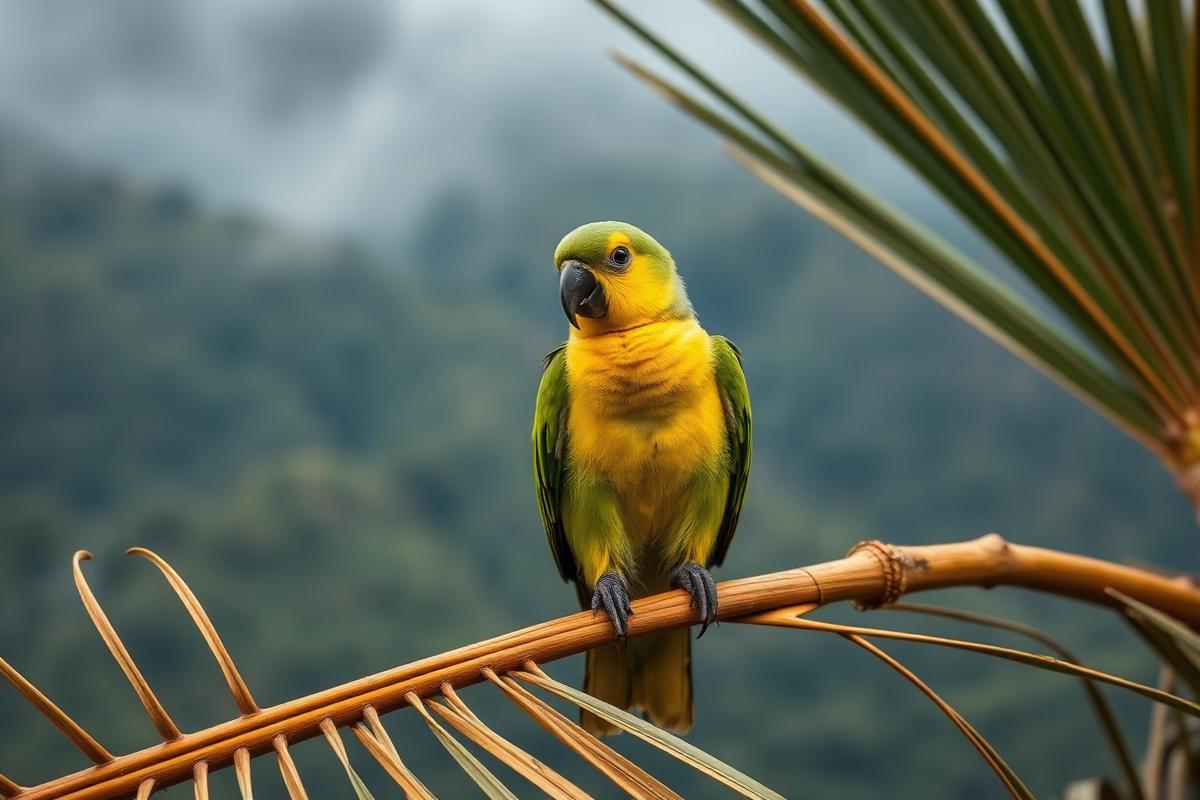
The Yellow-eared Parrot is a large, green Andean parrot with a broad yellow face patch and a heavy black bill. It is loud, sociable and hard to miss when a flock passes overhead.
It is also almost entirely dependent on a single tree: the Quindío wax palm, Colombia's national tree, which can grow over 50 metres tall and live for more than a century.
When the palms declined, the parrot declined with them. By 1999, a dedicated search across the Colombian Andes found just 81 birds.
Identification
Adults are around 42 cm long, mostly deep green with an olive-yellow belly and a long, pointed tail.
Key marks:
• Bright yellow patch running from above the eye across the ear coverts.
• Massive black bill, heavier than most parrots of similar size.
• Dark green wings with a yellowish wash on the underside in flight.
Flocks call constantly in flight — a rolling, nasal series of notes that carries across valleys and is usually the first sign of their presence.
Why the wax palm matters
Yellow-eared Parrots nest almost exclusively in cavities in tall wax palms, and they also roost and feed in them.
Wax palms had been declining for a specific reason. Young fronds were cut in enormous numbers each year for Palm Sunday celebrations, which stopped the next generation of palms from maturing. Meanwhile, adult palms left standing in cattle pasture slowly died without replacement.
The result was an ageing population of giant palms with no successors — and a parrot with a shrinking number of nest sites.
How the recovery happened
After the 1999 rediscovery of a viable flock in Roncesvalles, Tolima, Fundación ProAves built a campaign around three ideas.
1. Guard the nests. Field teams monitored nest palms directly through each breeding season.
2. Fix the palm supply. Thousands of wax palm seedlings were planted and fenced from cattle so they could actually reach maturity.
3. Change the tradition. Working with the Catholic Church in Colombia, the campaign promoted alternatives to wax palm fronds for Palm Sunday. Priests preached the message; communities adopted substitutes.
Artificial nest boxes filled the gap while young palms grew, and dedicated reserves were established at key sites.
The numbers
The population climbed steadily: from 81 birds in 1999 to several hundred within a decade, and past 4,000 by the early 2020s.
In 2021 the IUCN downlisted the species from Critically Endangered to Vulnerable — a rare direction of travel.
The parrot has also expanded back into areas it had abandoned, and in 2023 birds were recorded again in Ecuador, where the species had been considered extinct.
Behaviour and breeding
Yellow-eared Parrots are highly social. They roost communally in palms, sometimes in flocks of hundreds, and forage together on fruits, seeds and flowers of palms and montane trees.
Breeding runs mainly from January to July. Pairs use palm cavities, often with helpers from previous broods assisting at the nest — an unusual trait among parrots.
Clutches are typically three to four eggs. Chicks fledge after roughly nine weeks and stay with the family group for months.
What still threatens them
• Slow palm regeneration. Wax palms take decades to reach nesting size, so today's seedlings serve parrots that are not yet hatched.
• Cattle grazing. Livestock eat palm seedlings, which is why fencing matters as much as planting.
• Habitat fragmentation across the Andes, separating flocks into isolated groups.
• Climate pressure on montane cloud forest, which may shift where palms can grow at all.
Lessons other projects can copy
The Yellow-eared Parrot case is widely cited for a reason: it dealt with the actual mechanism of decline instead of the symptoms.
Guarding nests bought time. Planting palms addressed the long-term bottleneck. Changing Palm Sunday practice removed the annual harvest that prevented regeneration.
It also shows the value of working with cultural institutions rather than against them. The campaign succeeded because church leaders carried the message, not because of enforcement.
A comeback still in progress
The Yellow-eared Parrot went from 81 known birds to thousands within two decades. It is one of the clearest conservation wins in South America, and it happened because someone worked out that saving a parrot meant saving a palm.
Support ProAves reserves, visit the Cocora Valley and Andean birding lodges that fund this work, and share the story — it is one of the few genuinely good-news bird headlines of the century.
Key takeaways
- Only 81 Yellow-eared Parrots were known in 1999.
- The species nests almost exclusively in Quindío wax palms.
- Cutting fronds for Palm Sunday had stopped palms from regenerating.
- Nest guarding, palm planting and a church-backed campaign reversed the decline.
- Numbers now exceed 4,000 and the species was downlisted to Vulnerable in 2021.
Frequently asked questions
How many Yellow-eared Parrots are there now?
More than 4,000, up from just 81 known birds in 1999. The IUCN downlisted the species to Vulnerable in 2021.
Why does it depend on wax palms?
It nests, roosts and feeds in tall Quindío wax palms. Without mature palms containing cavities, it cannot breed successfully.
How did Palm Sunday affect the species?
Young wax palm fronds were harvested in bulk each year for celebrations, preventing seedlings from maturing into nest-sized trees.
Where can I see Yellow-eared Parrots?
ProAves reserves in Tolima, Antioquia and Quindío in Colombia, including sites near the Cocora Valley.
Is the species found outside Colombia?
It was long considered extinct in Ecuador, but birds were recorded there again in 2023, suggesting natural recolonisation.
Do they help each other raise chicks?
Yes. Nests often have helpers, usually offspring from earlier broods, which is unusual among parrots.
References
Related reading
Hyacinth Macaw: The Cobalt Giant of the Brazilian Pantanal
The Hyacinth Macaw is the world's largest flying parrot and one of conservation's more hopeful stories — a species pulled back from the brink of collapse by a single, focused Brazilian project.
Imperial Amazon: Dominica's National Bird on the Brink
The Imperial Amazon appears on the flag of Dominica. After Hurricane Maria, fewer than 250 are thought to remain in the wild.