Imperial Amazon: Dominica's National Bird on the Brink
The Imperial Amazon appears on the flag of Dominica. After Hurricane Maria, fewer than 250 are thought to remain in the wild.
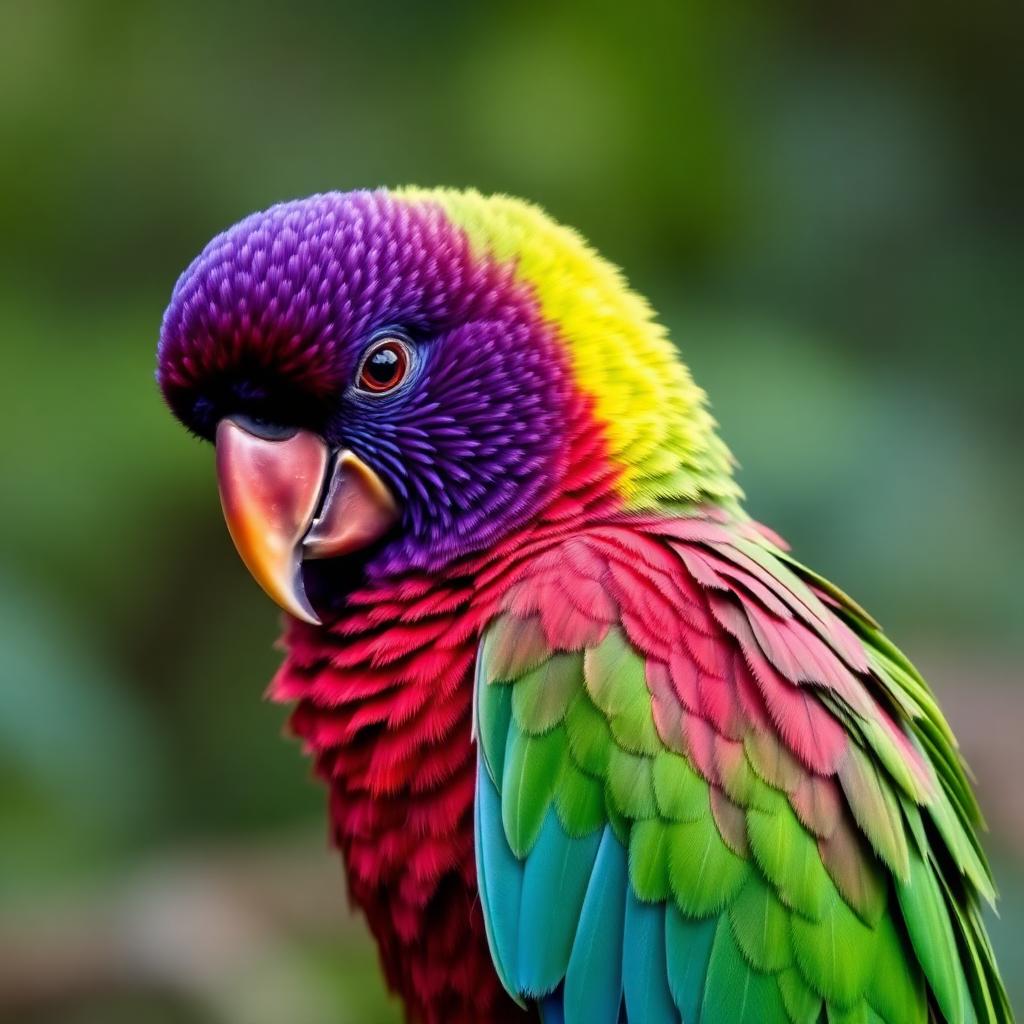
| Scientific name | Amazona imperialis |
|---|---|
| Length | ≈ 45–50 cm |
| Range | Mountain forests of Dominica, Lesser Antilles |
| Diet | Fruit, seeds, flowers of native rainforest trees |
| Population | ≈ 40–250 mature individuals |
| IUCN status | Critically Endangered |
The parrot on the flag
The Imperial Amazon (Amazona imperialis), known locally as the Sisserou, is a large deep-purple and green parrot endemic to the island of Dominica in the eastern Caribbean. It appears on the national flag — the only parrot on any national flag in the world.
Adults are around 45–50 cm long, with a dark purple head and underparts, green wings, and a heavy black bill.
A single mountain population
The species is confined to primary mountain rainforest on Dominica, particularly around Morne Diablotin and Morne Trois Pitons national parks. Historically it was more widespread; today the strongholds are the wettest, oldest forest patches above 600 metres.
The parrot nests in cavities in mature gommier, chatannyé and other large emergent trees. Suitable cavities are rare; competition with other cavity users is fierce.
The Hurricane Maria bottleneck
In September 2017, Hurricane Maria struck Dominica as a Category 5 storm and stripped the leaves and fruit from almost the entire island. The Imperial Amazon population is thought to have crashed to fewer than 50 individuals in the year that followed.
Post-hurricane surveys have found slow recovery, but the species remains at the edge of viability. The 2017 event compressed a already tiny population into an even smaller genetic bottleneck.
Slow-breeding, long-lived
Imperial Amazons are long-lived — probably decades in the wild — and reproduce slowly. Pairs typically raise one chick every second year, and only when food supply and cavity availability align.
That life history is well suited to a stable rainforest, but it means recovery from catastrophic events is measured in decades, not years.
What still threatens the species
Beyond hurricanes, the main long-term threats are habitat loss to agriculture and hurricane-related salvage logging, competition for nest cavities with the sympatric Red-necked Amazon (Amazona arausiaca), and historical illegal capture for the pet trade.
Climate change is expected to increase the frequency of major Atlantic hurricanes, which is the single most consequential threat for a species this restricted.
Parks, patrols and captive insurance
Morne Diablotin National Park was created in 2000 specifically to secure the core Imperial Amazon range. The Dominica Forestry, Wildlife and Parks Division runs long-term monitoring and, since Hurricane Maria, has taken a small number of birds into a controlled captive facility as insurance against further catastrophe.
International partners including the World Parrot Trust and Rare Species Conservatory Foundation have supported field surveys, cavity monitoring and post-hurricane food supplementation.
A national symbol worth keeping
The Sisserou is one of the most concentrated examples of a national symbol whose survival depends on protecting a specific forest, on a specific island, against a specific and worsening threat. Dominica has done more than most Caribbean states to secure that forest; the next Category 5 storm will still be the real test.
Key takeaways
- The Imperial Amazon is Dominica's national bird and appears on its flag.
- It is Critically Endangered with an estimated 40 to 250 individuals remaining.
- Hurricane Maria in 2017 caused a sudden, severe population crash.
- Long life and slow breeding mean recovery is measured in decades.
Frequently asked questions
Why is the Imperial Amazon on Dominica's flag?
It is endemic to Dominica and has been adopted as a national symbol of the island's forests and identity — the only parrot on any national flag.
How rare is the Sisserou today?
Post-Hurricane Maria estimates range from 40 to about 250 mature individuals, all in Dominica's mountain rainforests.
Where can I see one?
The best sites are the Syndicate Nature Trail on the edge of Morne Diablotin National Park, best visited early morning with a local guide.
How is it different from the Red-necked Amazon?
The Imperial Amazon is larger, has a deep purple head and body, and prefers higher-elevation forest; the Red-necked Amazon is smaller, mostly green with a red neck patch.
Is there a captive breeding programme?
A small controlled facility on Dominica holds a handful of birds as insurance; there is no established off-island captive population.
References
Related reading
Spix's Macaw: Bringing an Extinct-in-the-Wild Parrot Home
For twenty years, Spix's Macaw existed only in cages. Its 2022 release into Brazilian caatinga is the most ambitious parrot reintroduction ever attempted.
Hyacinth Macaw: The Cobalt Giant of the Brazilian Pantanal
The Hyacinth Macaw is the world's largest flying parrot and one of conservation's more hopeful stories — a species pulled back from the brink of collapse by a single, focused Brazilian project.