Wilson's Bird-of-Paradise: The Neon Dancer of Waigeo
Only two islands on Earth host Wilson's Bird-of-Paradise. Its neon head and choreographed display have made it a bucket-list species — with real access consequences.
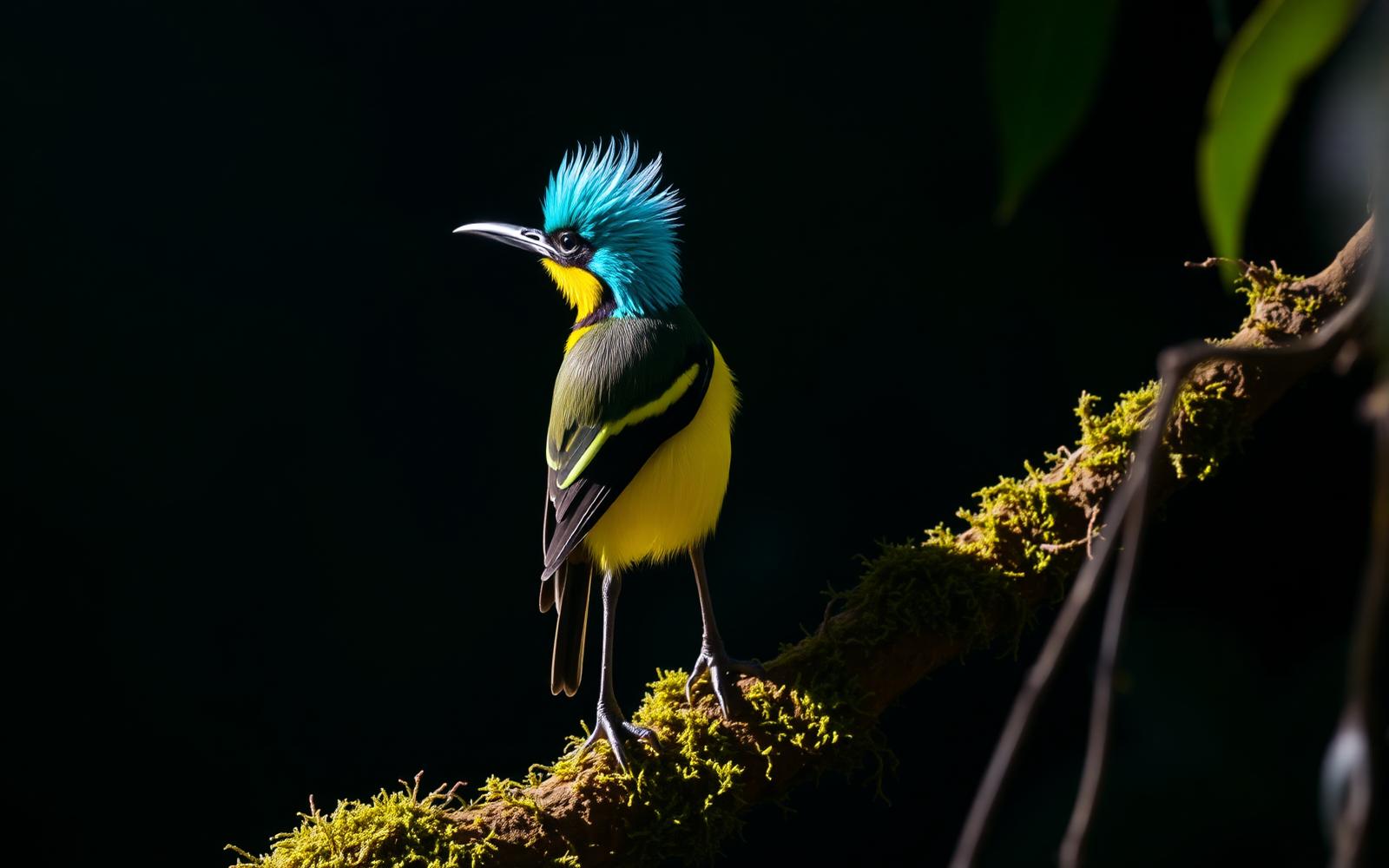
| Scientific name | Diphyllodes respublica |
|---|---|
| Length | 16 cm (male, excluding tail wires) |
| Range | Waigeo and Batanta islands, Raja Ampat, Indonesia |
| Habitat | Lowland and hill rainforest, 0 – 300 m |
| Diet | Fruit, arthropods |
| IUCN status | Near Threatened |
| Best viewing | August – October |
A ten-centimetre spectacle
Wilson's Bird-of-Paradise (Diphyllodes respublica) is one of the smallest and most vivid members of the Paradisaeidae family. The male has a turquoise-blue crown so bright it appears luminous in shade, a scarlet back, yellow cape and two curled violet tail wires. It is found only on the islands of Waigeo and Batanta in Raja Ampat, Indonesia.
For a bird this rare and this range-restricted to have become a globally famous species is essentially a David Attenborough effect — the Life of Birds sequence filmed in the early 2000s turned Waigeo into a bird-tourism destination overnight.
A two-island distribution
The entire wild population lives on two Indonesian islands totalling roughly 3,400 km². Within that, Wilson's Bird-of-Paradise prefers lowland and hill rainforest below 300 metres, especially where the understory has enough dead leaves and small saplings for males to build display courts.
This kind of range restriction has real conservation implications. Any large-scale habitat conversion on Waigeo or Batanta — logging, mining, palm oil — would immediately threaten the global population. The species is protected within the boundaries of Raja Ampat Marine Park.
The display court and courtship dance
Male Wilson's Bird-of-Paradise clear a patch of forest floor around 1 to 2 metres across, meticulously removing every leaf, twig and stem so that light from the canopy hits their plumage cleanly. They then use a low, near-vertical sapling as the display perch.
When a female arrives above, the male tips his body backwards, spreads the yellow-and-red back into a shield, and vibrates the tail wires. The blue crown catches light from above at exactly the angle the female is looking down from. The choreography is precise enough that photographers pre-position cameras low on the ground and simply wait.
Ethical viewing in Raja Ampat
Access is community-managed. Local landowners on Waigeo operate hides overlooking display courts and charge access fees that fund forest protection. Visits are typically at dawn, limited to small groups, and require silence for 1 to 2 hours.
Never approach a display court on foot without a local guide, never use flash on displaying birds, and be aware that repeated flushing of a male can cause him to abandon a court for a season — a meaningful loss for a species with such a small population.
Threats and status
The IUCN lists Wilson's Bird-of-Paradise as Near Threatened. The primary pressures are habitat loss from small-scale clearance and, historically, hunting for feathers. Illegal collection is now rare thanks to a combination of local pride and effective enforcement inside the marine park.
Sustainable tourism revenue is currently the most effective long-term protection. When a displaying male generates recurring income for a village, protecting his court becomes economically obvious.
A jewel worth protecting properly
Wilson's Bird-of-Paradise proves that a well-run ecotourism model can align local economics with rainforest protection. The species will remain rare — its range guarantees that — but with the current management model, it should stay visible on Waigeo for a very long time.
Key takeaways
- Wilson's Bird-of-Paradise is endemic to just two Indonesian islands.
- Males meticulously clear a display court to maximise light on their plumage.
- Ethical viewing is community-managed and requires local guides.
- The species is Near Threatened, with tourism revenue supporting protection.
Frequently asked questions
Where can I see Wilson's Bird-of-Paradise in the wild?
Only on the islands of Waigeo and Batanta in Raja Ampat, Indonesia. Community-run hides on Waigeo offer the most reliable access, typically at dawn.
How rare is Wilson's Bird-of-Paradise?
The species is classified as Near Threatened on the IUCN Red List, with a total range of only around 3,400 km² restricted to two Indonesian islands.
Why does the male clear the forest floor?
A cleared display court allows canopy light to hit the male's plumage cleanly and eliminates visual distractions when a female is watching from above.
When is the best time to see Wilson's Bird-of-Paradise?
August to October is generally regarded as peak display season, though males can be observed at active courts throughout most of the year.
Is photography allowed at the display courts?
Yes, but strict rules apply: no flash, no talking, hides only, and only with a local guide. Repeated disturbance can cause a male to abandon a court.
References
Related reading
The Resplendent Quetzal: Field Guide to Central America's Cloud-Forest Icon
Few birds are more mythologised than the Resplendent Quetzal. Behind the iridescence is a highly specialised cloud-forest species that depends on a single tree family to survive.
Victoria Crowned Pigeon: The Regal Ground Dweller of New Guinea
The Victoria Crowned Pigeon is the largest pigeon on Earth and carries a lace-like blue crest that looks designed rather than evolved.