Victoria Crowned Pigeon: The Regal Ground Dweller of New Guinea
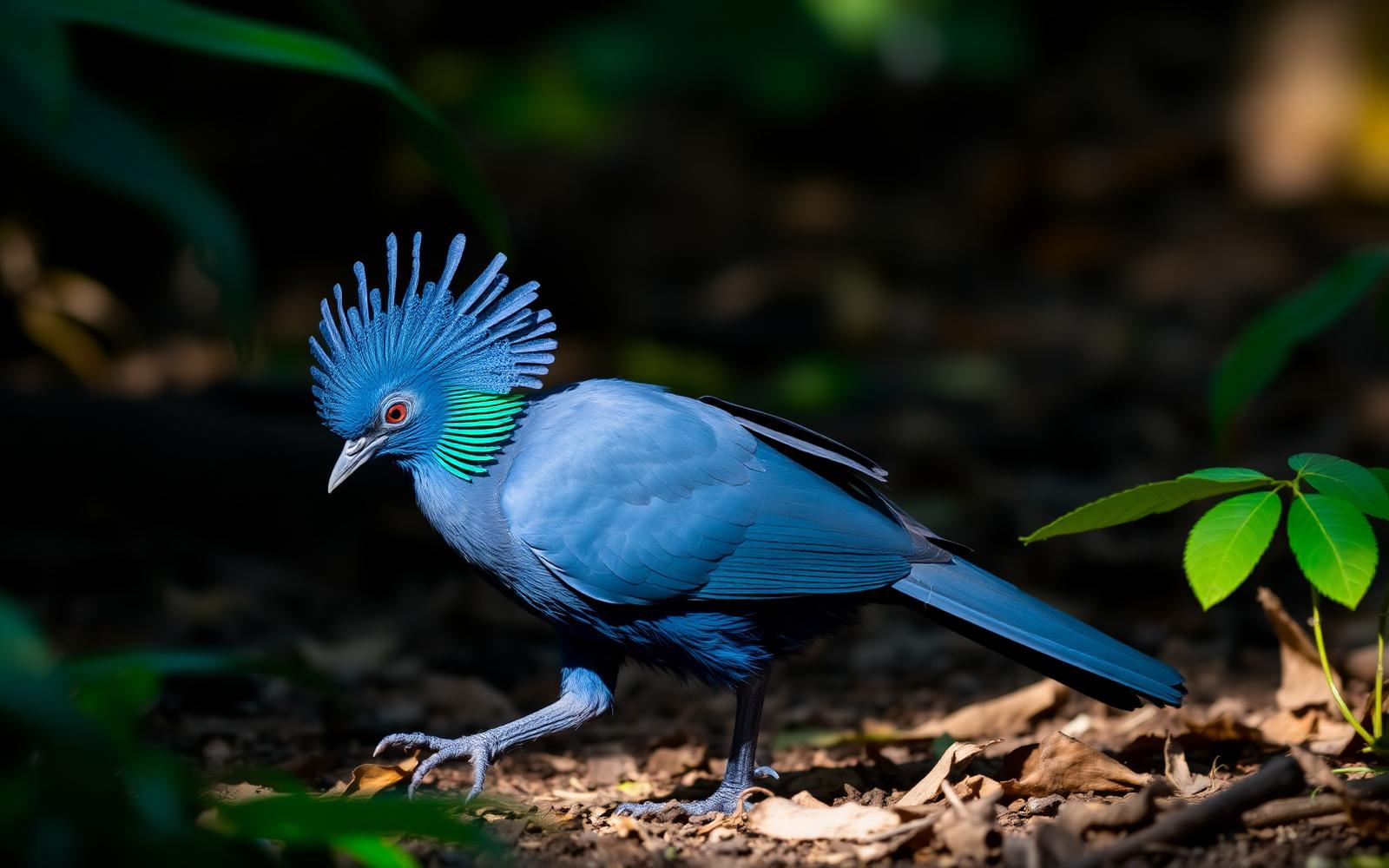
The Victoria Crowned Pigeon is the largest pigeon on Earth and carries a lace-like blue crest that looks designed rather than evolved.
| Scientific name | Goura victoria |
|---|---|
| Length | ≈ 74 cm |
| Weight | 2.1 – 2.5 kg |
| Range | Northern New Guinea and offshore islands |
| Habitat | Lowland rainforest and swamp forest |
| Diet | Fallen fruit, seeds, invertebrates |
| IUCN status | Near Threatened |
The world's largest pigeon
The Victoria Crowned Pigeon (Goura victoria) is one of three species of crowned pigeons endemic to New Guinea, and the largest pigeon in the world. Adults weigh 2.1 to 2.5 kg and stand about the size of a small turkey. The lace-like blue crest, tipped with white, is unmistakable.
The species is named after Queen Victoria, following its 19th-century scientific description — a reminder of how much of ornithology's taxonomy still carries its colonial-era naming.
Range and habitat
The Victoria Crowned Pigeon occupies lowland rainforest and swamp forest across northern New Guinea and several offshore islands, including Yapen and Biak. It prefers relatively undisturbed forest with a rich fallen-fruit resource on the forest floor.
Unlike many pigeons, it spends most of its time on the ground, walking calmly through leaf litter and flushing up to a low branch only when disturbed.
Diet and behaviour
Diet is dominated by fallen fruit, especially figs, along with seeds and occasional invertebrates. Small groups of 2 to 10 birds forage together in loose association. Their bass 'boom' call carries well through dense forest and is often the first indication of their presence.
Nests are simple stick platforms built low in the understory, with a clutch size of a single egg. Both parents share incubation.
Why they are declining
Two pressures dominate: hunting for meat and feathers, and habitat loss to logging and small-scale agriculture. The species is trusting and slow on the ground, which makes it easy to shoot or trap. Its low reproductive rate compounds the problem.
The IUCN lists the Victoria Crowned Pigeon as Near Threatened with a decreasing population trend. Populations near villages have often disappeared while remote forest blocks still hold healthy densities.
Conservation and viewing
Community-managed conservation areas across parts of the West Papuan mainland and Yapen have shown measurable recoveries where hunting pressure is reduced. Ecotourism revenue is a small but growing incentive for local villages to protect this species specifically, because visitors will pay to see it.
Ethical wild viewing is possible with community guides in a small number of protected forest sites. Avoid captive facilities where birds appear stressed or overcrowded.
An oversized ambassador for New Guinea
The Victoria Crowned Pigeon is charismatic enough to serve as a flagship for the whole of New Guinea's lowland rainforest fauna. Protecting it, in practice, means protecting the forest floor where it walks — and everything else that walks with it.
Key takeaways
- The Victoria Crowned Pigeon is the largest pigeon species on Earth.
- It is endemic to northern New Guinea and adjacent offshore islands.
- Ground-dwelling behaviour makes it particularly vulnerable to hunting.
- IUCN status is Near Threatened with a decreasing population.
Frequently asked questions
How big is a Victoria Crowned Pigeon?
Adults are about 74 cm long and weigh 2.1 to 2.5 kg — roughly the size of a small turkey and the largest pigeon species alive today.
Where do Victoria Crowned Pigeons live?
They are endemic to the lowland and swamp forests of northern New Guinea and offshore islands including Yapen and Biak.
Are Victoria Crowned Pigeons endangered?
They are currently listed as Near Threatened by the IUCN, with populations decreasing due to hunting and habitat loss.
What do Victoria Crowned Pigeons eat?
Their diet is dominated by fallen fruit and seeds, especially figs, supplemented by occasional invertebrates from the forest floor.
Can Victoria Crowned Pigeons fly?
Yes, but they are primarily ground-dwelling. They fly heavily and reluctantly, usually only into low branches when startled or to roost.
References
Related reading
Wilson's Bird-of-Paradise: The Neon Dancer of Waigeo
Only two islands on Earth host Wilson's Bird-of-Paradise. Its neon head and choreographed display have made it a bucket-list species — with real access consequences.
Helmeted Hornbill: The Bornean Bird Hunted for Its Skull
The Helmeted Hornbill is the only bird on Earth with a solid keratin casque. That casque, sold on the black market as 'red ivory', is driving the species toward extinction.