Whooping Crane: North America's Tallest Comeback
The Whooping Crane went from 21 birds to more than 800 in eighty years. Here is how — and why the species is still not out of danger.
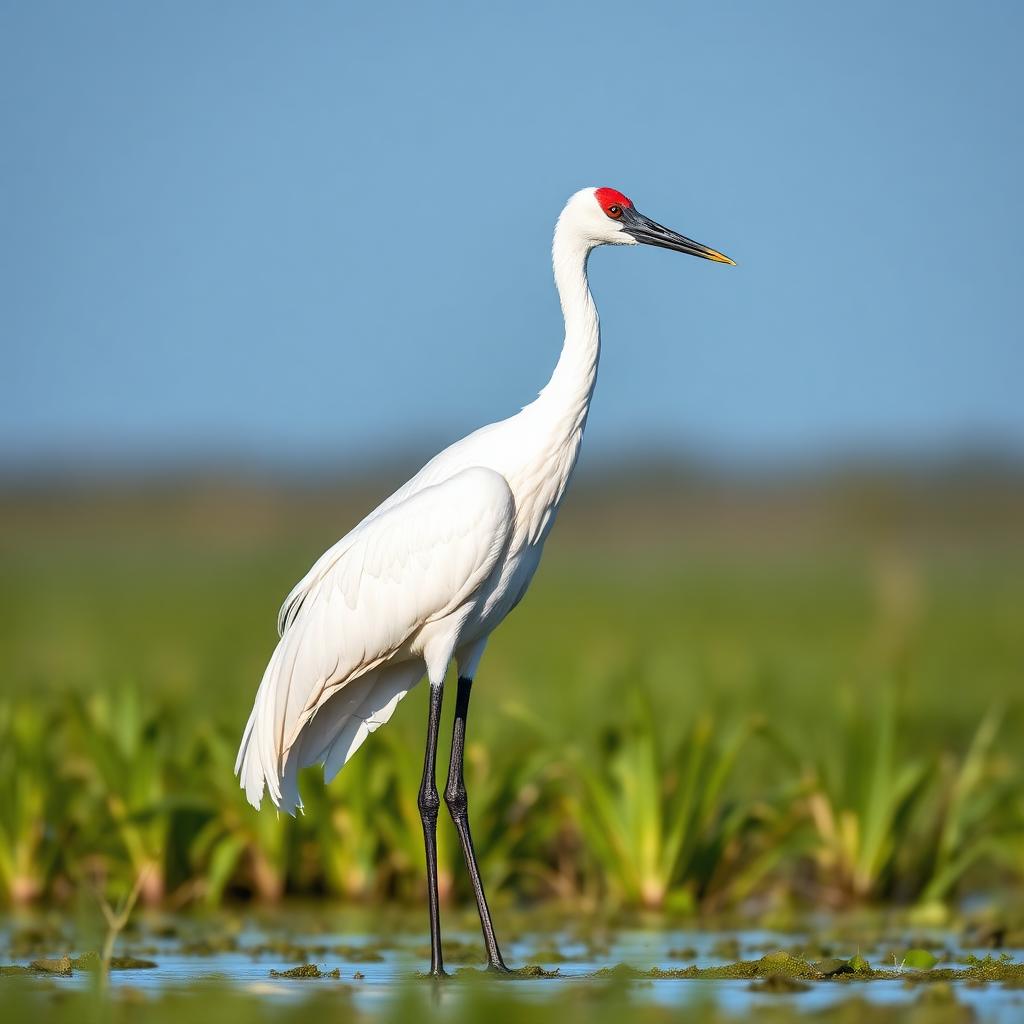
| Scientific name | Grus americana |
|---|---|
| Height | ≈ 150 cm — tallest bird in North America |
| Breeding range | Wood Buffalo National Park, Canada |
| Wintering range | Aransas NWR, Texas coast |
| Population | ≈ 800+ (all populations combined) |
| IUCN status | Endangered |
The tallest bird in North America
The Whooping Crane (Grus americana) stands nearly 1.5 metres tall, making it the tallest bird native to North America. Adults are almost pure white with a red crown, black facial mask and black wing tips visible only in flight.
In 1941, a single wild flock of 21 birds wintered on the Texas coast. That number represented the entire species on Earth. Today, all populations combined exceed 800 birds — one of the most-studied recoveries in conservation history.
Two continents, one migration
The original wild flock breeds in the wetlands of Wood Buffalo National Park in northern Canada and migrates 4,000 km south each autumn to winter along the Texas coast at Aransas National Wildlife Refuge.
Additional reintroduced populations exist: a non-migratory flock in Louisiana, and an eastern migratory flock that summers in Wisconsin and winters mostly in Florida and neighbouring states.
Diet and pair bonds
Whooping Cranes are omnivores, taking blue crabs, wolfberries, insects, small fish, amphibians, and grain from agricultural fields in migration. On the Texas wintering grounds, blue crab abundance is a strong predictor of survival and breeding success the following year.
They form long-term monogamous pair bonds and perform elaborate unison calls and dance displays to reinforce them. A typical pair produces one to two chicks per season, though usually only one survives to fledging.
How the population was rebuilt
Recovery began with strict legal protection of both breeding and wintering habitat, followed in the 1960s by captive breeding at the Patuxent Wildlife Research Center in Maryland and later the International Crane Foundation in Wisconsin.
From 2001 to 2015, ultralight aircraft led hand-reared chicks along a Wisconsin-to-Florida migration route — one of the most ambitious conservation experiments ever conducted. The technique successfully established the eastern migratory flock, though it has since been phased out in favour of parent-reared release.
Why the species is still fragile
Despite recovery, the species remains vulnerable. The core wild flock winters in a single area of the Texas coast, meaning a hurricane, chemical spill, or disease outbreak could hit a huge fraction of the global population at once.
Powerline collisions are the leading known cause of death for young Whooping Cranes on migration. Freshwater inflow to the Aransas estuary — which controls blue-crab abundance — is threatened by upstream water abstraction, particularly during droughts.
The largest crane story on the continent
The Whooping Crane is proof that a species can be brought back from 21 birds. It is also a reminder that recovery is never finished: as long as the wild flock depends on a single wintering site and a single river's inflow, the species remains one bad year from disaster.
Key takeaways
- The Whooping Crane population fell to 21 birds in 1941 and now exceeds 800.
- The only original wild flock migrates 4,000 km between Canada and Texas.
- Recovery combined captive breeding, habitat protection, and ultralight-led migration.
- Powerline collisions and Texas coastal risks remain major threats.
Frequently asked questions
How many Whooping Cranes are left?
The global population is above 800 birds, including approximately 540 in the original wild Aransas–Wood Buffalo flock and the remainder in reintroduced flocks.
Where can I see one?
The most reliable place is Aransas National Wildlife Refuge in Texas from November to March, best viewed from a licensed tour boat.
How tall is a Whooping Crane?
Adults stand up to about 1.5 metres, making the species the tallest bird native to North America.
Why did the population crash?
Wetland drainage across the US Great Plains, unregulated hunting for feathers and meat, and disturbance at breeding grounds together reduced the population to a single small flock by the 1940s.
Is the ultralight-led migration still happening?
No. The programme, run by Operation Migration, ended after 2015 and was replaced by parent-reared release methods.
References
Related reading
The California Condor: North America's Largest Bird Fights Back
In 1987, every California Condor left on Earth was pulled into captivity. The species is back — barely — thanks to one of the most expensive recovery programmes in history.
The Grey Crowned Crane: Africa's Golden-Crowned Wetland Icon
With its glowing straw-coloured crown and pale blue eyes, the Grey Crowned Crane is one of Africa's most recognisable birds — and one of its most rapidly declining wetland species.