The Grey Crowned Crane: Africa's Golden-Crowned Wetland Icon
With its glowing straw-coloured crown and pale blue eyes, the Grey Crowned Crane is one of Africa's most recognisable birds — and one of its most rapidly declining wetland species.
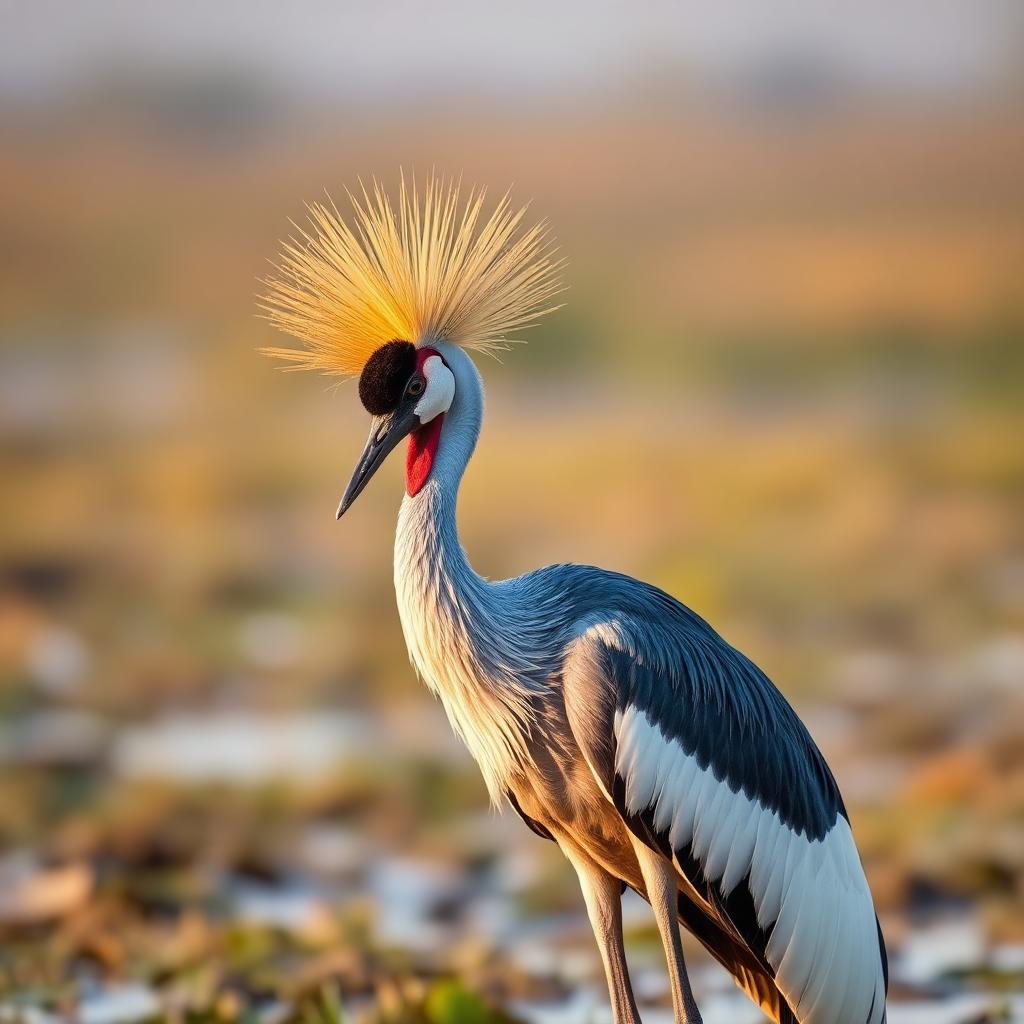
| Scientific name | Balearica regulorum |
|---|---|
| Height | ≈ 1 m |
| Wingspan | ≈ 2 m |
| Range | Eastern and southern Africa |
| Diet | Seeds, insects, small vertebrates |
| Population | ≈ 26,000–33,000 (declining) |
| IUCN status | Endangered |
A bird you cannot mistake
The Grey Crowned Crane (Balearica regulorum) is a tall, elegant wetland bird found from Uganda and Kenya down through Zimbabwe and northern South Africa. It is instantly recognisable: a slate-grey body, black-and-white wings, a red throat wattle and, above all, a halo-like crown of stiff, straw-coloured feathers that rise from the back of the head.
It is also Uganda's national bird and one of the very few crane species that habitually roosts in trees. Beautiful and adaptable as it is, the species has lost more than half of its population in the last 45 years, and now sits on the IUCN Red List as Endangered.
Range and preferred habitat
Grey Crowned Cranes favour a mosaic of shallow wetlands, wet grasslands and adjacent cultivated land. They feed in open pasture during the day and return to standing water at dusk. The species tolerates human landscapes well — up to a point — which is why rural Uganda, Rwanda and western Kenya still hold the largest breeding populations.
Two subspecies are recognised: B. r. regulorum in the south and B. r. gibbericeps in the east. The eastern subspecies is slightly larger and shows a more extensive red cheek patch.
Diet and daily behaviour
Grey Crowned Cranes are true omnivores. They forage by walking slowly through short grass, stamping their feet to flush insects — a technique bird-watchers can spot from a distance. Grass seeds, grasshoppers, millipedes, small frogs and the occasional lizard all feature in the diet.
Pairs stay together year-round and defend a small breeding territory around a wetland edge. Outside the breeding season, flocks of 30 to 150 birds gather at communal roosts and forage together in surrounding fields.
The famous crane dance
The Grey Crowned Crane's courtship dance is one of the most photographed bird displays in Africa. Both sexes take part. They bow, jump vertically two metres into the air, run in tight circles with wings outstretched, and toss tufts of grass overhead.
Unlike most crane displays, this dance is not restricted to the breeding season. Juveniles practise it, and adults use short, spontaneous bouts to strengthen pair bonds. If you see cranes dancing outside a breeding wetland, it is usually social, not sexual.
Why the population is falling
Three pressures drive the decline. First, wetland drainage for agriculture and settlement has removed critical breeding and roosting sites. Second, illegal capture for the domestic and international pet trade — chicks are prized as ornamental birds — has hollowed out entire local populations. Third, powerline collisions kill significant numbers of adults each year in South Africa and Kenya.
The International Crane Foundation and Nature Uganda run community-based programmes that pay farmers to protect nests found on private land, and this model has slowed the decline in specific catchments — but has not yet reversed it nationally.
A wetland species worth defending
The Grey Crowned Crane is a strong indicator of wetland health across a huge slice of Africa. Where cranes still dance in numbers, the surrounding water table is usually intact and local biodiversity is holding. Protecting them is essentially the same as protecting the wetlands that regulate rural water supplies.
Key takeaways
- The Grey Crowned Crane is listed as Endangered by the IUCN.
- Populations have declined by more than 50% in the last 45 years.
- The species is a wetland specialist that also uses adjacent farmland.
- Illegal chick capture and wetland drainage are the leading threats.
Frequently asked questions
Is the Grey Crowned Crane the same as the African Crowned Crane?
Yes. 'African Crowned Crane' is an informal name commonly applied to the Grey Crowned Crane (Balearica regulorum). A closely related species, the Black Crowned Crane, lives further north across the Sahel.
Why is it Uganda's national bird?
The Grey Crowned Crane appears on Uganda's flag and coat of arms and has held cultural and ceremonial significance in the region for centuries. Its calm temperament and pair-for-life bonding are frequently cited.
How many Grey Crowned Cranes are left?
Recent IUCN estimates put the global population at 26,000 to 33,000 mature individuals, down from more than 100,000 in the 1980s.
Can Grey Crowned Cranes be kept as pets?
No. International trade is restricted under CITES Appendix II and most range states prohibit domestic capture. Chicks removed from the wild rarely survive and their removal is a leading cause of population decline.
Where can I see Grey Crowned Cranes?
Reliable sites include Uganda's Mabamba Bay, Rwanda's Rugezi Marsh, Kenya's Lake Ol' Bolossat and the Wakkerstroom wetlands in South Africa.
References
Related reading
The Shoebill Stork: Africa's Prehistoric Wetland Hunter
With a bill shaped like a wooden clog and the patience of a heron, the Shoebill has become the most requested bird in African birding tourism. Here is the biology behind the icon.
The Secretary Bird: Africa's Long-Legged Snake Hunter
The Secretary Bird kills snakes by kicking them with the impact of a boxer's punch. It is also disappearing from parts of Africa faster than most people realise.