The Secretary Bird: Africa's Long-Legged Snake Hunter
The Secretary Bird kills snakes by kicking them with the impact of a boxer's punch. It is also disappearing from parts of Africa faster than most people realise.
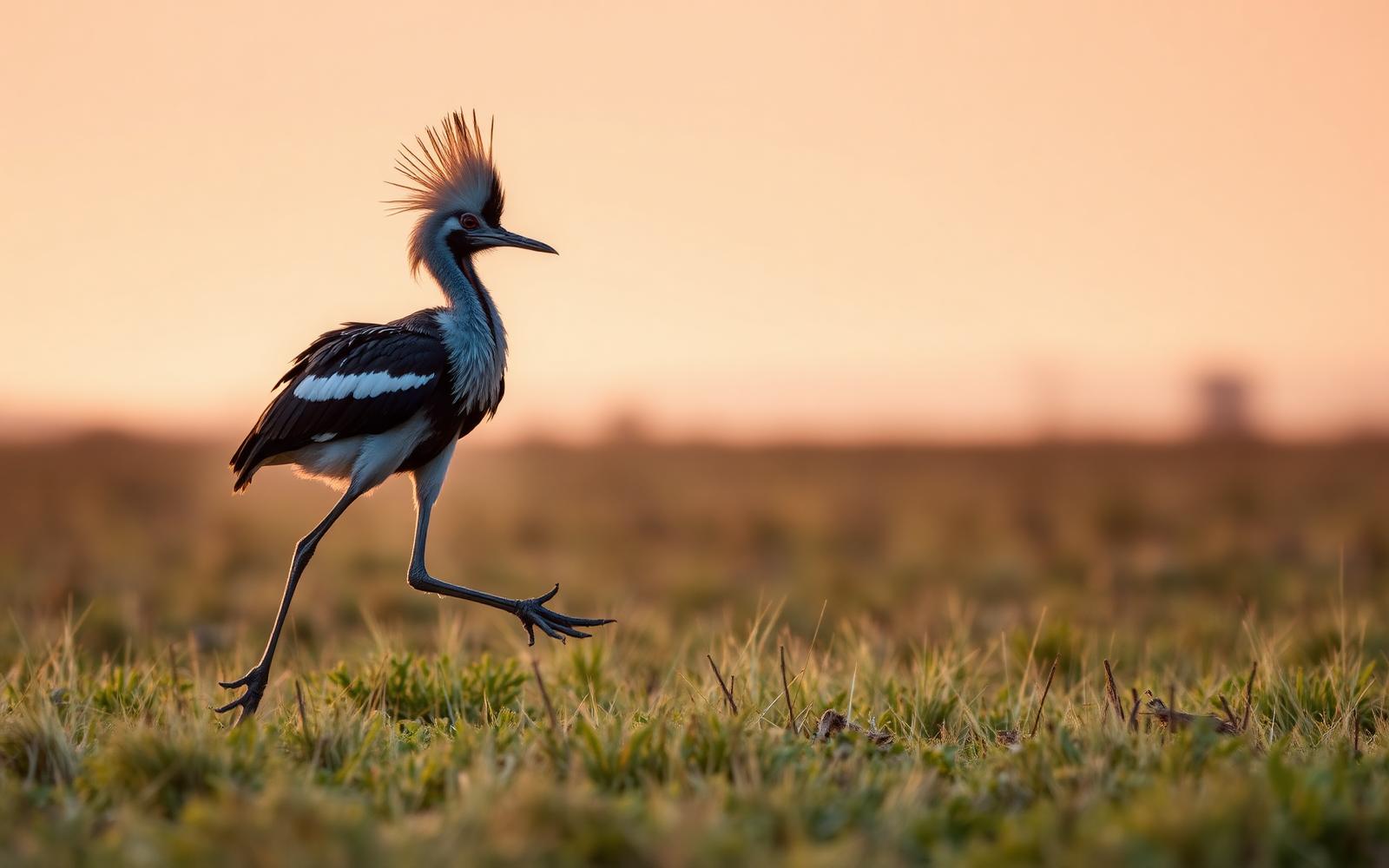
| Scientific name | Sagittarius serpentarius |
|---|---|
| Family | Sagittariidae (monotypic) |
| Height | up to 1.3 m |
| Wingspan | ≈ 2.1 m |
| Range | Sub-Saharan Africa |
| Kick force | ≈ 195 N (5× body weight) |
| IUCN status | Endangered |
| Population trend | Decreasing |
A raptor that walks
The Secretary Bird (Sagittarius serpentarius) is the only living member of its family, Sagittariidae. It stands up to 1.3 metres tall on stilt-like legs, hunts almost entirely on foot, and can cover 20 to 30 kilometres in a working day across open African savanna. It is unmistakable — and increasingly hard to find.
Despite its stork-like posture, the Secretary Bird is a true raptor, related more closely to hawks and vultures than to any long-legged wading bird.
Where the Secretary Bird lives
The species ranges across most of sub-Saharan Africa, from Senegal in the west to the Horn of Africa in the east, and south to the Cape. It prefers open grassland and lightly wooded savanna with fewer than 10% woody cover — dense bush is unusable because Secretary Birds hunt by walking and looking.
Territories are large: 50 to 250 km² per pair. This alone makes the species vulnerable to landscape-scale habitat conversion, particularly the spread of small-scale cultivation into former grassland.
The kick that kills snakes
The Secretary Bird's most famous behaviour is snake killing. High-speed video studies published in 2016 measured the strike force of a captive bird at roughly 195 newtons — about five times the bird's body weight — delivered in a strike lasting only 15 milliseconds. That is well under the time a snake needs to counter-strike.
In practice, snakes make up only around 5% of the diet. The bulk is grasshoppers, beetles, small mammals, lizards and ground-nesting bird eggs. But when it comes to snakes, the Secretary Bird kills adders and even young cobras with a specific, repeatable technique that leaves the bird well clear of the fangs.
Breeding on top of a thorn tree
Secretary Birds build flat, unlined stick nests on top of flat-topped acacia trees, 5 to 7 metres above ground. Clutches are 1 to 3 eggs, incubated for around 45 days. Fledging takes another 65 to 80 days.
Chicks are highly vulnerable while flightless, and productivity is often low outside protected areas. Fires, tree loss and nest predation each contribute to a reproductive rate that struggles to compensate for adult mortality.
Why the status changed
In 2020, the IUCN uplisted the Secretary Bird from Vulnerable to Endangered. Sub-Saharan population declines of 30 – 50% over three generations have been recorded, driven by habitat conversion to agriculture, powerline collisions, secondary poisoning, and — in some areas — deliberate persecution.
The species is now the subject of a dedicated BirdLife International action plan, with the strongest remaining populations found in Kenya, Tanzania and South Africa's Kruger and Karoo ecosystems.
A grassland species under grassland pressure
The Secretary Bird's decline is not a mystery, and it is not irreversible. Protecting large blocks of intact savanna, burying transmission lines where feasible, and controlling rodenticide use all measurably improve local outcomes. The species is too visible, and too odd, to lose.
Key takeaways
- The Secretary Bird is the only living species in its family.
- Its snake-killing kick delivers five times its body weight in 15 milliseconds.
- Snakes are famous prey but form only about 5% of the diet.
- The species was uplisted to Endangered by the IUCN in 2020.
Frequently asked questions
Why is it called a Secretary Bird?
The most widely accepted explanation is that the bird's black crest of long feathers resembled the quill pens 19th-century clerks tucked behind their ears. An alternative origin traces the name to an Arabic term for 'hunter-bird'.
Is a Secretary Bird a raptor?
Yes. Despite its long legs and stork-like posture, the Secretary Bird is a true bird of prey, placed in its own family within the raptor order Accipitriformes.
How powerful is a Secretary Bird's kick?
Studies have measured strike force at approximately 195 newtons — about five times the bird's body weight — delivered in around 15 milliseconds, faster than a snake's counter-strike.
Are Secretary Birds endangered?
Yes. The IUCN uplisted the Secretary Bird from Vulnerable to Endangered in 2020, following documented population declines of 30 to 50% across sub-Saharan Africa.
Can Secretary Birds fly?
Yes, and they roost in trees at night. But they hunt almost exclusively on foot and prefer walking to flying during daylight hours.
References
Related reading
The Philippine Eagle: A Complete Guide to the World's Rarest Raptor
With fewer than 400 breeding pairs remaining, the Philippine Eagle is one of the rarest raptors on Earth. Here's what field biologists have learned in three decades of recovery work.
The Shoebill Stork: Africa's Prehistoric Wetland Hunter
With a bill shaped like a wooden clog and the patience of a heron, the Shoebill has become the most requested bird in African birding tourism. Here is the biology behind the icon.