Sumatran Ground Cuckoo: One of the Least-Known Birds Alive
The Sumatran Ground Cuckoo went a century without being recorded. Even today, only a handful of photographs of a live bird exist.
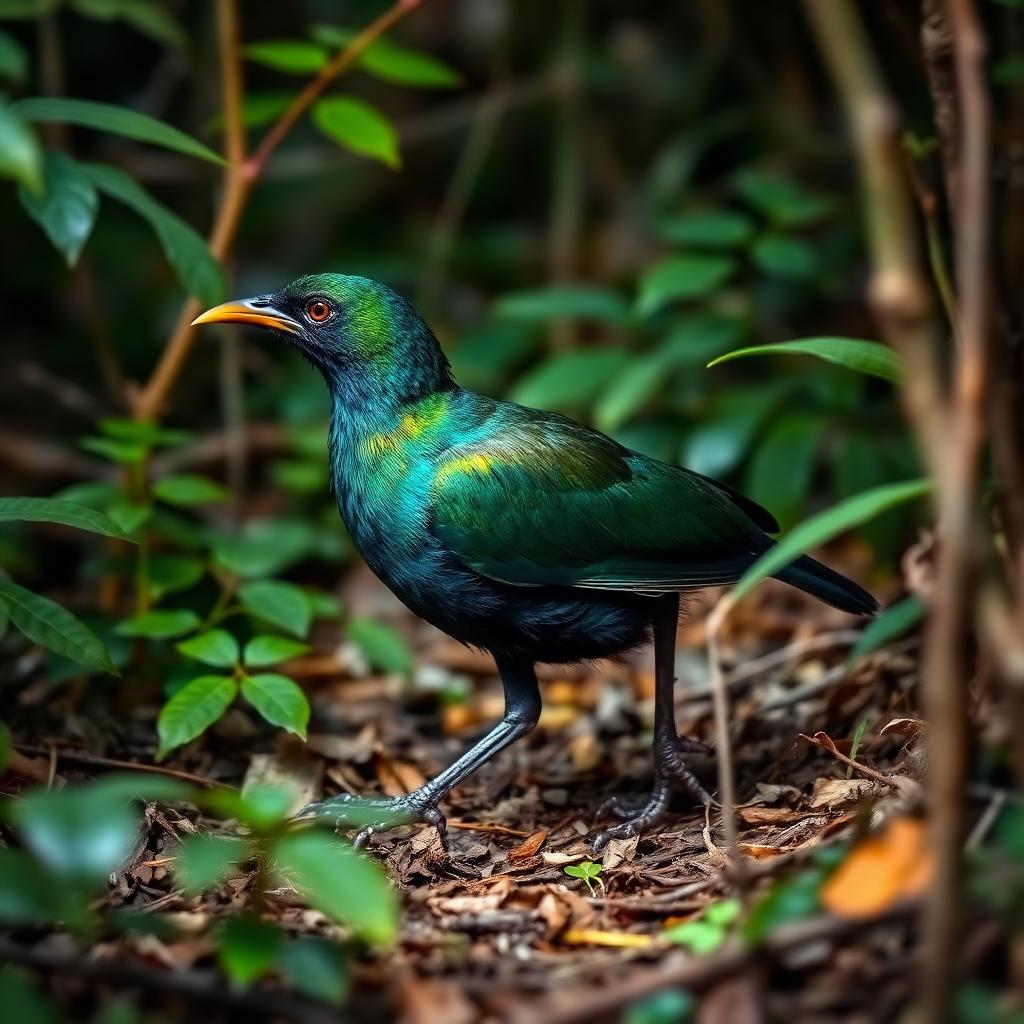
| Scientific name | Carpococcyx viridis |
|---|---|
| Length | ≈ 55 cm |
| Range | Lowland and hill forest, western Sumatra |
| Diet | Large insects, small vertebrates |
| Population | ≈ 70–400 mature individuals (est.) |
| IUCN status | Critically Endangered |
A ghost of Sumatran forests
The Sumatran Ground Cuckoo (Carpococcyx viridis) is a large, long-legged ground-dwelling cuckoo endemic to the lowland and hill forests of western Sumatra. Adults are around 55 cm long, with iridescent green upperparts, a heavy dark bill, and bare bluish-purple skin around the eye.
For most of the twentieth century, it was one of the least-known birds in the world. Until 1997 there were essentially no field records at all.
The 1997 camera-trap rediscovery
The species was described from specimens in 1879, then almost forgotten. In 1997, a live bird was accidentally caught in a snare in Bengkulu Province and briefly held before being released, confirming the species still existed.
In 2006, mammal researchers running camera traps in Kerinci Seblat National Park captured the first-ever photographs of a Sumatran Ground Cuckoo in the wild. Since then, further camera-trap detections have expanded the known range slightly, but the species remains extraordinarily hard to observe directly.
What little we know
Field observations are so few that basic biology remains speculative. The bird is thought to walk quietly through dense understorey, hunting large insects, small reptiles, amphibians and possibly small mammals. Its call, when finally recorded, turned out to be a series of hoarse notes given at dawn.
It appears to be closely related to the Bornean Ground Cuckoo (Carpococcyx radiatus) and was formerly treated as a subspecies of it. Genetic work supported elevation to full species status.
Where recent records have come from
Recent detections cluster in Kerinci Seblat and Bukit Barisan Selatan national parks in western Sumatra, mostly below 1,500 metres elevation. Additional records suggest the species persists at very low density across a broader arc of remaining lowland and hill forest.
Because it uses habitat that is also prime for oil palm and pulpwood conversion, most of its range has already been lost.
The classic Sumatran story
The dominant threat is habitat loss. Sumatra has lost more than half of its lowland forest since 1985, mostly to oil palm and industrial plantation forestry. Where forest remains, road access and snaring pressure are increasing.
Because the species is likely occurring at very low densities to begin with, even modest additional pressure could tip local populations to functional extinction.
Camera traps as conservation tools
For a species this hard to see, camera-trap arrays run by Fauna & Flora International, WCS Indonesia and university partners have become the primary conservation tool. They provide the only routine population data.
Effective on-the-ground protection depends on the integrity of Kerinci Seblat and other Sumatran protected areas, which face constant pressure from encroachment.
A species we barely know, still worth keeping
The Sumatran Ground Cuckoo is a reminder that the biodiversity crisis is playing out in species we have only just re-met. Protecting it means holding back the same industrial-scale land conversion that already reshaped most of the island.
Key takeaways
- The Sumatran Ground Cuckoo went nearly a century without a confirmed field record.
- It was rediscovered in 1997 and first photographed in the wild in 2006.
- It is Critically Endangered, with an estimated 70–400 mature individuals.
- Habitat loss to oil palm and plantation forestry is the dominant threat.
Frequently asked questions
How long was the Sumatran Ground Cuckoo missing?
Between its 1879 description and 1997, there were no confirmed sightings — a gap of well over a century.
Can I see one?
Realistically, no. Even researchers based in Kerinci Seblat rely on camera traps rather than direct observation.
How is it different from the Bornean Ground Cuckoo?
The two are close relatives. The Sumatran species is more iridescent green on the upperparts and shows subtle plumage and vocal differences that support treating them as separate species.
How many are left?
Estimates are highly uncertain, ranging from about 70 to 400 mature individuals across western Sumatra.
What eats it?
Very little is documented. Sun bears, clouded leopards and large snakes could all be potential natural predators.
References
Related reading
Helmeted Hornbill: The Bornean Bird Hunted for Its Skull
The Helmeted Hornbill is the only bird on Earth with a solid keratin casque. That casque, sold on the black market as 'red ivory', is driving the species toward extinction.
Rufous-headed Hornbill: The Panay Rainforest's Vanishing Voice
The Rufous-headed Hornbill is now one of the world's rarest hornbills, restricted to a few thousand hectares of intact rainforest on a single Philippine island.