Rufous-headed Hornbill: The Panay Rainforest's Vanishing Voice
The Rufous-headed Hornbill is now one of the world's rarest hornbills, restricted to a few thousand hectares of intact rainforest on a single Philippine island.
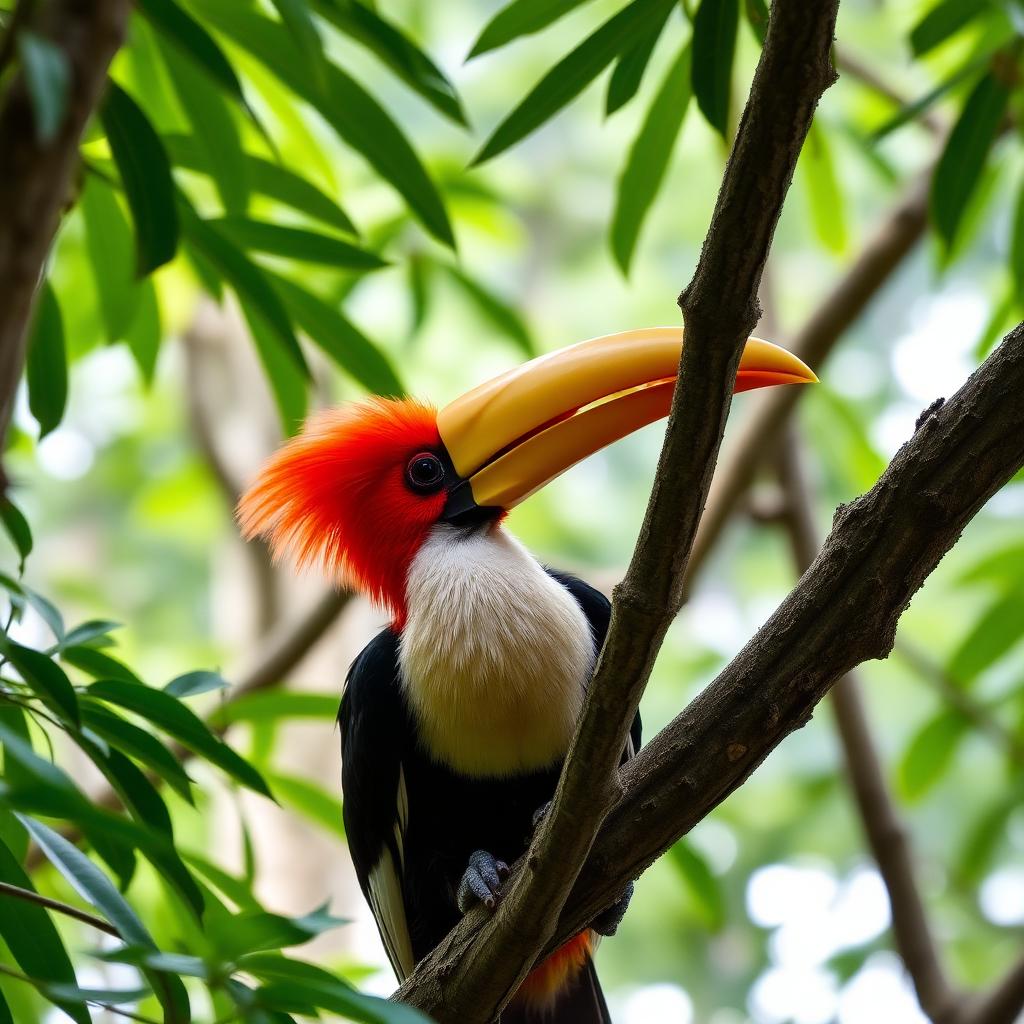
| Scientific name | Rhabdotorrhinus waldeni |
|---|---|
| Length | ≈ 60 cm |
| Range | Panay and Negros islands, Philippines (Negros almost extirpated) |
| Diet | Figs, other rainforest fruit, occasional insects |
| Population | ≈ 1,000–2,500 (declining) |
| Habitat need | Mature dipterocarp forest with large hollows |
| IUCN status | Critically Endangered |
The rainforest's loudest disappearing voice
The Rufous-headed Hornbill (Rhabdotorrhinus waldeni), also called Walden's Hornbill, is a striking Philippine forest bird found today only on the island of Panay, with a tiny remnant on Negros. Adult males have a vivid orange-red head, cream throat and a very large, yellow, casqued bill; females are similar but with a dark head.
Its ringing, resonant call was once one of the defining daytime sounds of West Visayan rainforest. In most of its former range that sound is now missing.
A collapsed range
Historically, the Rufous-headed Hornbill occurred on four Philippine islands: Panay, Negros, Guimaras and Ticao. On Guimaras and Ticao it is extinct. On Negros it survives, if at all, as fewer than 100 birds in scattered fragments. The last stronghold is Panay, particularly the North-West Panay Peninsula Natural Park and the Central Panay Mountain Range.
Even inside Panay, the species is confined to mature lowland dipterocarp forest below about 1,200 metres — the exact forest type that has been most heavily logged across the Philippines.
How hornbill nesting works
Like all Bucerotidae, Rufous-headed Hornbills nest in tree cavities. The female enters the cavity, and both birds seal the entrance with mud and food debris until only a narrow slit remains. The male then feeds her — and later the chick — through this slit for the entire nesting period, typically 90–100 days.
This behaviour has a serious ecological consequence: the species cannot breed without large, mature hollow trees. Selective logging of dipterocarps removes exactly the trees the birds need. In heavily logged forest, hornbills can persist as non-breeding adults for years before quietly disappearing.
A giant seed disperser
Rufous-headed Hornbills eat mainly figs and other large rainforest fruit. They swallow fruit whole and defecate seeds intact, often far from the parent tree. In healthy forest, they are among the most important seed dispersers for at least a dozen tree species.
When they vanish, forest regeneration for those specific tree species also declines — a slow, invisible knock-on that outlasts the bird by decades.
The Philippine Hornbill Programme
Since 1999, the Philippine Endemic Species Conservation Project (PhilinCon) has run a community warden network in North-West Panay, paying local villagers to monitor and protect known nest trees. Fewer than 100 active nests are known — every one is tracked.
The programme is credited with stabilising the North-West Panay sub-population, and repeated attempts to establish an insurance captive-breeding population in European zoos have finally produced consistent second-generation birds since 2020. But without expanded protection of Panay's remaining lowland forest, the wild future is fragile.
A hornbill worth hearing again
The Rufous-headed Hornbill is one of the tightest examples of a species pinned to a single forest type on a single island. Its loss would be permanent. Its recovery is technically possible — and depends on whether the last lowland dipterocarp forest of Panay is kept standing.
Key takeaways
- The Rufous-headed Hornbill survives almost entirely on the island of Panay, Philippines.
- It cannot breed without large, mature dipterocarp tree hollows.
- Fewer than 100 known active nests are monitored each year.
- IUCN status is Critically Endangered.
Frequently asked questions
How many Rufous-headed Hornbills are left?
Estimates range from 1,000 to 2,500 mature individuals, with the North-West Panay Peninsula holding the bulk of the population.
Why is it Critically Endangered?
Because its lowland dipterocarp forest habitat has been almost entirely logged across its historic range, and it cannot breed without large tree hollows.
Is 'Walden's Hornbill' the same species?
Yes. 'Walden's Hornbill' is an older common name for the same species (Rhabdotorrhinus waldeni).
How does a hornbill nest inside a sealed cavity?
The female enters the cavity and both birds seal the entrance with mud, leaving a narrow feeding slit. The male feeds her and later the chicks through this slit for the entire 90–100-day nesting period.
Where can I see a Rufous-headed Hornbill?
The best ethical option is a guided visit to the North-West Panay Peninsula Natural Park with a PhilinCon-approved local guide. Wild sightings are never guaranteed and should be arranged in advance to avoid nest disturbance.
References
Related reading
The Philippine Eagle: A Complete Guide to the World's Rarest Raptor
With fewer than 400 breeding pairs remaining, the Philippine Eagle is one of the rarest raptors on Earth. Here's what field biologists have learned in three decades of recovery work.
Helmeted Hornbill: The Bornean Bird Hunted for Its Skull
The Helmeted Hornbill is the only bird on Earth with a solid keratin casque. That casque, sold on the black market as 'red ivory', is driving the species toward extinction.