Steller's Sea Eagle: The Giant Raptor of the Russian Far East
Steller's Sea Eagle is a coastal giant with a bright yellow beak and a nine-kilo body. It hunts salmon on some of the wildest coasts on Earth.
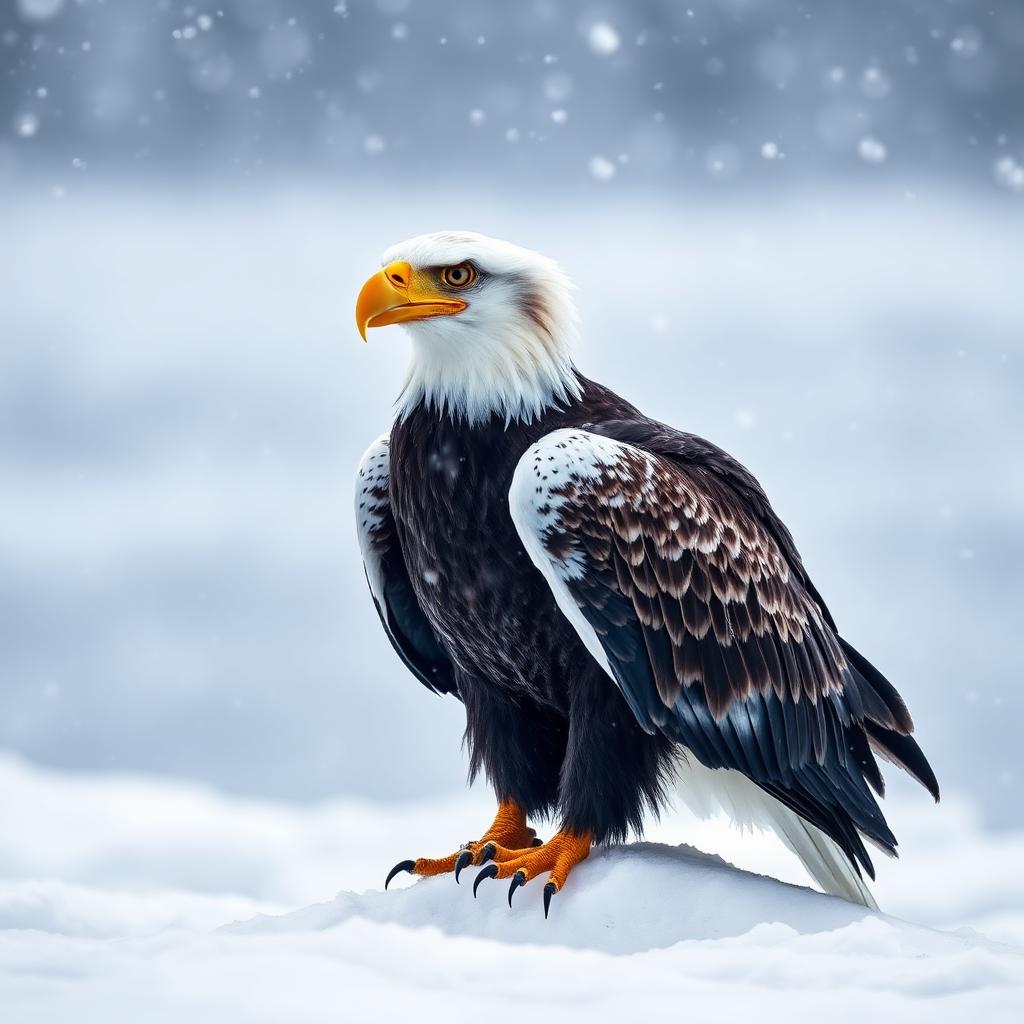
| Scientific name | Haliaeetus pelagicus |
|---|---|
| Wingspan | 2.0 – 2.5 m |
| Weight | 5 – 9 kg (heaviest eagle by mass) |
| Range | Russian Far East, Sakhalin, wintering in Hokkaido and Korea |
| Diet | Salmon, other fish, seabirds, carrion |
| IUCN status | Vulnerable |
The heaviest eagle in the world
Steller's Sea Eagle (Haliaeetus pelagicus) is the heaviest eagle on Earth. Adult females can weigh nine kilograms and carry a huge, bright yellow-orange beak that is unmistakable at any distance.
It lives along the cold, storm-battered coasts of the Russian Far East and winters south into northern Japan, where it has become one of the most sought-after birds in the world for photographers.
A very narrow range
The species breeds along the Sea of Okhotsk, on the Kamchatka Peninsula, in the lower reaches of the Amur River, on Sakhalin and on parts of the Kuril Islands. In winter, many birds move south to the coasts and pack ice of Hokkaido, and smaller numbers reach Korea and Alaska.
For such a large raptor, this is an extremely narrow range. Almost the entire world population depends on the health of the North Pacific rim.
Built for salmon
Steller's Sea Eagle is built around one main resource: salmon. Long, powerful legs and heavy talons let it lift large fish from the water. The huge beak is used to tear through frozen carcasses and to compete with other scavengers on the sea ice.
Adults have dark chocolate bodies, white shoulders, thighs and tail, and that neon-bright beak. Juveniles are duller and take five years or more to reach full adult plumage.
Hunting on ice and river
In summer, breeding pairs concentrate around spawning rivers of Kamchatka, the Amur and Sakhalin, catching salmon in shallow water or stealing them from bears. In winter, huge numbers gather on the drift ice off Hokkaido, where fisheries and carcasses of large mammals provide additional food.
The eagle is opportunistic. It will take seabirds, crabs, small mammals and carrion when fish are scarce.
Nests the size of small cars
Steller's Sea Eagles build massive stick nests on tall trees or coastal cliffs. Traditional nest structures are reused and enlarged for many years, sometimes reaching two metres across.
Pairs typically lay two eggs but often raise only one chick. Reproductive rates are naturally low, which makes populations sensitive to any additional adult mortality.
Why a Vulnerable listing
The global population is estimated at fewer than 5,000 mature individuals, and it is declining. Major threats include:
The main pressures
Overfishing of salmon and other prey species in the North Pacific reduces the food supply during breeding. Coastal development on Sakhalin and around the Sea of Okhotsk destroys nest trees and forest.
Lead poisoning is a serious ongoing killer. Eagles ingest lead shot from deer carcasses left by hunters, particularly in Hokkaido. Collisions with wind turbines and power lines add further losses each year.
What is being done
Japan has banned lead ammunition for large game hunting in several regions, reducing but not eliminating the risk. Russian reserves such as Kronotsky in Kamchatka and the Magadan Nature Reserve protect key breeding habitat, and Hokkaido's Shiretoko Peninsula is a UNESCO World Heritage Site partly because of the eagle.
International monitoring is coordinated through BirdLife International and long-running Russian-Japanese research programmes. But climate-driven changes in salmon runs and sea ice remain outside any conservation project's direct control.
Where to see a Steller's Sea Eagle
The classic destination is eastern Hokkaido in February — Rausu on the Shiretoko Peninsula, and the drift ice off Utoro and Nemuro Bay. Hundreds of eagles gather here alongside White-tailed Eagles to feed on fish and carcasses.
For summer birds on breeding territory, boat trips along Kamchatka's rivers during salmon runs offer rare views of adults hunting.
A giant with a narrow future
Steller's Sea Eagle is a raptor built on a scale most bird-watchers never expect. It is also a species whose entire world depends on a small stretch of North Pacific coast, and on decisions made about fisheries, forests and hunting ammunition thousands of kilometres away. Protecting it is a test of how well we can manage a shared ocean.
Key takeaways
- Steller's Sea Eagle is the heaviest eagle in the world, up to 9 kg.
- It breeds only along a narrow strip of the Russian Far East.
- Winter concentrations off Hokkaido are among the world's greatest raptor spectacles.
- Lead poisoning from hunter carcasses is a leading cause of mortality.
- The global population is estimated at fewer than 5,000 mature birds.
Frequently asked questions
Is Steller's Sea Eagle larger than a Bald Eagle?
Yes. It is significantly heavier and has a larger beak, though wingspans overlap. Bald and White-tailed Eagles are close relatives but noticeably smaller.
Why is its beak so yellow?
The bright orange-yellow beak is a natural pigment feature of adults. It likely functions in social signalling among pairs and rivals.
How many Steller's Sea Eagles are left?
BirdLife International estimates fewer than 5,000 mature individuals, with an ongoing gradual decline.
When is the best time to see them in Japan?
February is peak season along the Shiretoko Peninsula in Hokkaido, when eagles gather on drift ice from the Sea of Okhotsk.
Do Steller's Sea Eagles reach Alaska?
A small number of vagrants reach the Aleutian Islands and mainland Alaska each year, but there is no established breeding population outside Asia.
Why does lead ammunition threaten them?
Eagles feed on gut piles and carcasses left by deer hunters. Lead fragments in that meat cause fatal poisoning that has been documented for decades in Hokkaido.
References
Related reading
Harpy Eagle: The Apex Predator of the Neotropical Rainforest
The Harpy Eagle takes monkeys and sloths from the canopy with talons the size of a grizzly bear's. Yet across most of its range, it is now functionally rare.
Snowy Owl: The Arctic Nomad You Cannot Predict
The Snowy Owl is one of the few large birds most people can recognise on sight — and yet almost everything else about it, from where it will spawn to where it will winter, is genuinely hard to predict.