Siberian Crane: The Last Great White Migration
The Siberian crane travels up to 5,000 km between Arctic Russia and its winter wetlands. Today almost the entire species depends on one Chinese lake — and on our choices.
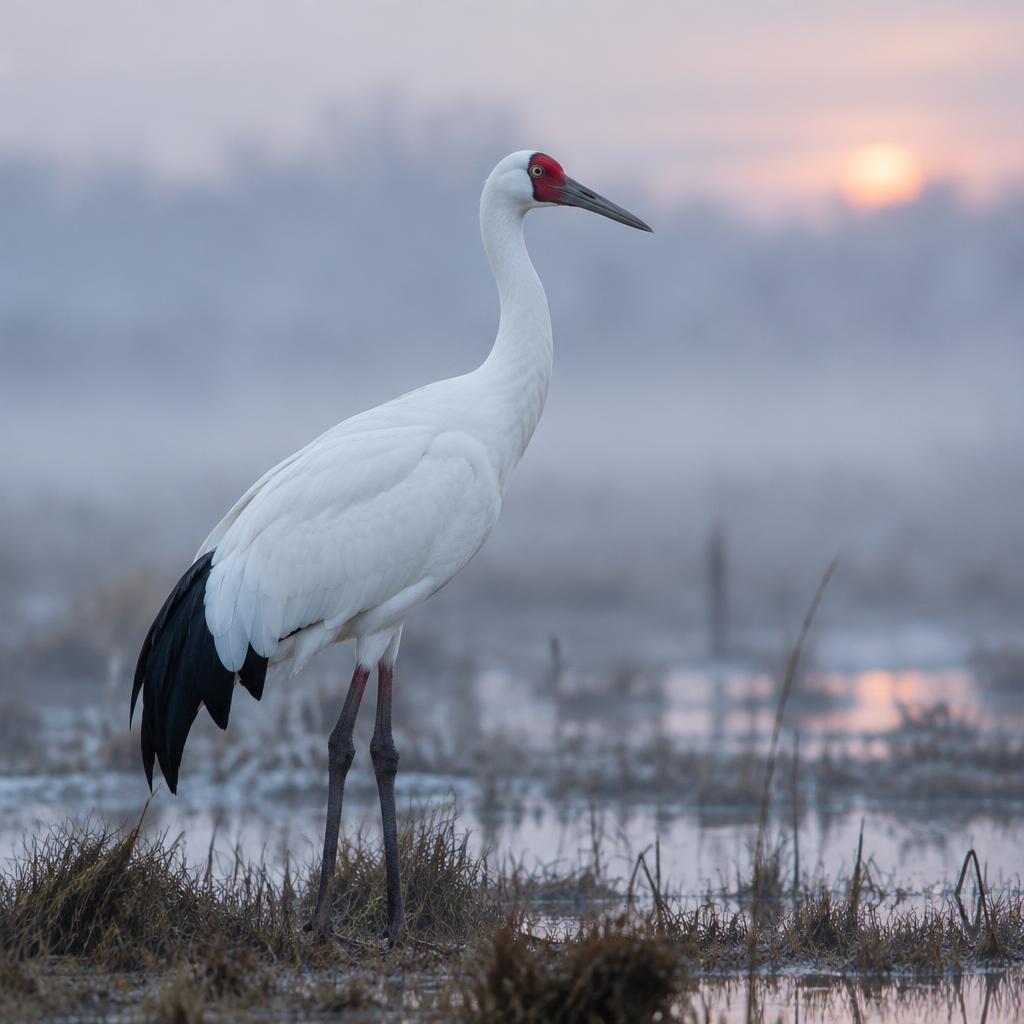
| Scientific name | Leucogeranus leucogeranus |
|---|---|
| Height | About 140 cm; wingspan up to 230 cm |
| Breeding range | Arctic Russia (Yakutia; formerly western Siberia) |
| Winter range | Mainly Poyang Lake, China |
| Population | Estimated 3,500–4,000 birds |
| IUCN status | Critically Endangered |
| Habitat | Shallow wetlands, marshes and lake shores |
| Diet | Aquatic plants, roots, tubers and small animals |
A Ghost of the Wetlands
Standing well over a metre tall, cloaked in brilliant white with a bare red face, the Siberian crane is one of the most striking birds in Asia. To many cultures along its flyway it is a symbol of purity, longevity and good fortune.
Yet this celebrated bird is in deep trouble. The Siberian crane is Critically Endangered, and its story has narrowed to a single thread: almost the entire world population now winters at one place, Poyang Lake in China. When a whole species depends on one wetland, its future hangs by a thread.
This article explores the Siberian crane’s life, its astonishing migrations, the reasons for its decline, and the international effort to keep its ancient journeys alive.
How to Recognise a Siberian Crane
Adults are almost entirely white, with black primary feathers that show clearly in flight and a brick-red, featherless face and forecrown. The long, slightly decurved bill is dark, and the legs are pinkish-red.
Several features help separate it from other white waterbirds:
• Much larger and longer-legged than egrets, with a heavier bill • Black wingtips visible in flight, unlike the all-white whooping crane’s broader black trailing edge pattern • Red facial skin rather than the red crown patch of other cranes • A high, fluting call that carries over long distances
Juveniles are tinged rusty-brown on the head and body and lack the bare red face, gradually whitening over their first two years. Pairs often stay together for life and perform the unison calls and dances typical of cranes.
One of the Longest Migrations on Earth
Siberian cranes breed in the low Arctic wetlands of Yakutia in northeastern Russia. Historically there were three populations: a western one wintering in Iran, a central one wintering in India, and the large eastern one wintering in China.
The western and central flocks have effectively vanished. The last regular cranes in India’s Keoladeo National Park disappeared in the early 2000s, and only a handful of birds still reach Iran. The eastern population — some 3,500 to 4,000 birds — now makes up about 98 percent of the species.
Each autumn these birds fly up to 5,000 kilometres from Yakutia to Poyang Lake in Jiangxi Province, stopping at a chain of wetlands in Russia and northeastern China. The journey demands precise timing: the cranes must arrive when water levels expose the shallow feeding grounds they need.
Why the Siberian Crane Is in Danger
The species’ greatest vulnerability is concentration. With nearly every bird wintering at Poyang Lake, any change to that single ecosystem affects the whole species. The lake’s water levels are influenced by the Three Gorges Dam and by drought, and in recent years low water has at times left the cranes’ food — the tubers of submerged plants — out of reach or stranded dry.
Other pressures include:
1. Loss and degradation of stopover wetlands along the flyway 2. Disturbance from people, boats and grazing livestock at feeding sites 3. Illegal hunting and poisoning in parts of the range 4. Collisions with power lines, a growing problem for large birds 5. Climate change altering both Arctic breeding habitat and winter water regimes
The disappearance of the western and central populations shows how quickly a flyway can unravel once key sites are lost. Conservationists are determined the eastern population will not follow the same path.
Conservation Across a Flyway
Because the Siberian crane crosses so many borders, its protection has become a model of international cooperation. A formal agreement under the Convention on Migratory Species coordinates work among range states, and a network of protected wetlands — from the breeding grounds in Yakutia to Poyang Lake — safeguards the most important sites.
At Poyang, reserve staff monitor water levels and crane numbers through the winter, and local communities are increasingly involved in protection and birdwatching tourism. Satellite tracking has revealed the cranes’ exact routes and stopovers, allowing conservationists to target the wetlands that matter most.
Captive breeding centres, including the International Crane Foundation and Russian facilities, maintain insurance populations and have experimented with teaching young cranes migration routes — the same ‘flight of hope’ approach used with ultralight aircraft for other cranes. Reintroduction to former western and central range areas remains a long-term ambition.
There are reasons for cautious optimism: the eastern population has been broadly stable or slowly growing, and awareness of the species in China has never been higher.
Where to See Siberian Cranes
For birdwatchers, Poyang Lake between November and March offers one of the world’s great wildlife spectacles: thousands of white cranes feeding in the shallows alongside swans, geese and other waterbirds. Several reserves around the lake provide hides and viewing platforms, and visiting with a responsible local operator helps support protection.
If you go, keep these guidelines in mind:
• Keep a respectful distance and never flush feeding or resting birds • Stay on marked paths and follow reserve rules • Choose tour operators that contribute to local conservation • Share your sightings and photographs to support monitoring
Keeping the Flyway Alive
The Siberian crane has already lost two of its three great migrations. The one that remains — Arctic Russia to Poyang Lake — is a living link between tundra and subtropical wetland, and between the people of many nations who share responsibility for it.
Protecting that link means protecting water itself: the rhythm of floods and droughts that feeds the cranes. To learn more, read our guides to the whooping crane and red-crowned crane, and consider supporting the organisations working along the East Asian flyway. The last great white migration is still flying — with care, it can keep flying for centuries to come.
Key takeaways
- The Siberian crane is a large, snow-white crane with a red face and black wingtips.
- About 98 percent of the species winters at Poyang Lake in China.
- It is Critically Endangered; the western and central populations have nearly vanished.
- Water-level changes at Poyang and wetland loss along the flyway are the key threats.
- International agreements, satellite tracking and community conservation offer hope.
Frequently asked questions
How many Siberian cranes are left in the wild?
The global population is estimated at roughly 3,500–4,000 birds, almost all belonging to the eastern population that winters at Poyang Lake in China.
Where do Siberian cranes migrate?
They breed in Arctic Yakutia, Russia, and fly up to 5,000 km south to winter at Poyang Lake in China. Tiny remnant numbers still attempt the western route to Iran.
Why is the Siberian crane Critically Endangered?
The species has lost most of its range and now depends almost entirely on one wintering lake. Changes to Poyang’s water levels, wetland loss on the flyway, hunting and power-line collisions all threaten it.
What do Siberian cranes eat?
They feed mainly on aquatic plants — especially the tubers and roots of submerged vegetation — dug from shallow wetland sediments, along with some small animals.
How can you tell a Siberian crane from a whooping crane?
Both are white with black wingtips, but the Siberian crane has a bare red face and a slimmer, slightly downcurved bill, and it lives in Asia rather than North America.
Can Siberian cranes be seen by tourists?
Yes. Poyang Lake in Jiangxi Province, China, hosts thousands of cranes each winter, and reserves around the lake offer viewing facilities. Visiting responsibly supports local conservation.
References
Related reading
Whooping Crane: North America's Tallest Comeback
The Whooping Crane went from 21 birds to more than 800 in eighty years. Here is how — and why the species is still not out of danger.
Red-crowned Crane: The Dance of Longevity and Survival
From snowy Hokkaido feeding grounds to the Korean DMZ, the red-crowned crane links a powerful cultural legacy with a fragile wetland future.