Red-crowned Crane: The Dance of Longevity and Survival
From snowy Hokkaido feeding grounds to the Korean DMZ, the red-crowned crane links a powerful cultural legacy with a fragile wetland future.
| Scientific name | Grus japonensis |
|---|---|
| Length | About 150–158 cm |
| Range | Northeast Asia; resident in Hokkaido |
| Population | Roughly 3,000–3,800 birds; estimates vary by year |
| IUCN status | Vulnerable |
| Habitat | Marshes, wet grasslands and shallow rivers |
| Diet | Fish, invertebrates, small vertebrates and plants |
A red crown above the snow
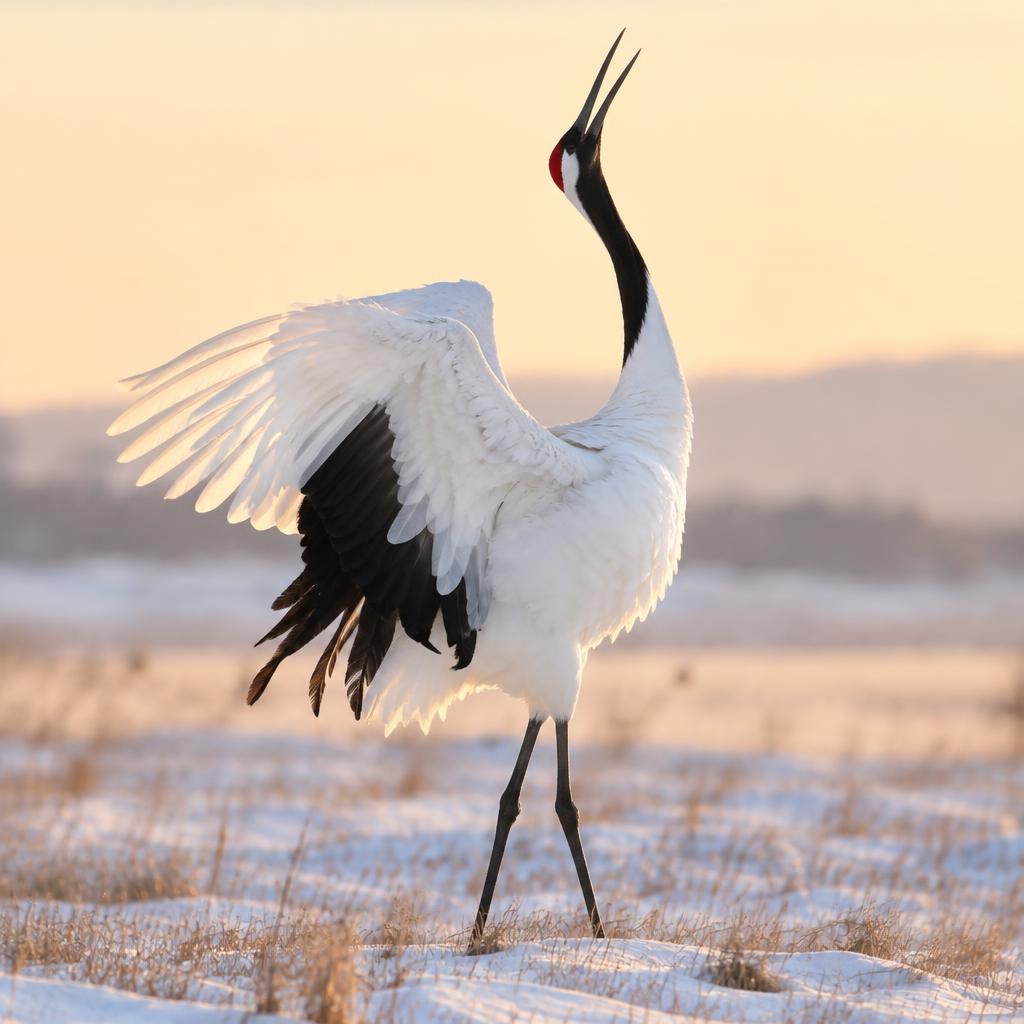
A red-crowned crane stands almost as tall as a person. In the snow, its white body can seem to vanish until the bird turns and reveals a black neck, dark wing feathers and a small patch of bare red skin. Then it bows. Another crane answers, and the still scene breaks into leaps and open wings.
This is Grus japonensis, a wetland bird with an outsize place in East Asian art and belief. Its grace is real, but so is its need for space, food and safe water. The recovery of cranes in Hokkaido shows what local care can achieve. Across the species’ wider range, however, a fine display is no guarantee of a secure future.
Tancho: a living symbol of long life
In Japan, tancho refers to the red crown. The crane is widely linked with longevity, good fortune and lasting bonds. Its form appears in paintings, textiles and festive designs. The old idea of a crane living for a thousand years belongs to folklore, not biology, yet it captures the deep respect this bird inspires.
Paper cranes carry related hopes for peace and healing, though an origami crane is not a precise field guide image of this species. Chinese and Korean traditions also give cranes a strong symbolic role. These meanings cross borders more easily than conservation plans do. For the living bird, respect must reach beyond a picture on a screen: it must protect the marsh where a pair can nest without disturbance.
What the crane’s dance really means
The dance has no single fixed script. Birds bow, jump, run a few steps and spread their broad wings. They may toss bits of grass or other loose material. A pair can move in close response, then pause as if the whole exchange has stopped at once. Dancing supports courtship and the bond between partners, but young cranes dance too.
Nor is every dance a prelude to breeding. Displays can occur outside the nesting season and in groups. Paired birds also give coordinated calls, distinct from the silent movements that draw most camera lenses. Adults usually maintain long pair bonds, though a lost partner may be replaced. In spring, pairs defend wetland territories and build ground nests in shallow marsh vegetation. They commonly lay two eggs, but raising young to independence is a much harder task than laying them.
Look closely at a standing adult and the black feathers can seem to form a tail. They are actually inner wing feathers hanging over the true tail, which is white. The red crown is bare skin rather than a cap of red feathers. Young birds look less crisp, with brownish tones on the head and neck. These details help separate a field observation from the clean, simplified crane familiar in decorative art.
One species, two different ways of life
The species has a resident population in Hokkaido and migratory populations on the Asian mainland. Continental birds breed in northeastern China and the Russian Far East, including wetlands of the Amur basin. They move south for winter, using parts of eastern China and the Korean Peninsula. These routes make a chain of suitable wetlands more useful than any isolated reserve.
On the Korean Peninsula, areas around the Demilitarized Zone provide key winter habitat. Restricted access has left some landscapes less built up than nearby land, though the DMZ is not an untouched refuge. Cranes also use adjacent rice fields and managed sites. Changes in farming, disturbance and infrastructure can alter the value of those places. Hokkaido’s cranes generally stay on the island, so their winter needs and risks differ from those of birds crossing national borders.
The 1952 rescue: 33 cranes in Hokkaido
Hunting and wetland conversion drove Japan’s cranes close to disappearance. A small group was found again in the Kushiro wetlands in 1924. Local people later tried to help the birds through the hardest winter months. Feeding trials began around 1950; in early 1952 cranes began accepting the corn offered to them. That year’s first census recorded just 33 birds in Hokkaido.
That number describes the Japanese population, not the world total. Regular winter feeding, legal protection and habitat work then helped numbers grow. The story is often shortened to a single rescue event, but recovery took decades of repeated effort. Farmers, local residents, wardens and researchers all had roles. The lesson is not simply that feeding saves cranes. It is that steady care can buy time while a small population rebuilds, provided the landscape still offers places to breed and raise chicks.
Tsurui and Kushiro: watching without crowding
In eastern Hokkaido, Tsurui and the Kushiro area are closely tied to winter crane watching. Managed feeding sites can bring birds into view against open snow. Elsewhere, shallow river reaches offer night roosts where flowing water may remain ice free. Feeding grounds, roosts and summer nesting marshes serve different needs; none can fully replace the others.
Use designated viewing areas and check local rules before a visit. Do not approach a resting flock, enter a roost or offer your own food. A bird forced to fly wastes energy during a cold season. Keep road stops safe and respect farms as working land, not public hides. Long lenses and patience help more than a close approach. Watch small actions as well as leaps: a pair feeding calmly or stepping into a river reveals how the birds use this winter landscape.
Why recovery has not removed the risk
A useful broad population figure is roughly 3,000–3,800 birds worldwide, but estimates differ by date and method. Total birds and mature individuals are not the same measure. The global IUCN category is Vulnerable. A strong recovery in one region does not cancel losses or poor breeding conditions elsewhere, and national status labels may differ from the global one.
Wetland drainage, changes in water flow and conversion of surrounding land remain major pressures. Power lines can kill cranes through collisions, especially where wires cross regular flight routes. Avian influenza adds another concern: dense winter gatherings may increase opportunities for infection to spread. Supplementary feeding therefore brings both benefits and management duties. Disease monitoring, clean site practices and a wider spread of safe feeding and roosting habitat can reduce dependence on a few crowded places, though no single measure removes all risk.
Food supply also changes with land use. Cranes forage in shallow water and on open ground, taking animal prey as well as plant material. A drained marsh can remove nesting cover and feeding sites at the same time. Farm fields may supply food, but they can also bring birds close to roads, fences and people. Conservation works best when landowners have clear advice and support, rather than being asked to carry the costs of a celebrated bird alone.
Keep the dance rooted in living wetlands
The next stage of conservation must connect seasonal needs. Breeding pairs require quiet marshes with suitable water levels. Winter flocks need dependable food and safe roosts. Migrants need stopovers that remain usable from year to year. Marking or rerouting dangerous power lines, protecting river flows and coordinating work across borders are practical steps, not just broad promises.
For visitors, the most useful question is not how close a camera can get, but whether the visit supports good management. Local guides can explain seasonal restrictions and direct spending toward communities that share their land with cranes. A quiet visit leaves the birds free to feed, rest and choose their own distance.
The tancho’s cultural strength can help build support, but symbols cannot stand in for field results. Counts, nesting success and disease surveillance show whether protection is working. Hokkaido’s recovery gives grounds for hope precisely because people kept doing the work after the first winter rescue. Support wetland conservation groups, choose responsible crane-viewing operators and share the full story behind the dance: a revered bird survives when people leave room for its daily life.
Key takeaways
- The tancho is a symbol of long life, good fortune and enduring bonds, but it remains a wild wetland bird.
- Winter feeding helped Hokkaido’s population recover after the 1952 census found just 33 cranes.
- Resident Japanese cranes and migratory continental cranes face different pressures.
- Wetland protection, safer power lines and disease safeguards must accompany feeding.
Frequently asked questions
Why do red-crowned cranes dance?
Dancing helps courtship and pair bonding, but juveniles and birds outside the breeding season also dance. It is not solely a mating display.
What does tancho mean?
Tancho refers to the red crown. In Japan the crane is strongly linked with longevity and good fortune.
Where can I see them in Japan?
Eastern Hokkaido is the main area, especially managed winter viewing sites near Tsurui and Kushiro. Follow local access rules and stay clear of roosts.
Are red-crowned cranes endangered?
Their global IUCN category is Vulnerable. National red lists can use different categories and should not be confused with the global assessment.
How many red-crowned cranes remain?
A broad estimate is roughly 3,000–3,800 birds worldwide. Counts from different years and counts of mature birds are not directly interchangeable.
Did only 33 cranes survive worldwide in 1952?
No. The famous count of 33 refers to the Japanese population in Hokkaido, not the entire species.
References
Related reading
The Grey Crowned Crane: Africa's Golden-Crowned Wetland Icon
With its glowing straw-coloured crown and pale blue eyes, the Grey Crowned Crane is one of Africa's most recognisable birds — and one of its most rapidly declining wetland species.
Whooping Crane: North America's Tallest Comeback
The Whooping Crane went from 21 birds to more than 800 in eighty years. Here is how — and why the species is still not out of danger.