Ribbon-tailed Astrapia: The Longest Tail in Birds
A crow-sized bird-of-paradise trailing white tail streamers three times its body length through the mossy highlands of Papua New Guinea.
| Scientific name | Astrapia mayeri |
|---|---|
| Body length | About 32 cm, excluding tail |
| Tail streamers | Up to about 1 metre in males |
| Range | Central highlands of Papua New Guinea |
| Altitude | 1,800 – 3,400 m |
| Described | 1939 — one of the last BOPs found |
| IUCN status | Near Threatened |
A tail out of all proportion
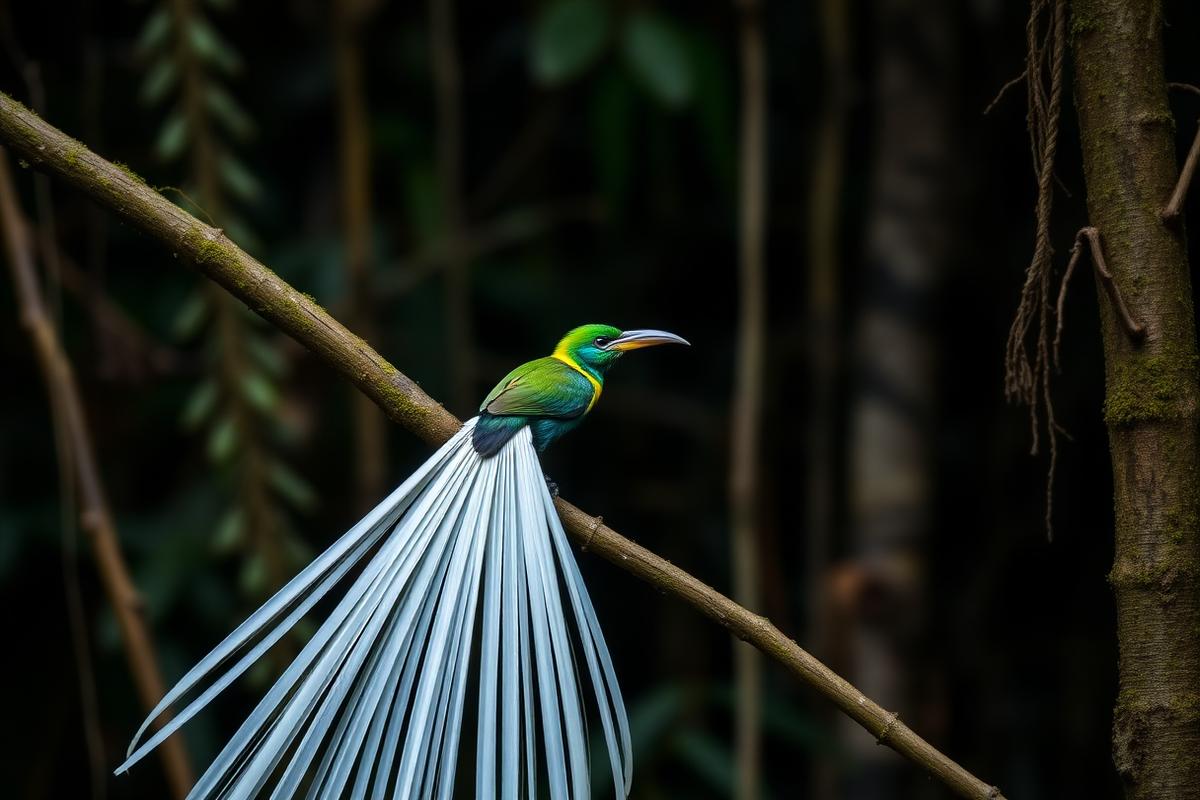
Among the 45 or so birds-of-paradise, the Ribbon-tailed Astrapia holds one clear record. Its two central tail feathers can reach a metre in length on a bird whose body is barely a third of that.
No other bird carries tail feathers so long relative to its size. In flight the streamers ripple behind the male like white ribbon, which is exactly how the species got its name.
It lives high in the central cordillera of Papua New Guinea, in cold, mossy forest that stays wrapped in cloud for much of the day.
Identification
Adult males are velvet black with an intense iridescent green head that flashes emerald when it catches light. A small tuft sits above the bill.
The tail is the giveaway: two long, narrow white streamers with black tips.
Females are much plainer — brownish and blackish, barred below, with a normal-length tail. Young males look female-like for several years before the streamers grow.
The species is often seen in the same forest as the Brown Sicklebill, whose machine-gun call is one of the standard sounds of these highlands.
A small highland range
The Ribbon-tailed Astrapia occurs only in the central highlands of Papua New Guinea, mainly between Mount Hagen, Tari and the Kubor Range.
It occupies montane and subalpine forest, typically from about 1,800 to 3,400 metres, and is most numerous in the upper part of that band where moss, tree ferns and epiphytes dominate.
The total range is small — roughly comparable to a mid-sized national park in area — but much of it remains forested.
Diet and foraging
Fruit makes up most of the diet, especially the fruits of Schefflera and other montane trees. Birds also probe moss, bark and epiphyte clumps for insects, spiders and small frogs.
Astrapias are active foragers, hanging acrobatically, sometimes upside down, to reach fruit clusters. Males keep the streamers clear with a distinctive body posture rather than folding them.
In cold, wet conditions the fruit-plus-protein mix matters: high-altitude birds need reliable energy, and Schefflera crops largely set where birds concentrate.
Courtship and display
Males display alone or in loose groups at traditional perches. The routine includes hopping between branches, bowing, and sudden pivots that swing the streamers in wide arcs.
The green head is angled to catch light during these movements, so a bird can appear to switch colour instantly.
Females choose, mate, then leave. They build the nest, incubate and raise the young without male help — standard for most birds-of-paradise.
Because males invest nothing but display, sexual selection has been free to push the tail to lengths that would be impossible in a species where males help raise chicks.
Hybrids and taxonomy
The Ribbon-tailed Astrapia meets Stephanie's Astrapia in a narrow overlap zone, and the two hybridise regularly. Hybrid birds — once described as a separate species, Barnes' Astrapia — show intermediate tail lengths.
The species was scientifically described only in 1939, from feathers used in highland headdresses that reached collectors before the bird itself did.
That late description reflects how recently the New Guinea highlands were mapped, not how rare the bird is.
Threats and status
The species is listed as Near Threatened. The main pressures are:
1. Hunting for plumes. Tail streamers are prized for traditional headdresses, and adult males are the targets.
2. Habitat loss at the lower edge of its range, where gardens and settlements expand upslope.
3. A small overall range, which magnifies the impact of any localised loss.
Traditional plume use is regulated in principle and feathers are often inherited or reused, but commercial demand adds pressure that customary use never did.
Where birders see them
The Tari Gap and the lodges around Mount Hagen are the classic access points. Fruiting Schefflera near the road often draws several astrapias at once.
Practical notes:
• Early morning, in cold cloud, is prime time.
• Travel with established local guides; land access in Papua New Guinea is customary and must be arranged, not assumed.
• Bring rain protection for optics — persistent drizzle is normal at this altitude.
Extreme evolution, still intact
The Ribbon-tailed Astrapia is what happens when female choice runs without brakes for a very long time in an isolated mountain range. It is still reasonably common where its forest stands, which makes it a species to protect early rather than rescue late.
Support community-run lodges in the PNG highlands, avoid buying plumes, and share this article to introduce more people to the bird with the longest tail on earth.
Key takeaways
- Male tail streamers reach about a metre — the longest relative to body size of any bird.
- It lives only in the central highlands of Papua New Guinea.
- Females raise young alone, freeing male traits to evolve to extremes.
- It hybridises with Stephanie's Astrapia where ranges meet.
- Plume hunting and upslope habitat loss are the main concerns.
Frequently asked questions
How long is the Ribbon-tailed Astrapia's tail?
Male central tail feathers can reach about one metre, roughly three times the bird's body length.
Where does the Ribbon-tailed Astrapia live?
Only in montane forest of the central highlands of Papua New Guinea, between about 1,800 and 3,400 metres.
Is it endangered?
It is listed as Near Threatened. Its range is small and plume hunting continues, but suitable forest remains widespread.
Do females have long tails?
No. Females are brown and barred with a normal tail. Only adult males grow the white streamers.
What does it eat?
Mainly fruit, especially Schefflera, plus insects, spiders and occasional small vertebrates gleaned from moss and bark.
When was it discovered?
It was described in 1939, after highland tail feathers reached collectors — one of the last birds-of-paradise to be named.
References
Related reading
Wilson's Bird-of-Paradise: The Neon Dancer of Waigeo
Only two islands on Earth host Wilson's Bird-of-Paradise. Its neon head and choreographed display have made it a bucket-list species — with real access consequences.
King of Saxony Bird-of-Paradise: New Guinea's Feathered Marvel
The King of Saxony Bird-of-Paradise wears two extraordinary head plumes so strange that early scientists refused to believe they were real.