King of Saxony Bird-of-Paradise: New Guinea's Feathered Marvel
The King of Saxony Bird-of-Paradise wears two extraordinary head plumes so strange that early scientists refused to believe they were real.
| Scientific name | Pteridophora alberti |
|---|---|
| Length | 22 cm body; head plumes up to 50 cm |
| Range | Central highlands of New Guinea |
| Elevation | 1,400 – 2,850 m |
| Diet | Fruit, insects, small vertebrates |
| IUCN status | Least Concern |
A bird that looked like a hoax
When the first King of Saxony Bird-of-Paradise (Pteridophora alberti) specimen reached European scientists in the 1890s, many refused to accept it was real. The bird's two head plumes were so long, so strangely shaped and so brightly coloured that experts suspected a taxidermy joke.
It was real, and more than a century later it remains one of the most improbable-looking birds on Earth.
The plumes
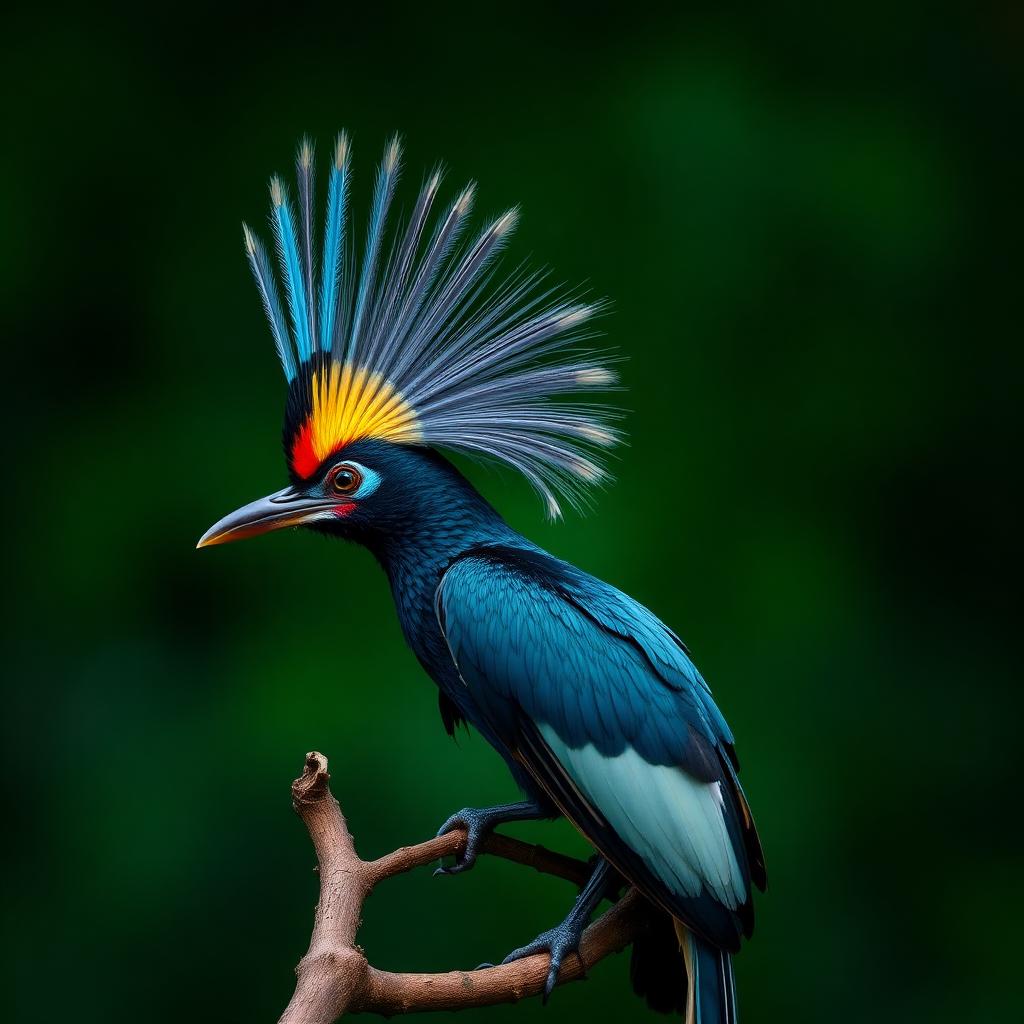
Each adult male carries two elongated feathers on the crown that are twice the length of the bird's own body — up to 50 cm on a 22 cm bird. Each plume is edged with a row of small, rectangular flags that shine sky-blue and reflect light like enamel or plastic.
The structure is so unusual that it inspired the bird's scientific name — Pteridophora, meaning 'fern bearer'.
Cloud forests of New Guinea
The species is endemic to the central mountain spine of New Guinea, from the Weyland Range in the west across the highlands of both Indonesian West Papua and Papua New Guinea. It lives in cloud forest and mid-montane forest between roughly 1,400 and 2,850 metres.
This is cool, mossy, wet forest — one of the most biologically rich habitats in the world and home to at least 15 other bird-of-paradise species.
The display
Male King of Saxony Birds-of-Paradise display from a chosen sub-canopy branch called a 'display perch'. When a female approaches, the male bounces, tilts his head, swings the two plumes forward over his face and produces a bizarre static-hissing call that sounds more like radio interference than a bird.
The plumes are so long and flexible that the male can flick them individually. A watching female inspects the plumes, the call, the movement and the perch, and then decides whether to mate.
Extreme sexual selection
Like most birds-of-paradise, the species is polygynous. Males play no part in nesting or raising chicks; their entire evolutionary contribution is that display.
Because females carry all the cost of reproduction, they can afford to be very selective. Over millions of years, this pressure has driven male ornaments to extremes almost unmatched in the animal kingdom — with the King of Saxony sitting at the far end of the scale.
The female's world
Females are camouflaged in soft brown with a barred underside. They build cup nests low in dense vegetation and raise one to two chicks alone.
Because the female avoids the exposed sub-canopy where males display, she is far less often photographed and much less well known than her spectacular partner.
Plumes and culture
Highland cultures across Papua New Guinea have used King of Saxony plumes in ceremonial headdresses for centuries. Traditional trade routes carried the plumes across the island long before European contact.
In many communities the plumes remain highly valued, but almost all modern harvest is subject to customary quotas or legal restrictions. The species is protected under Papua New Guinea's Fauna (Protection and Control) Act and traded internationally only under CITES rules.
Least Concern — for now
The King of Saxony Bird-of-Paradise is currently listed as Least Concern by the IUCN. Its range is large, its habitat still substantially intact, and hunting pressure appears sustainable in most areas.
Long-term risks are similar to those facing other New Guinea highland birds: logging concessions creeping into montane forest, road building through remote valleys, and climate-driven changes to the narrow altitude band it occupies.
Where to see one
The most reliable sites are around Kumul Lodge and other lodges near Mount Hagen and the Tari Basin in Papua New Guinea, where male display perches are known and can be watched with local guides.
In Indonesian West Papua, some Arfak Mountain lodges offer access to nearby bird-of-paradise habitat, although the King of Saxony is easier to find further east along the central range.
The bird that beats fiction
There is no need for CGI or exaggeration to describe the King of Saxony Bird-of-Paradise. A 22-centimetre songbird with two plumes twice its length, edged with enamel-blue flags, hissing on a mossy branch in a cloud forest at 2,000 metres — this is what evolution actually produced. Protect New Guinea's highland forests and this bird will keep dancing there for the next century, too.
Key takeaways
- The King of Saxony Bird-of-Paradise carries two head plumes twice its body length.
- The plumes are edged with tiny sky-blue enamel-like flags.
- It lives only in the highland cloud forests of New Guinea.
- Males display from sub-canopy perches while females raise chicks alone.
- It is currently Least Concern but sensitive to logging of montane forest.
Frequently asked questions
Why are the plumes so long?
They evolved through very strong sexual selection: females consistently choose the most extreme males, so ornaments have grown far beyond any practical function.
Are the blue flags on the plumes really that colour?
Yes. Structural colour in the flags produces a vivid, plastic-looking blue that stands out in the dim cloud-forest understory.
Is the King of Saxony Bird-of-Paradise endangered?
No. The IUCN currently classifies it as Least Concern, but any large-scale logging of New Guinea's mid-montane forest could quickly change that.
Do local people still use the plumes?
Yes, in traditional headdresses. Modern use is regulated under Papua New Guinea law and international CITES trade rules.
How long can males live?
Wild lifespans are poorly known, but banded and captive birds suggest males can live 15 to 20 years, spending most of that time at or near a display perch.
How can I visit responsibly?
Use established local lodges and licensed guides, keep display-perch distances they recommend, and avoid using flash photography around lekking males.
References
Related reading
Wilson's Bird-of-Paradise: The Neon Dancer of Waigeo
Only two islands on Earth host Wilson's Bird-of-Paradise. Its neon head and choreographed display have made it a bucket-list species — with real access consequences.
Victoria Crowned Pigeon: The Regal Ground Dweller of New Guinea
The Victoria Crowned Pigeon is the largest pigeon on Earth and carries a lace-like blue crest that looks designed rather than evolved.