Red-fronted Macaw: Bolivia’s Critically Endangered Parrot
In Bolivia’s dry valleys, a rare macaw’s future depends on safe cliffs, native food plants, and cooperation with farming communities.
| Scientific name | Ara rubrogenys |
|---|---|
| Length | About 55–60 cm |
| Range | Inter-Andean dry valleys, Bolivia |
| Population | 1,160 counted in 2021; older estimates around 1,000 or fewer |
| IUCN status | Critically Endangered |
| Nesting | Mainly cliff cavities; locally palms |
| Main threats | Habitat loss, crop conflict, illegal trade |
A macaw of cliffs, not rainforest
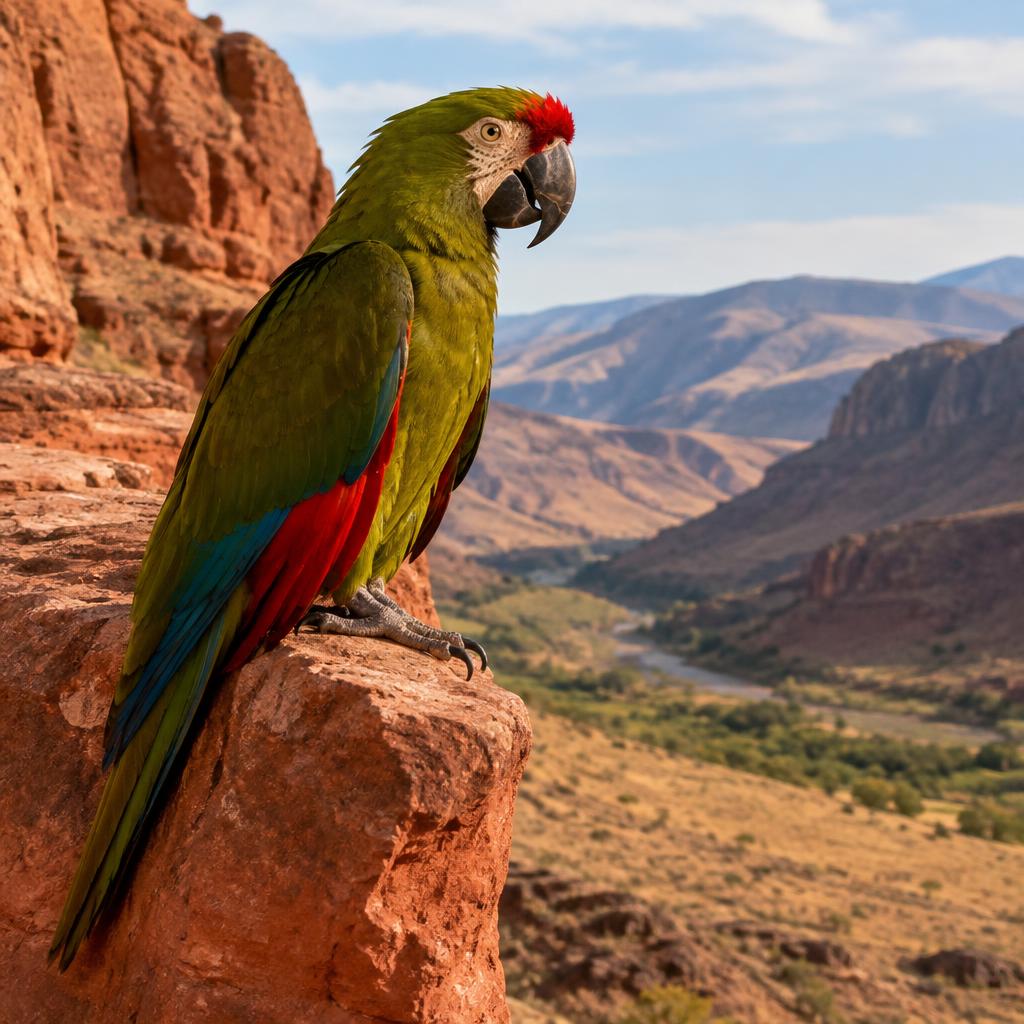
The red-fronted macaw crosses a landscape of bare rock, thorn scrub, and farm plots. Its green wings flash blue in flight; a red forehead and orange-red shoulders catch the light when it banks. This is not an Amazon rainforest bird. Ara rubrogenys belongs to the dry valleys tucked between the Andes in central Bolivia.
Its world is small, and much of it is worked by people. A nesting cliff may stand above a river, while the nearest rich food source is a field of peanuts or maize. That close overlap shapes both the danger and the hope for this Critically Endangered parrot. Saving it means protecting nest sites and making room for farmers to earn a living without losing their crops.
Recognizing the red-fronted macaw
At roughly 55 to 60 centimeters long, this is a medium-sized macaw with a long, tapering tail. Most of the body is green. Look for the red forehead, red around the ear area, orange-red patches at the shoulders, and blue flight feathers. The bill is dark and heavy, built to open hard seeds. Males and females look much alike in the field.
Pairs often remain close as they fly, feed, or rest. A flock may announce itself with harsh calls before any birds appear above the valley wall. Young birds have less developed red markings, so a duller head alone does not mean a different species. Watch from a distance and use several features together. Good views of wing color, shape, and the face are more useful than a glimpse of red.
Bolivia’s inter-Andean dry valleys
This macaw is endemic to Bolivia: its natural wild range lies nowhere else. It occurs in inter-Andean dry valleys in Cochabamba, Chuquisaca, Potosí, and Santa Cruz. The Mizque, Grande, Caine, and Pilcomayo river basins frame its known distribution. Within that broad outline, suitable feeding grounds and safe breeding sites are patchy rather than continuous.
The habitat is a mix of seasonal dry woodland, thorny scrub, steep slopes, and river corridors. Rainfall comes in pulses, and plants do not offer the same foods all year. Macaws move between resources as seeds and fruit become available. A map that marks a single cliff can miss much of the habitat a flock needs.
Dry woodland is easy to overlook beside Bolivia’s better-known rainforests. Yet clearing trees, heavy grazing, and the loss of native food plants can thin the valley’s support system. Conservation needs to connect nesting areas with feeding habitat rather than protect rock faces in isolation.
Cliff nests and the limits of safe space
Most red-fronted macaws nest in holes and cracks in steep cliffs. Pairs inspect cavities, perch near entrances, and defend the immediate nest space. Several pairs may use the same cliff, though each needs its own suitable chamber. A tall rock wall is not automatically good habitat: access, shelter, and the shape of the cavity all matter.
The species is not an absolute cliff specialist. Armonía’s national survey also recorded breeding activity in palms, a useful reminder that local habits vary. Protecting only the most famous cliffs could leave other breeding sites exposed. Nest monitoring should follow evidence from the birds rather than a fixed picture of what a macaw nest ought to look like.
A nest can fail without any visible damage to the cliff. Adults need enough food to raise chicks, and repeated disturbance can disrupt their routine. Researchers monitor breeding activity to learn which sites produce young. Visitors should stay well back, avoid playback, and never approach cavities for a photograph.
How many red-fronted macaws remain?
Older accounts often put the population at about 1,000 birds or fewer. That shorthand captures the scale of the crisis, but it needs a date. A coordinated national census in March and April 2021 registered 1,160 individuals, compared with a previous estimate of 807 in 2012. Armonía’s later program reporting rounded the population to about 1,200. [4](https://armoniabolivia.org/national-population-census-of-the-red-fronted-macaw-in-bolivia/)
These figures should not be treated as a precise count for every later year, or as proof that the danger has passed. Survey coverage, bird movements, and methods can affect comparisons. The number of mature birds is also not the same as the total number counted, which may include young birds.
The IUCN category remains Critically Endangered. A restricted range and a small population leave little margin for continued losses. The most useful questions go beyond the headline total: Are more pairs breeding? Are chicks surviving? Are feeding areas secure? Repeated surveys and nest records help separate lasting recovery from a single encouraging count.
Peanuts, maize, and the illegal bird trade
Peanuts and maize offer rich food in a dry landscape. When macaws feed in cultivated fields, the cost falls on farming households, not on distant birdwatchers. For a family with a small harvest, repeated losses can matter a great deal. Describing every affected farmer as an enemy of wildlife misses the real problem and makes cooperation harder.
Crop conflict can lead to persecution. Practical responses need to be shaped with growers: identify when damage is worst, test nonlethal protection, and check whether a measure actually saves food or money. No single deterrent should be presented as a proven cure across all valleys. Work also needs to retain native feeding habitat so that farms are not the only rich food patches left.
Trapping for the pet trade adds a separate pressure. Removing chicks or adults takes birds from an already small population and can damage breeding sites. A parrot advertised as rare should never become a reason to seek one as a pet. Buyers should reject wild-caught birds, while enforcement and local reporting must make capture less profitable.
Armonía’s reserve and community conservation
Asociación Armonía works with local communities at the Red-fronted Macaw Nature Reserve, also described as the Red-fronted Macaw Community Reserve, near the Río Mizque in the Omereque area. Its value lies in the link between an important breeding cliff and the people who live nearby. Protection is more durable when local residents help shape it and share the benefits.
Armonía’s 2022 annual report recorded 23 active nests at the community reserve and described tourism income supporting local conservation. That is a dated result, not a promise of the same nest total in every season. It shows why patient nest monitoring and community partnerships matter alongside the purchase or designation of protected land. [3](https://armoniabolivia.org/wp-content/uploads/2023/08/Red-fronted-Macaw-Program-Annual-Report-2022-Asociacion-Armonia.pdf)
The wider program also reaches other parts of the range. Work in the Caine and Grande basins reduces dependence on one showcase site. Local guides, school outreach, habitat protection, and action against illegal trade address different parts of the same problem. A successful reserve should be a base for wider coexistence, not an island surrounded by growing pressure.
For visitors, the best encounter is one that leaves the birds’ routine unchanged. A guide can explain where to stand and when to move away. Keep voices low near viewing areas, carry out litter, and ask how your booking benefits the community. These small choices help make living macaws worth more locally than captured birds or a brief rush of unregulated visitors.
Keep the valley alive around the bird
The red-fronted macaw’s future rests on more than saving a striking parrot. It depends on working dry valleys where native trees still feed flocks, cliffs remain safe, and farming families have good reasons to support protection. A rise in a survey count is welcome, but it does not remove the need for long-term care.
If you visit, book through responsible local operators, follow current access rules, and keep nest locations off public maps. Spend money in nearby communities rather than treating the valley as a quick photo stop. If you cannot travel, support credible habitat and community conservation work. Help keep this Bolivian macaw flying by backing the people and places that sustain it.
Key takeaways
- Endemic to Bolivia’s inter-Andean dry valleys, not the Amazon rainforest.
- Most nests are in cliffs, but some breeding occurs in palms.
- The 2021 census counted 1,160 birds; older figures were lower.
- Reducing crop conflict and illegal trade is essential.
- Community conservation links safe nesting sites with local livelihoods.
Frequently asked questions
Where does the red-fronted macaw live?
Only in Bolivia, in inter-Andean dry valleys across parts of Cochabamba, Chuquisaca, Potosí, and Santa Cruz.
Is the red-fronted macaw Critically Endangered?
Yes. Its IUCN category is Critically Endangered despite an encouraging national count in 2021.
Are there fewer than 1,000 left?
Older estimates were around 1,000 or fewer. A 2021 national census registered 1,160 individuals; counts need dates and should not be confused with mature-bird estimates.
Why do farmers come into conflict with macaws?
Macaws eat maize and peanuts, which can cause serious losses for small farms. Conservation needs practical, nonlethal responses developed with growers.
Where do red-fronted macaws nest?
Mostly in cliff cavities. Breeding has also been recorded in palms in parts of the range.
References
Related reading
Hyacinth Macaw: The Cobalt Giant of the Brazilian Pantanal
The Hyacinth Macaw is the world's largest flying parrot and one of conservation's more hopeful stories — a species pulled back from the brink of collapse by a single, focused Brazilian project.
Imperial Amazon: Dominica's National Bird on the Brink
The Imperial Amazon appears on the flag of Dominica. After Hurricane Maria, fewer than 250 are thought to remain in the wild.