Puerto Rican Amazon: The Iguaca’s Long Road to Recovery
From 13 wild birds to a multi-site recovery network, the Iguaca’s return shows what sustained parrot conservation can achieve—and why it must continue.
| Scientific name | Amazona vittata |
|---|---|
| Length | About 28–30 cm |
| Range | Puerto Rico; recovery sites at El Yunque, Río Abajo, and Maricao |
| Population | About 541 total in 2017; wild and managed birds combined |
| IUCN status | Critically Endangered |
| Historic low | 13 wild birds in 1975 |
| Local name | Iguaca |
Iguaca: a voice that almost vanished
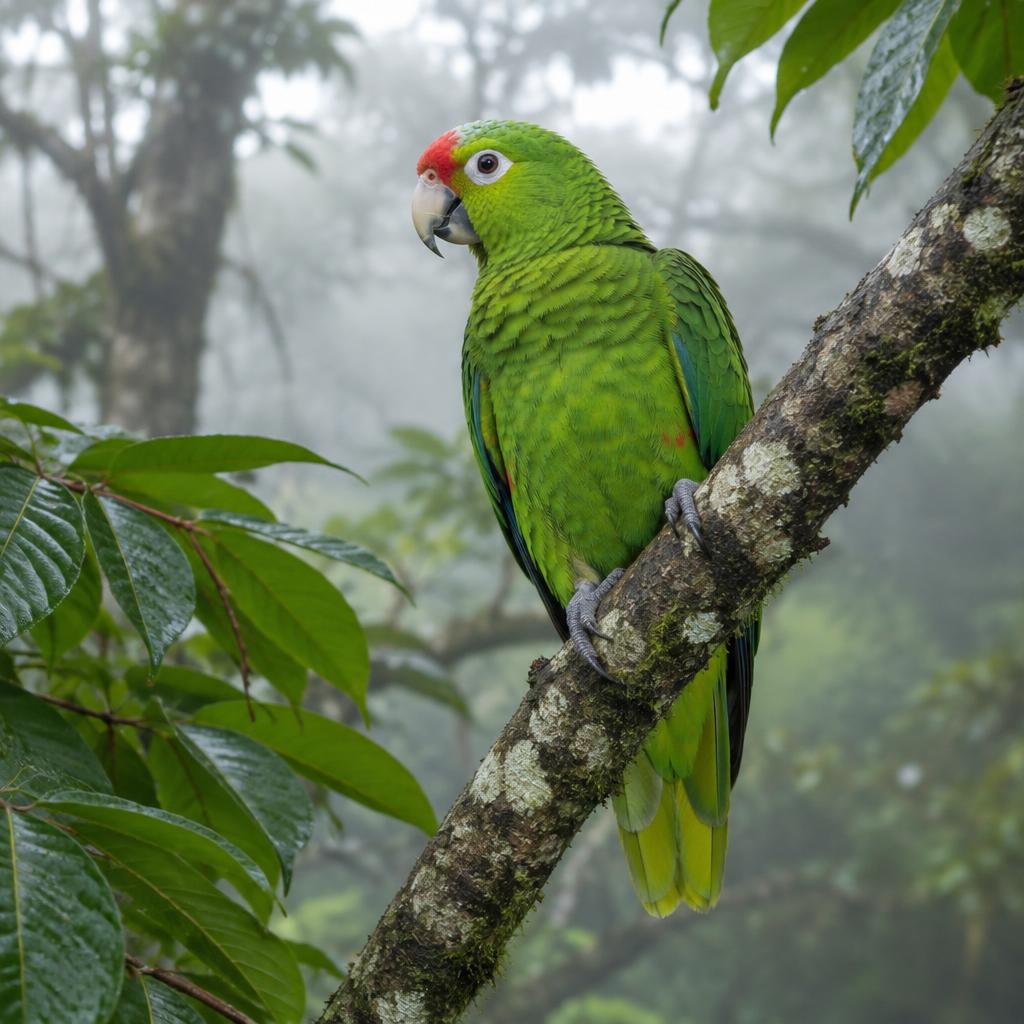
The Puerto Rican Amazon is a green parrot with a red forehead, white eye rings, and blue in its wings. In flight, it can seem to merge with the forest until a call gives it away. Known as Iguaca, a name rooted in Taíno heritage, Amazona vittata is found naturally only in Puerto Rico. Its story is one of near loss and painstaking return.
In 1975, just 13 birds remained in the wild. That figure is not a legend or a loose way of saying rare: it marks the depth of a documented population crisis. Today, captive breeding, releases, and forest protection have brought the species far beyond that low point. Yet the Iguaca remains Critically Endangered, and its gains still depend on skilled care and safe habitat.
Know the island’s native parrot
An adult Puerto Rican Amazon measures about 28 to 30 centimeters long. Its short, squared tail and sturdy body give it a different shape from a long-tailed parakeet. Green feathers dominate, with dark edges that can create a lightly scaled look. The red forehead and pale eye rings are useful field marks when the light and viewing angle are good.
Blue flight feathers become clearer as the wings open. Males and females look much alike, so most field views will not reveal sex. Calls can help trained observers find a flock, but a loud parrot in Puerto Rico is not automatically an Iguaca. Introduced parrots also occur on the island. Check several features, use a reliable local guide, and never enter a restricted breeding area to settle an identification.
From widespread bird to 13 wild survivors
The species once occupied a much wider range of Puerto Rican habitats. Large-scale forest clearance reduced food and nesting sites, while trapping and other human pressures added losses. As the population shrank, the remaining birds became concentrated in the eastern mountains. El Yunque became their final wild stronghold rather than a complete picture of the habitats the species could use.
A parrot can survive in a forest without that forest offering enough safe nest holes or dependable food for a growing population. Cavities take time to form, and other animals may compete for them. Small populations also face a harsher version of ordinary bad luck: losing a few adults or several nests can erase much of a season’s gain.
The 13 wild birds recorded in 1975 therefore represent both a biological bottleneck and an urgent warning. Saving habitat alone was no longer enough. Managers needed to protect the remaining wild pairs while building a breeding program that could return birds to the forest. That work became a long-term partnership rather than a short rescue campaign.
El Yunque, Hugo, and María
El Yunque National Forest holds the wet mountain forest most closely tied to the Iguaca’s survival story. Here, teams have watched nests, improved nesting opportunities, and followed birds through difficult breeding seasons. The forest is protected, but legal protection cannot stop a hurricane. A small flock in one mountain range remains exposed to a single destructive storm.
Hurricane Hugo struck Puerto Rico in 1989 and sharply reduced the El Yunque wild population. Broken trees and stripped crowns affected much more than perches. Storms can destroy nest cavities, scatter flocks, and remove fruit and seeds just when surviving birds need food. Recovery after the wind drops is therefore a long process, not a simple count of immediate survivors.
Hurricane María in 2017 brought another severe setback. The El Yunque wild flock was devastated, and the recovery program again had to rely on its wider network and managed birds. The lesson was not that rainforest conservation had failed. It was that a species this rare needs several populations, storm-ready facilities, and staff able to restore care after roads and communications are damaged.
Iguaca and Río Abajo: the recovery backbone
The Iguaca Aviary at El Yunque and the José Vivaldi Aviary at Río Abajo are central to the recovery effort. The U.S. Fish and Wildlife Service manages Iguaca, while Puerto Rico’s Department of Natural and Environmental Resources manages the Río Abajo facility. The U.S. Forest Service is also a core partner. These institutions share a task that no single site can carry alone. [1](https://www.fws.gov/sites/default/files/documents/2026-02/20240402_puerto-rican-parrot-inter-agency-program-english.pdf)
Captive breeding is not simply a matter of producing the largest possible number of chicks. Managers must consider health, ancestry, pair compatibility, and the needs of the wild flocks. Veterinary checks and careful records help reduce avoidable losses. Where appropriate, captive-produced chicks can also support wild nests through managed fostering.
Birds chosen for release need skills that a protected enclosure does not automatically teach. They must cope with natural foods, fly well, and respond to danger. Release preparation and follow-up are therefore part of the same job as breeding. Aviary totals measure a valuable safety net, but they cannot by themselves show whether a free-living population is becoming self-sustaining.
Río Abajo and Maricao broaden the map
Wild releases at Río Abajo began in 2006, establishing a second free-living population away from El Yunque. This northern forest landscape offered a chance to rebuild the species beyond its last refuge. It also spread risk: a local disaster, disease event, or poor breeding season would no longer affect every wild bird in the same place.
Maricao Commonwealth Forest added a third recovery location, with an introduction in November 2016. The western site widened the geographic spread again. The Fish and Wildlife Service describes recovery work across El Yunque, Río Abajo, and Maricao, rather than treating one famous forest as the whole program. [2](https://www.fws.gov/project/recovery-puerto-rican-parrot)
A release is a beginning, not a finished result. Teams need to know whether birds survive, find food, form pairs, and raise young. A flock may still need additional releases or other help. Three locations also remain exposed to island-wide events such as a major hurricane, so geographic spread reduces risk without making the species disaster-proof.
What does a total of 500-plus mean?
Recovery accounts often describe roughly 500 or more Puerto Rican Amazons in total. That figure must be read with care: it combines managed birds and free-flying birds, and it belongs to a particular reporting period. A federal review reported about 541 individuals in 2017, up from about 284 in 2008. It is not a fresh census for every later year. [4](https://ecos.fws.gov/docs/five_year_review/doc5215.pdf)
The distinction matters because a bird in an aviary and a breeding adult in the forest play different roles in recovery. Both are valuable, but adding them together can hide changes at individual sites. Storm losses, new chicks, releases, and deaths all shift the balance. A useful update should state the date, location, and whether the count covers wild birds, managed birds, or both.
The species remains Critically Endangered on the IUCN Red List; it is also listed as endangered under U.S. law. These are separate systems, not conflicting labels. Long-term recovery means more than passing a round-number milestone. It requires wild flocks that reproduce reliably, enough genetic diversity, secure forests, and a program strong enough to withstand future shocks.
Clear reporting helps supporters understand both progress and the work still needed.
Help recovery become lasting resilience
The return from 13 wild birds is a remarkable gain, but the Iguaca is not safely beyond danger. Every breeding season still links forest quality, nest care, skilled staff, and the weather. The recovery network at El Yunque, Río Abajo, and Maricao gives the species more options than it had at its lowest point.
Visitors can help by respecting closures, using authorized viewing opportunities, and keeping clear of aviaries and nest sites. Do not use playback or share sensitive locations to improve someone else’s chances of a photograph. Support habitat protection and credible recovery partners, and reject the trade in wild parrots. Let the Iguaca’s return be a reason to sustain the work, not a reason to stop it.
Key takeaways
- The Iguaca is endemic to Puerto Rico and remains Critically Endangered.
- Only 13 birds remained in the wild in 1975.
- Hurricanes Hugo and María caused major setbacks at El Yunque.
- Aviaries and releases support recovery across three forest locations.
- A 500-plus total includes managed birds, not just wild parrots.
Frequently asked questions
What is an Iguaca?
Iguaca is the local name, rooted in Taíno heritage, for the Puerto Rican Amazon, Amazona vittata.
How many Puerto Rican Amazons are left?
Totals depend on the date and whether managed birds are included. A federal review reported about 541 combined wild and captive birds in 2017; that is not a current wild-only count.
Why is 1975 important?
The wild population reached just 13 birds, a low point that shows how close the species came to disappearing from nature.
When did releases begin at Río Abajo?
Releases establishing the Río Abajo wild population began in 2006. Maricao received an introduction in November 2016.
How did hurricanes affect recovery?
Hugo in 1989 and María in 2017 severely harmed the El Yunque wild population and its forest habitat, underlining the need for several recovery sites.
Can visitors enter the aviaries?
Do not assume public access. Check official guidance for authorized visits and viewing opportunities, and respect all restrictions around breeding and release areas.
References
Related reading
Bali Myna: Saving Indonesia's Whitest Songbird
The Bali Myna is arguably the most trafficked songbird in Southeast Asia. Its snow-white plumage and status as Bali's provincial bird made it a target — and its slow return is now a case study in island reintroduction.
Imperial Amazon: Dominica's National Bird on the Brink
The Imperial Amazon appears on the flag of Dominica. After Hurricane Maria, fewer than 250 are thought to remain in the wild.