Bali Myna: Saving Indonesia's Whitest Songbird
The Bali Myna is arguably the most trafficked songbird in Southeast Asia. Its snow-white plumage and status as Bali's provincial bird made it a target — and its slow return is now a case study in island reintroduction.
| Scientific name | Leucopsar rothschildi |
|---|---|
| Length | ≈ 25 cm |
| Range | Western Bali only |
| Diet | Fruit, insects, small reptiles |
| Wild low | 6 birds (2001) |
| Current wild population | ≈ 400–500 (rising) |
| IUCN status | Critically Endangered |
A bird from just one province
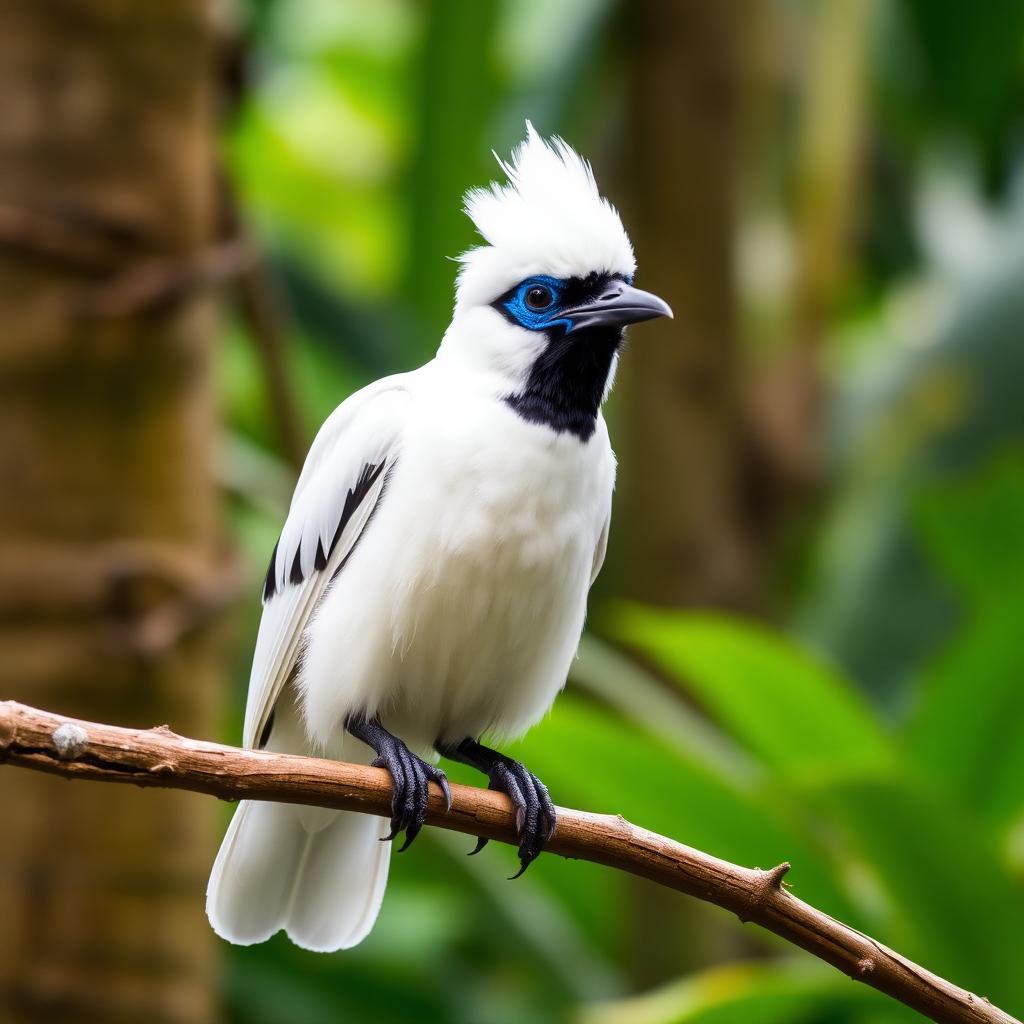
The Bali Myna (Leucopsar rothschildi) is a small, all-white starling found in the wild only in the far west of Bali, Indonesia. Its plumage is pure snow white, tipped with black on wings and tail, and offset by a startling patch of turquoise-blue bare skin around each eye.
It is also Bali's provincial bird and, at least on paper, a national mascot. In practice, its beauty is exactly what almost destroyed it.
Range and habitat
The natural range of the Bali Myna is confined to Bali Barat National Park in the arid, monsoon-scrub western tip of the island. Historically, it may have occupied a slightly wider area, but even in the 19th century it was known as a very local species.
The birds prefer semi-open woodland with mature trees for nesting. They are cavity nesters and depend heavily on the presence of large, older trees — habitat that has been thinned by decades of firewood collection and clearance.
The illegal songbird trade
Indonesia has one of the world's largest domestic songbird markets. Estimates from TRAFFIC suggest that tens of millions of birds pass through markets in Java and Bali each year, with rare and visually striking species like the Bali Myna commanding particularly high prices.
Poaching, not habitat loss, drove the collapse. In 1990 the wild population was around 15 birds. By 2001 it had fallen to just six adults. Every reintroduction attempt in this period was undermined by poachers who removed released birds within weeks.
How the recovery worked
The turning point came from a combination of steps: enhanced ranger patrols inside Bali Barat National Park, expansion of a captive-breeding network (globally coordinated through the European and American zoo studbooks), and the creative use of Nusa Penida island — technically outside the natural range — as a safer 'insurance' release site.
Local ownership was crucial. Bali's traditional villages (banjar) were granted breeding permits and a share of the legal captive-bred trade, which realigned economic incentives away from poaching.
What remains difficult
The wild population inside Bali Barat now sits at around 400–500 birds and is slowly climbing. But poaching pressure has not disappeared, and captive-bred stock in private ownership remains poorly tracked. Genetic diversity in the recovered population is limited, so a single disease outbreak could still cause a serious setback.
A recovery still in progress
The Bali Myna will not be safe until the wider Indonesian songbird trade is brought under proper regulation. But its journey from six birds to several hundred — inside a specific, well-managed national park — shows that even the most heavily trafficked species can be pulled back if the right combination of enforcement, community ownership and captive breeding is sustained for long enough.
Key takeaways
- The Bali Myna is naturally found only in the west of Bali, Indonesia.
- In 2001 only six wild birds remained, entirely due to illegal capture for the songbird trade.
- Coordinated captive breeding, community ownership and enforcement have raised the wild population to 400–500.
- It remains Critically Endangered on the IUCN Red List.
Frequently asked questions
Is the Bali Myna the same as the Bali Starling?
Yes. 'Bali Starling' and 'Rothschild's Mynah' are older names for the same species — Leucopsar rothschildi.
Where can I see wild Bali Mynas?
Bali Barat National Park in the far west of Bali is the only reliable site. Ranger-guided tours are the recommended way to see them ethically.
Why is the Bali Myna so rare?
Because it was heavily targeted by the illegal songbird trade for its striking appearance. At the low point in 2001, only six wild birds remained.
How many Bali Mynas exist today?
Roughly 400–500 in the wild inside Bali Barat National Park, with several thousand in coordinated captive breeding programmes worldwide.
Is the Bali Myna still endangered?
Yes — the IUCN currently lists it as Critically Endangered, one step from Extinct in the Wild.
References
Related reading
The Philippine Eagle: A Complete Guide to the World's Rarest Raptor
With fewer than 400 breeding pairs remaining, the Philippine Eagle is one of the rarest raptors on Earth. Here's what field biologists have learned in three decades of recovery work.
Spix's Macaw: Bringing an Extinct-in-the-Wild Parrot Home
For twenty years, Spix's Macaw existed only in cages. Its 2022 release into Brazilian caatinga is the most ambitious parrot reintroduction ever attempted.