Palila: The Yellow Honeycreeper Tied to a Single Tree
The Palila is one of the last finch-billed Hawaiian honeycreepers. Its future is locked to a single tree species on the slopes of Mauna Kea.
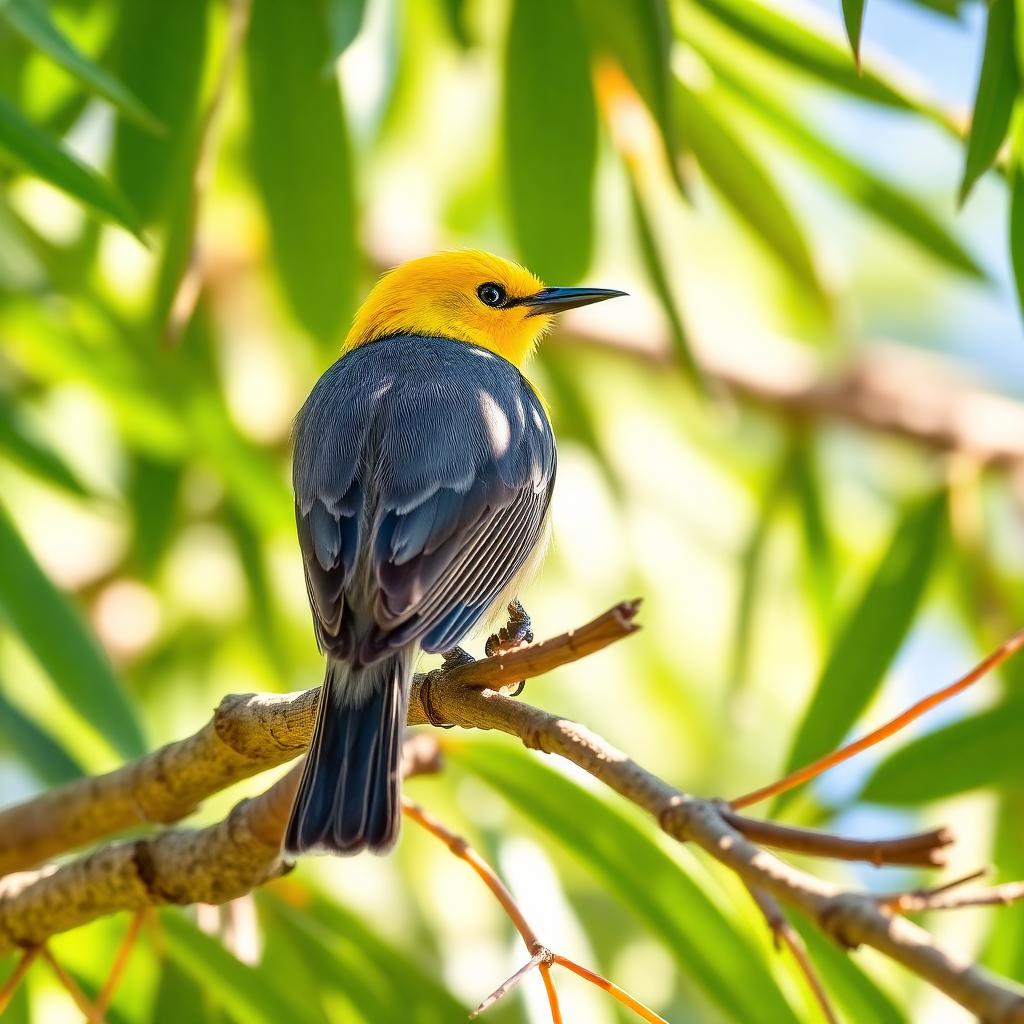
| Scientific name | Loxioides bailleui |
|---|---|
| Length | ≈ 19 cm |
| Range | Upper slopes of Mauna Kea, Hawai'i (Big Island) |
| Diet | Immature māmane seeds, flowers, caterpillars |
| Population | ≈ 850–1,200 individuals |
| IUCN status | Critically Endangered |
A finch-billed relic
The Palila (Loxioides bailleui) is a stocky, thick-billed songbird of the upper slopes of Mauna Kea on Hawai'i's Big Island. Adults show a lemon-yellow head and breast, grey back and a heavy pale bill built for cracking open tough seeds.
It is one of the last surviving finch-billed Hawaiian honeycreepers, a lineage that once radiated into more than fifty species across the archipelago. Today the Palila is confined to a single mountain and one habitat type.
One tree, one bird
The Palila is an extreme dietary specialist. Roughly 90% of its food is the green, immature seed pods of the māmane tree (Sophora chrysophylla). The seeds contain quinolizidine alkaloids that are toxic to most vertebrates; the Palila handles them without harm.
It also takes māmane flowers, caterpillars found inside māmane pods, and occasional naio berries. Where māmane fails to fruit, Palila fail to breed.
A shrinking mountain
Fossil evidence shows Palila once occurred across several Hawaiian islands. Today the entire wild population is on the western and southern slopes of Mauna Kea, in a narrow band of subalpine dry forest between about 2,000 and 3,000 metres elevation.
That band has been eroded for more than a century by feral sheep, goats and mouflon, which browse māmane seedlings and prevent forest regeneration.
A long, steep decline
Palila numbers have fallen from roughly 6,600 birds in 2003 to around 850–1,200 individuals in the most recent surveys. The population has contracted upslope as lower-elevation forest has degraded.
Drought years, which reduce māmane pod production, are followed by sharp population dips. Climate change is expected to compress the suitable elevational band further.
The bird that went to court
The Palila is one of the very few animals to have given its name to a US federal court case. In Palila v. Hawaii Department of Land and Natural Resources (1979 and later), courts ruled that allowing feral sheep and goats to destroy māmane habitat constituted illegal 'take' of an Endangered Species Act–listed animal.
The rulings forced the state to begin removing ungulates from Palila habitat and set an important precedent for habitat-based interpretation of the Endangered Species Act.
Restoration, translocation and captive rearing
Recovery work now focuses on three fronts: ongoing removal of feral ungulates, active māmane and naio replanting on Mauna Kea, and a captive-rearing programme run by San Diego Zoo Wildlife Alliance and partners.
Attempts to establish a second wild population on the northern slope of Mauna Kea have had mixed results; without adequate māmane cover, translocated birds struggle to survive.
A specialist worth the effort
The Palila is a case study in how narrow specialisation, once an evolutionary advantage, becomes a liability in a landscape being reshaped by introduced mammals and warming climate. Its recovery depends less on charisma and more on the slow, unglamorous work of letting māmane forest grow back on a Hawaiian mountainside.
Key takeaways
- The Palila is a Critically Endangered Hawaiian honeycreeper endemic to Mauna Kea.
- About 90% of its diet is the immature seed pods of the māmane tree.
- The population has fallen from around 6,600 in 2003 to about 1,000 today.
- A landmark 1979 legal case tied habitat protection to the US Endangered Species Act.
Frequently asked questions
Where does the Palila live?
Only on the upper western and southern slopes of Mauna Kea on Hawai'i's Big Island, between roughly 2,000 and 3,000 metres elevation.
Why is the māmane tree so important?
Its immature green seed pods make up around 90% of the Palila's diet; without healthy māmane forest, the species cannot breed successfully.
How many Palila are left?
Recent surveys estimate 850 to 1,200 individuals, a decline from more than 6,000 in the early 2000s.
What is the Palila court case?
Palila v. Hawaii DLNR was a landmark US federal ruling holding that letting feral ungulates destroy habitat counted as illegal 'take' under the Endangered Species Act.
Can I see a Palila in the wild?
Yes, with a licensed local guide on Mauna Kea's Palila Forest Discovery Trail, though sightings depend on weather and season.
References
Related reading
Kirtland's Warbler: The Songbird That Needed Fire
Kirtland's Warbler recovered from 167 singing males to more than 2,000 pairs by rebuilding one very specific habitat: young jack-pine forest.
Cebu Flowerpecker: The Bird That Came Back From the Dead
For most of the twentieth century, the Cebu Flowerpecker was considered extinct. Its rediscovery in 1992 changed how we think about small, forgotten forests.