Cebu Flowerpecker: The Bird That Came Back From the Dead
For most of the twentieth century, the Cebu Flowerpecker was considered extinct. Its rediscovery in 1992 changed how we think about small, forgotten forests.
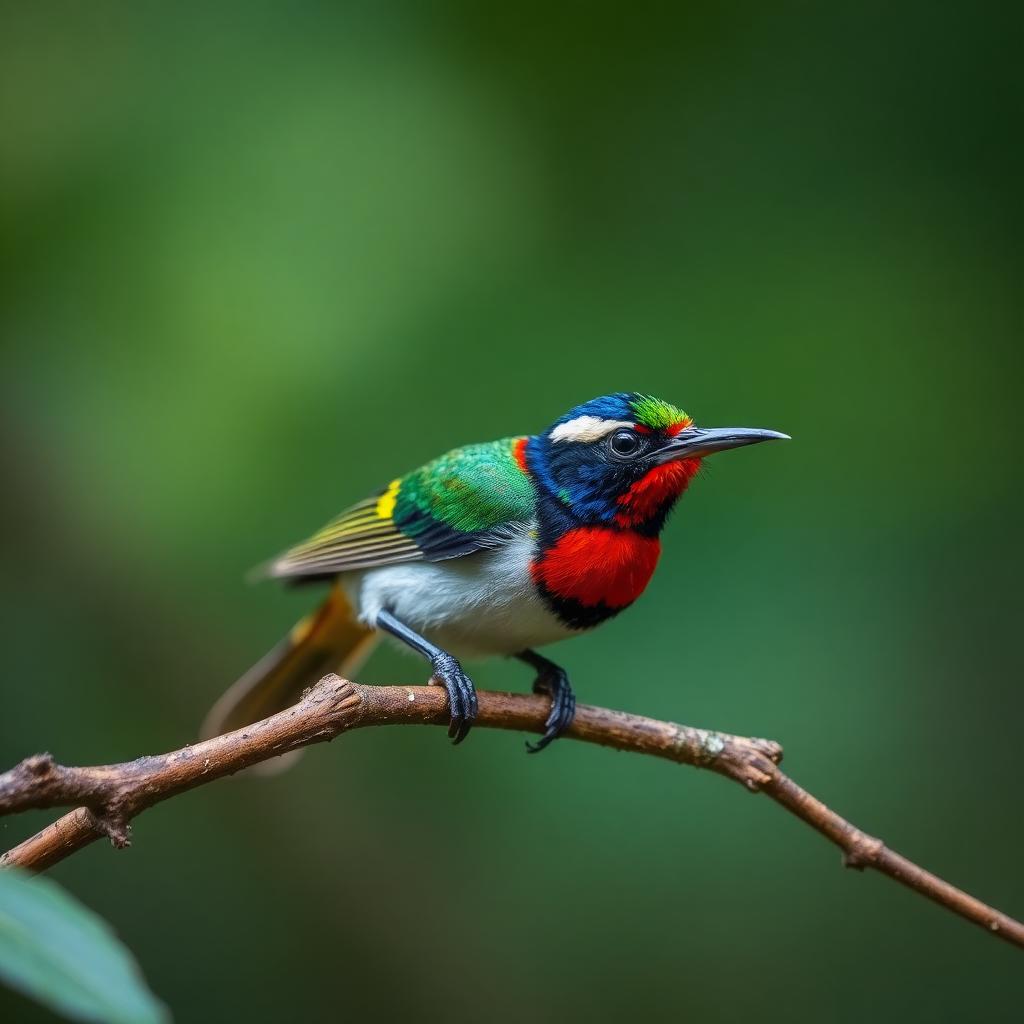
| Scientific name | Dicaeum quadricolor |
|---|---|
| Length | ≈ 12 cm |
| Range | Small forest fragments on Cebu, Philippines |
| Diet | Mistletoe berries, small insects |
| Population | ≈ 60–70 mature individuals |
| IUCN status | Critically Endangered |
A four-colour bird from a forgotten forest
The Cebu Flowerpecker (Dicaeum quadricolor) is a tiny, brilliantly patterned songbird endemic to the Philippine island of Cebu. Adult males show four distinct colours — red back, iridescent blue crown, orange throat and white flanks — packed onto a body barely 12 cm long.
For most of the twentieth century, ornithologists believed the species was extinct. Then, in 1992, a small population was found in a fragment of remnant limestone forest at Tabunan, in the mountains of central Cebu.
The extinction that wasn't
Cebu's forests were among the earliest to be almost totally cleared in the Philippines. By the early 1900s, less than 1% of the island's original forest cover remained. Multiple endemic species — including the Cebu Warbler and Cebu Flowerpecker — were reported extinct.
The 1992 rediscovery by Rob Timmins and colleagues, in a fragment estimated at only a few hundred hectares, was one of the most surprising ornithological findings of the twentieth century.
A mistletoe specialist
Like most flowerpeckers, the Cebu Flowerpecker specialises on mistletoe berries. It swallows the sticky fruit, digests the pulp quickly, and wipes the seed off on a branch, planting the next generation of mistletoe as it feeds.
This creates a tight, three-way dependency between the bird, its host trees, and the mistletoe. Fragmenting the forest disrupts all three at once.
Where the birds still are
Small numbers have subsequently been found at several other sites on Cebu — Nug-as, Alcoy, Dalaguete, and the Central Cebu Protected Landscape — but the total population is very small. Recent estimates place it at just 60 to 70 mature individuals.
Every known sub-population is confined to a fragment of a few hundred hectares. The species is now the poster child for the biological value of even the smallest remnant forest patches.
Threats to a species this small
The main threats are ongoing forest loss and degradation, small-scale logging, and fire in the dry season. At population sizes this low, chance events — a single fire, a landslide, an outbreak of disease — could remove an entire sub-population.
Because so few individuals remain, genetic isolation between fragments is also a real long-term concern.
Community forests and slow protection
Local conservation groups such as the Cebu Biodiversity Conservation Foundation have worked since the 1990s with barangay (village) leaders in Tabunan, Nug-as and Alcoy to protect remaining forest patches through community agreements and small-scale patrols.
The formal designation of the Central Cebu Protected Landscape has helped secure some habitat, but consistent on-the-ground protection remains under-resourced.
A very small bird carrying a large lesson
The Cebu Flowerpecker is a reminder that species do sometimes come back — but only if the last fragments of habitat are still standing when researchers finally look. Every remaining scrap of Cebu's forest is now measurably valuable, and worth defending as if the future of a species depends on it, because it does.
Key takeaways
- The Cebu Flowerpecker was considered extinct for most of the twentieth century.
- It was rediscovered in 1992 in a small forest fragment at Tabunan, Cebu.
- Fewer than 70 mature individuals remain, in a handful of forest patches.
- Its survival depends on mistletoe, host trees, and community-managed forest fragments.
Frequently asked questions
Was the Cebu Flowerpecker really extinct?
It was declared extinct in the early twentieth century, but was rediscovered alive in 1992 in a small remnant forest patch on Cebu.
How rare is it today?
It is Critically Endangered, with an estimated 60 to 70 mature individuals across a handful of small forest fragments.
Where can I see one?
The best-known site is Tabunan Forest in the Central Cebu Protected Landscape, accessible with a licensed local guide. Sightings are never guaranteed.
Why is mistletoe important?
The bird eats mistletoe berries and disperses the seeds. Fragmenting the forest disrupts both the mistletoe and its host trees, breaking a three-way ecological dependency.
Is any captive population held?
No. All known individuals are wild, in a small number of forest patches on Cebu.
References
Related reading

The Philippine Eagle: A Complete Guide to the World's Rarest Raptor
With fewer than 400 breeding pairs remaining, the Philippine Eagle is one of the rarest raptors on Earth. Here's what field biologists have learned in three decades of recovery work.
Rufous-headed Hornbill: The Panay Rainforest's Vanishing Voice
The Rufous-headed Hornbill is now one of the world's rarest hornbills, restricted to a few thousand hectares of intact rainforest on a single Philippine island.