Okarito Kiwi (Rowi): The Rarest Kiwi in the World
The Okarito Kiwi — known in Māori as the rowi — is the rarest kiwi species, hanging on in a single patch of forest on New Zealand's West Coast.
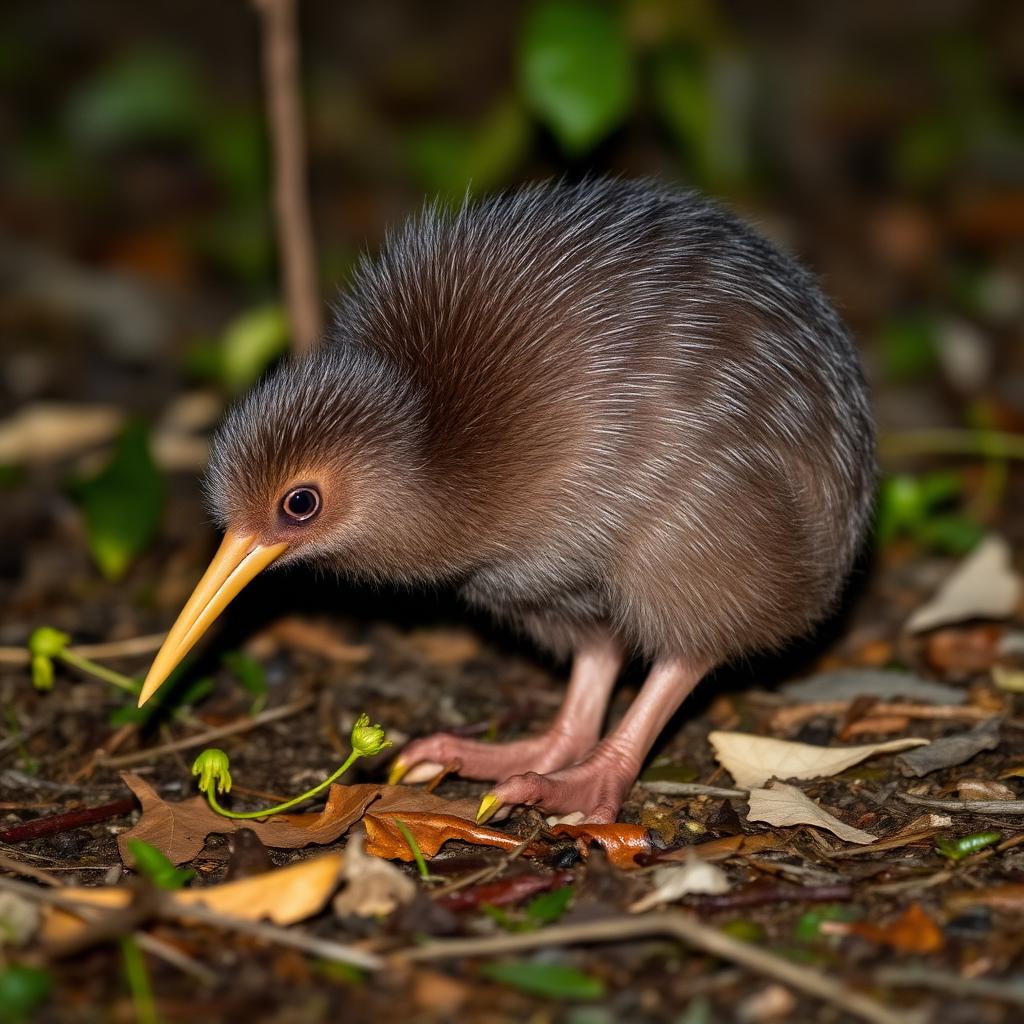
| Scientific name | Apteryx rowi |
|---|---|
| Common name | Rowi / Okarito Kiwi |
| Weight | 1.9 – 3.0 kg |
| Range | Okarito Forest, South Westland, NZ |
| Population | ~600 adults (2024 estimate) |
| IUCN status | Vulnerable (recovering) |
A kiwi almost no one has heard of
Everybody knows the kiwi. Far fewer people know that there are five species — and that the rarest of them was only formally described as separate in 2003.
The Okarito Kiwi, or rowi (Apteryx rowi), lives in a small block of forest on the West Coast of New Zealand's South Island. There are only around 600 adult birds left in the world.
What sets rowi apart
Rowi are slightly smaller than their close relatives and tend to be greyer, with occasional pale facial feathers. Females are noticeably larger than males, as in all kiwi species.
Genetic studies confirm the rowi is distinct from the tokoeka and other brown kiwi, with its own evolutionary history stretching back tens of thousands of years.
Just one forest
The entire wild population lives in the Okarito Forest, a lowland rainforest between the Southern Alps and the Tasman Sea in South Westland. That is one of the smallest natural ranges of any bird in the world.
In the past the rowi lived across a much wider area of the South Island's West Coast, but predators and habitat loss squeezed it into this final refuge.
Why numbers crashed
Kiwi evolved without any land mammal predators. When rats, cats, dogs, ferrets and above all stoats arrived with European settlers, chicks proved almost defenceless.
Without intervention, more than nine out of ten wild-hatched rowi chicks were killed by stoats before reaching adulthood. That is not a population that can recover on its own.
Operation Nest Egg
The rowi is one of the flagship species of Operation Nest Egg, a Department of Conservation programme run with iwi partners and NGOs. Wild eggs are lifted from the forest, incubated safely, and chicks are raised in predator-free crèches until they are big enough to fight off a stoat.
The birds are then returned to the Okarito Forest. Survival of released juveniles is far higher than natural chicks, and the wild population has been slowly rebuilding for two decades.
How a rowi lives
Rowi are nocturnal. They forage on the forest floor, probing leaf litter for worms, beetle larvae, cicadas and native crayfish, using nostrils placed at the very tip of the bill — a feature nearly unique among birds.
Pairs are strongly monogamous, often for life, and share large territories that they defend with loud, shrill duets echoing through the forest at night.
A taonga species
For Ngāi Tahu and other Māori iwi, kiwi are taonga — treasures. Cultural monitoring of rowi is embedded in the conservation programme, and iwi partners play a leading role in decisions about the birds.
The rowi is not simply a rare biological resource; it is a living cultural link to the pre-human forests of Aotearoa.
The road ahead
Numbers are trending up but still well below any comfort zone. Long-term recovery depends on landscape-scale predator control across the Okarito Forest, continued Operation Nest Egg releases, and the establishment of secure secondary populations on nearby predator-free islands.
Climate change and disease pressure on such a small population remain real concerns.
A comeback still being written
The rowi is proof that even a species reduced to a few hundred birds can be pulled back from the edge, but only through decades of coordinated work. If you visit New Zealand, support kiwi conservation organisations, keep dogs out of kiwi habitat, and consider volunteering or donating — the birds notice every bit of it.
Key takeaways
- The rowi is the world's rarest kiwi, with only around 600 adults.
- The entire wild population lives in Okarito Forest, South Westland.
- Stoats and other introduced mammals almost wiped it out.
- Operation Nest Egg is central to its slow recovery.
- Iwi partnership is embedded in the conservation programme.
Frequently asked questions
How is the rowi different from other kiwi?
It is a separate species (Apteryx rowi), with distinct genetics, a greyer plumage tone and a very restricted range in Okarito Forest.
How many are left?
Around 600 adult birds as of the most recent Department of Conservation estimates.
Can I see one in the wild?
Yes, guided night walks in the Okarito area offer a chance to hear and occasionally see wild rowi, always with strict rules to protect them.
Are they still declining?
Thanks to Operation Nest Egg and predator control the population is slowly increasing, but it remains critically small.
Why can't kiwi fly?
Kiwi evolved on islands with no land mammal predators, so flight was not needed and their wings shrank to tiny vestiges.
How can I help?
Support NZ conservation organisations working on kiwi, keep dogs on lead near kiwi habitat, and donate to Operation Nest Egg.
References
Related reading
The Kakapo Recovery Programme: How New Zealand Saved a Flightless Parrot
The Kakapo went from a handful of survivors in the 1990s to more than 250 birds today. Here's how — and what still threatens the world's only flightless nocturnal parrot.
North Island Kōkako: The Blue-Wattled Forest Singer
The North Island Kōkako is a slow, gliding forest songbird whose long, organ-like dawn calls once defined New Zealand's mature podocarp forests.