North Island Kōkako: The Blue-Wattled Forest Singer
The North Island Kōkako is a slow, gliding forest songbird whose long, organ-like dawn calls once defined New Zealand's mature podocarp forests.
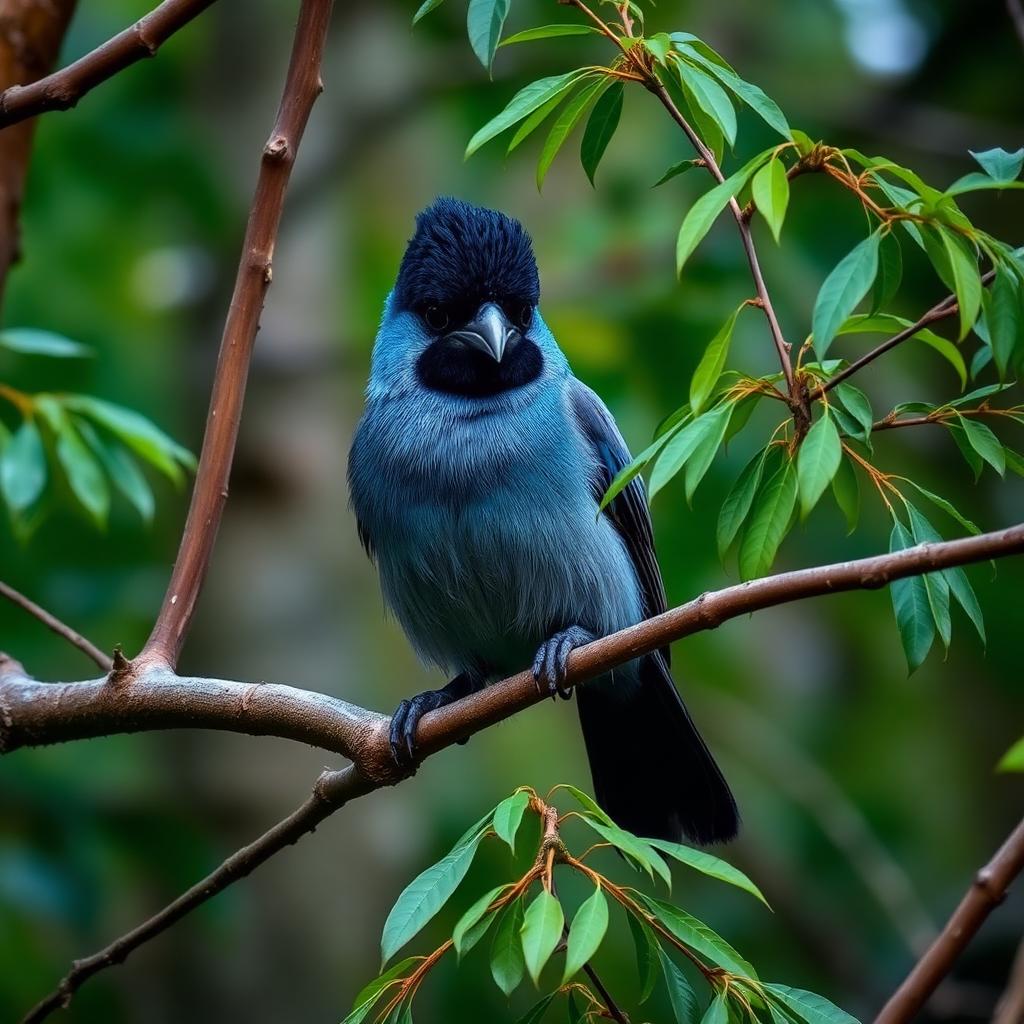
| Scientific name | Callaeas wilsoni |
|---|---|
| Length | ≈ 38 cm |
| Range | Managed native forest fragments, North Island, NZ |
| Diet | Leaves, fruit, invertebrates |
| Population | ≈ 2,500 pairs (and growing) |
| IUCN status | Near Threatened |
A songbird that glides
The North Island Kōkako (Callaeas wilsoni) is a slate-grey, robin-relative-sized songbird of New Zealand's mature podocarp-broadleaf forests. It has a black bandit-mask across the face and two vivid blue wattles that hang from the base of the lower mandible.
It flies weakly for a passerine, preferring to run up branches and glide between trees. Its dawn song — long, pure, organ-like phrases — is one of the defining sounds of remnant North Island forest.
Diet and territory
Kōkako pairs hold large territories and eat a mix of leaves, fruit, flowers and invertebrates depending on season. They are one of very few New Zealand passerines that regularly take foliage as a significant part of the diet.
Pairs are typically monogamous and long-lived, and rebuild the same territory across years when habitat and predator pressure allow.
Introduced mammals and habitat loss
Kōkako evolved in a New Zealand entirely without mammalian predators. Introduced ship rats, brushtail possums and stoats hit them hard — rats and possums raid nests, possums also compete for fruit and flowers.
By the 1990s, most remaining populations were unbalanced, with adult males singing without ever finding a mate. Several regional populations went functionally extinct.
The predator-control turnaround
Intensive control of rats and possums around active Kōkako territories, especially in the Waipapa and Mapara ecological areas and later in Pureora and Ark in the Park (Waitakere Ranges), reversed the decline.
The national population has climbed from around 400 pairs in 1999 to more than 2,500 pairs today, and is now expanding into new managed forest blocks each year.
Translocations and offshore refuges
Translocations to predator-free offshore islands such as Tiritiri Matangi, Little Barrier and Kapiti have created insurance populations that also serve as sources for reintroductions on the mainland.
These island populations breed at higher rates because they do not carry the cost of continuous predator pressure — and they show what mainland forests can look like when rats and possums are held down.
A note on the South Island Kōkako
The South Island Kōkako (Callaeas cinereus) is a separate species with orange wattles. It has not been reliably confirmed since 2007 and is officially classed as 'Data Deficient' — quite possibly extinct. Occasional unconfirmed sightings keep hope alive.
Community-led predator control
Much of the Kōkako's recovery is now driven by community trapping groups in places such as Ark in the Park, Hunua and Pukaha. This ties the species to the broader Predator Free 2050 vision for New Zealand.
For the Kōkako, that vision is not aspirational — it is the mechanism that already turned the population around.
A song worth hearing at dawn
The North Island Kōkako is one of the clearest success stories in New Zealand conservation. It shows that mainland predator control at the scale of tens of thousands of hectares does work, and that a forest can get its voice back if enough people are willing to check trap lines in the rain.
Key takeaways
- The North Island Kōkako is a slate-grey New Zealand songbird with vivid blue wattles.
- It glides between trees rather than flying strongly for long distances.
- Rats and possums caused steep declines in the 20th century.
- Sustained predator control has grown the population from around 400 to over 2,500 pairs.
Frequently asked questions
Is the Kōkako a wattlebird?
Yes — it belongs to the family Callaeidae, the endemic New Zealand wattlebirds, along with the Saddleback and (probably extinct) Huia.
Where can I hear a Kōkako sing?
Reliable sites include Tiritiri Matangi Island, Pureora Forest Park, and Ark in the Park in the Waitakere Ranges near Auckland.
Are there Kōkako on the South Island?
The South Island Kōkako (Callaeas cinereus) is officially Data Deficient. There have been credible unconfirmed reports, but no accepted records for many years.
Why do Kōkako glide?
They have relatively weak flight muscles for a songbird and evolved in dense forest where short glides between branches are more efficient than sustained flight.
How long do they live?
Kōkako can live 20 years or more in stable predator-managed populations.
References
Related reading
The Kakapo Recovery Programme: How New Zealand Saved a Flightless Parrot
The Kakapo went from a handful of survivors in the 1990s to more than 250 birds today. Here's how — and what still threatens the world's only flightless nocturnal parrot.
Black Stilt (Kakī): The World's Rarest Wading Bird
The Black Stilt has all-black plumage, long red legs, and one of the smallest wild populations of any wader on Earth.