Northern Bald Ibis: A Species Returning From Ruin
The Northern Bald Ibis is one of Europe's most surprising conservation stories — a species declared extinct locally, and now teaching pilots to lead its migration.
| Scientific name | Geronticus eremita |
|---|---|
| Length | 70–80 cm |
| Range | Morocco (wild); Turkey, Austria, Italy (reintroduced) |
| Diet | Insects, small vertebrates, seeds |
| Population | ≈ 700 wild individuals + growing reintroduced flocks |
| IUCN status | Endangered (down-listed from CR in 2018) |
A bird that outlived its own extinction
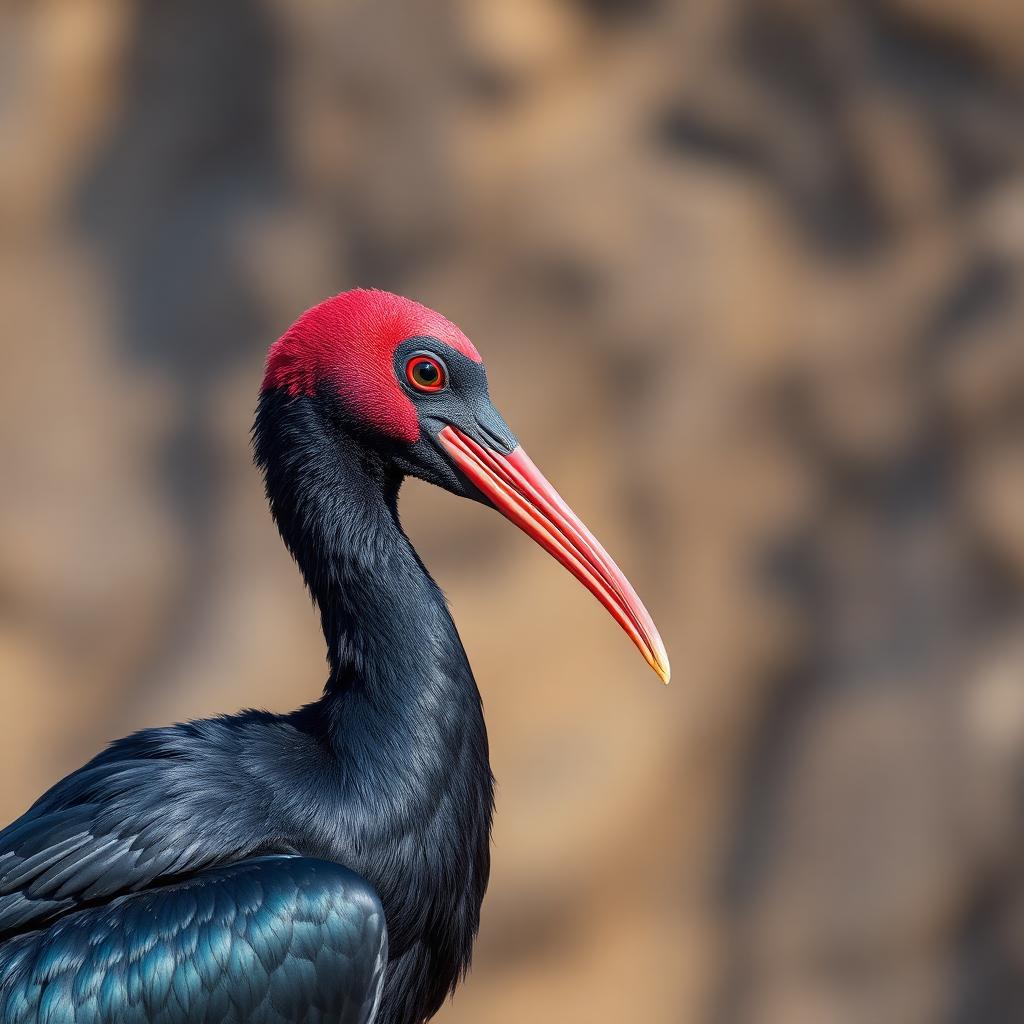
The Northern Bald Ibis (Geronticus eremita) is a large, glossy-black ibis with a bare red face and a long down-curved red bill. It looks archaic — and in a sense it is. It once bred across much of North Africa, the Middle East and central Europe, and appears in ancient Egyptian hieroglyphs as the symbol for 'akh', meaning 'radiant spirit'.
By the twentieth century, it was gone from Europe entirely and clinging on in tiny numbers in Morocco and Syria. In 2018 it was down-listed from Critically Endangered to Endangered, thanks to an unusual combination of Moroccan community protection and European reintroduction.
Where it lives today
The only continuous wild population lives on the Atlantic coast of Morocco in and around Souss-Massa National Park, where three main colonies breed on coastal cliffs. Their population has grown from around 220 birds in the 1990s to more than 700 today.
A separate reintroduced population now migrates each year between Austria/Germany (breeding) and Tuscany, Italy (wintering), reversing a European extinction that lasted more than 400 years.
Diet and breeding
Northern Bald Ibises feed on insects, small reptiles, snails and seeds, foraging in short-grazed pasture, stubble and semi-desert steppe. Nests are built on cliff ledges in loose colonies, and both parents feed the chicks.
Pairs typically raise two to three chicks per year. Adult survival is high when nest cliffs are protected from disturbance and when foraging grounds nearby are managed as low-input pasture rather than intensive agriculture.
The Waldrapp reintroduction: teaching a migration
Because migratory knowledge in ibises is passed from adults to young, a reintroduced flock had no one to teach it. Since 2004, the Waldrappteam project has used human foster parents to raise chicks and then pilots in microlights to lead the young birds across the Alps to their wintering site in Tuscany.
Every year for two decades, this migration has been reinforced with new cohorts. The current population is beginning to migrate independently, an early sign that a lost migratory tradition is being re-established.
What still threatens the species
In Morocco, illegal hunting outside protected areas, disturbance at cliff colonies, and the loss of extensive-grazing landscapes are ongoing concerns. In the reintroduced European population, powerline collisions and illegal shooting on migration through Italy remain the two biggest causes of death.
Climate change is also shifting suitable breeding-season conditions, particularly in Morocco, where a series of drought years has affected chick provisioning.
A slow, hopeful return
The Northern Bald Ibis is one of the few birds whose story is quietly reversing direction. It is not saved — a single disease outbreak in Morocco or a bad winter in Italy could set it back years. But a bird once known only from ancient Egyptian tombs is again crossing the Alps under its own power.
Key takeaways
- Wild Northern Bald Ibises survive mainly in Morocco's Souss-Massa National Park.
- The Waldrappteam project is teaching a reintroduced flock to migrate across the Alps.
- The species was down-listed from Critically Endangered to Endangered in 2018.
- Powerline collisions and illegal shooting are the main threats on migration.
Frequently asked questions
Is the Northern Bald Ibis extinct in Europe?
It was for around 400 years. A reintroduced migratory population has been slowly re-established between Austria, Germany and Italy since 2004.
Where can I see one in the wild?
The most reliable place is Souss-Massa National Park in Morocco. Reintroduced birds can also be seen at breeding sites in Austria and wintering areas in Tuscany.
Why is it called 'bald'?
Adults have a bare red face and forehead, unfeathered — hence the name. Juveniles have a fully feathered head that gradually becomes bare with maturity.
How is a migration taught to a bird?
Chicks are hand-raised by human foster parents, then led on their first southbound migration by pilots flying microlight aircraft the birds have imprinted on.
Is it related to the Southern Bald Ibis?
Yes. Both belong to the genus Geronticus. The Southern Bald Ibis (G. calvus) is a different species, endemic to South Africa, Lesotho and Eswatini.
References
Related reading
The Kakapo Recovery Programme: How New Zealand Saved a Flightless Parrot
The Kakapo went from a handful of survivors in the 1990s to more than 250 birds today. Here's how — and what still threatens the world's only flightless nocturnal parrot.
The California Condor: North America's Largest Bird Fights Back
In 1987, every California Condor left on Earth was pulled into captivity. The species is back — barely — thanks to one of the most expensive recovery programmes in history.