Marvelous Spatuletail: The Hummingbird With Two Racket Tails
The Marvelous Spatuletail carries two long tail rackets it whips in front of its body. It lives in one narrow valley in northern Peru.
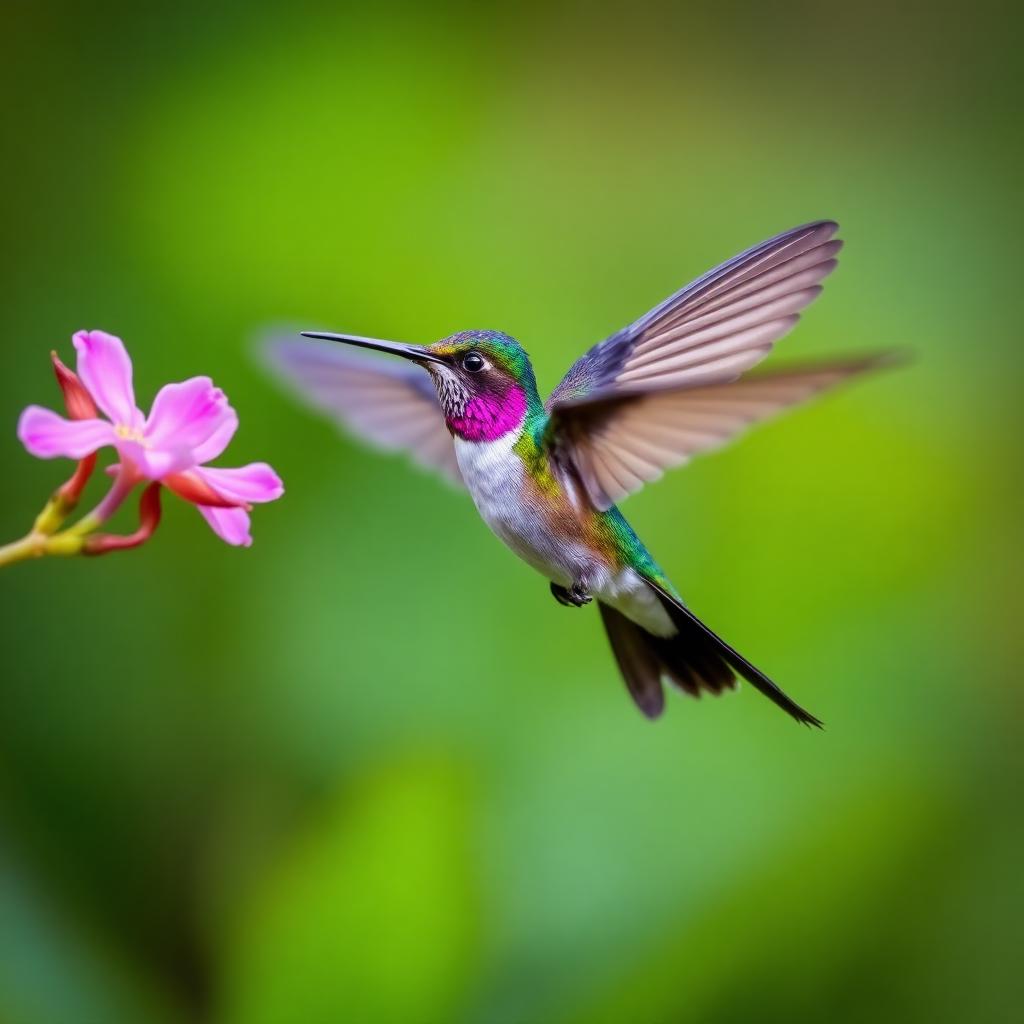
| Scientific name | Loddigesia mirabilis |
|---|---|
| Length | ≈ 10–15 cm inc. tail |
| Range | Utcubamba Valley, Amazonas, northern Peru |
| Diet | Nectar (esp. red-flowered lilies), small insects |
| Population | ≈ 250–1,000 mature individuals |
| IUCN status | Endangered |
A hummingbird with only four tail feathers
The Marvelous Spatuletail (Loddigesia mirabilis) is one of the most striking hummingbirds on Earth. Most hummingbirds have ten tail feathers; the Marvelous Spatuletail has only four. In adult males, two of those are extended into long wire-like shafts ending in wide iridescent 'spatules' or rackets.
The species is restricted to a small stretch of the Utcubamba River valley in the Amazonas region of northern Peru, at 2,100 to 2,900 metres elevation.
The racket-tail display
During courtship the male hovers in front of a perched female, waving the two long racket tails in wide arcs and crossing them repeatedly over his body. The display is short, intense and burns so much energy that males rarely hold it for more than seconds at a time.
The rackets are not aerodynamic; they impose a real flight cost. That the trait persists at all is a textbook example of sexual selection driving an ornament past the point of practical use.
One valley in the Andes
The species has been reliably recorded only in the Utcubamba drainage and a handful of adjacent side valleys. It favours the interface between remnant forest and shrubby second growth, especially where red-flowered lilies (Alstroemeria) and Bomarea vines are common.
Because the entire range lies within a single narrow catchment, any single landscape-scale disturbance would put the species at global risk.
Nectar and hard-won calories
Marvelous Spatuletails feed heavily on nectar from the red-flowered lily Alstroemeria formosissima, along with several Bomarea and Passiflora species. They also take small insects and spiders, which supply the protein needed to grow feathers, especially for males renewing tail rackets.
Feeder stations at community reserves such as Huembo (managed by ECOAN) have made the species reliably observable and provide long-term monitoring data.
Fire, forest loss and folklore
Habitat loss to agriculture and cattle grazing is the primary threat. Dry-season fires used to clear pasture regularly escape into remaining forest patches.
There is also a small persistent local trade in male hearts, based on a folk belief that they act as an aphrodisiac. Even at low levels, targeting adult males in a species this restricted has demographic consequences.
Community reserves and habitat restoration
The Peruvian NGO ECOAN, with support from American Bird Conservancy, has established the Huembo Reserve specifically to protect Marvelous Spatuletail habitat, and works with surrounding communities on tree planting and sustainable land use.
Nectar-plant restoration — planting Alstroemeria and Bomarea along forest edges — has proven especially effective because it links the birds' feeding ecology directly to community-managed land.
An ornament worth protecting
The Marvelous Spatuletail is an evolutionary experiment that only makes sense inside one narrow Andean valley. Keeping that experiment running is a matter of protecting a specific set of hillsides, of specific nectar plants, and of the communities that live alongside them.
Key takeaways
- The Marvelous Spatuletail has only four tail feathers; males carry two long racket-tipped shafts.
- It is endemic to a small area of the Utcubamba Valley in northern Peru.
- The display uses so much energy males only hover for seconds at a time.
- Habitat loss, fire and small-scale poaching are the main threats.
Frequently asked questions
Where can I see the Marvelous Spatuletail?
The most reliable site is the Huembo Reserve in Amazonas, Peru, managed by ECOAN, where feeders bring males to observable perches.
Do females have the racket tails?
No. The two long racket-tipped tail feathers are found only in adult males; females have a short forked tail.
How many Marvelous Spatuletails exist?
Estimates place the global population between 250 and 1,000 mature individuals across the Utcubamba drainage.
Why is the species Endangered?
It has a very small, single-catchment range, ongoing habitat loss to fire and agriculture, and low-level poaching of adult males.
What do they eat?
Mostly nectar from red-flowered lilies (Alstroemeria) and Bomarea vines, plus small insects for protein.
References
Related reading

The Resplendent Quetzal: Field Guide to Central America's Cloud-Forest Icon
Few birds are more mythologised than the Resplendent Quetzal. Behind the iridescence is a highly specialised cloud-forest species that depends on a single tree family to survive.
Long-wattled Umbrellabird: The Cloud Forest's Strangest Cotinga
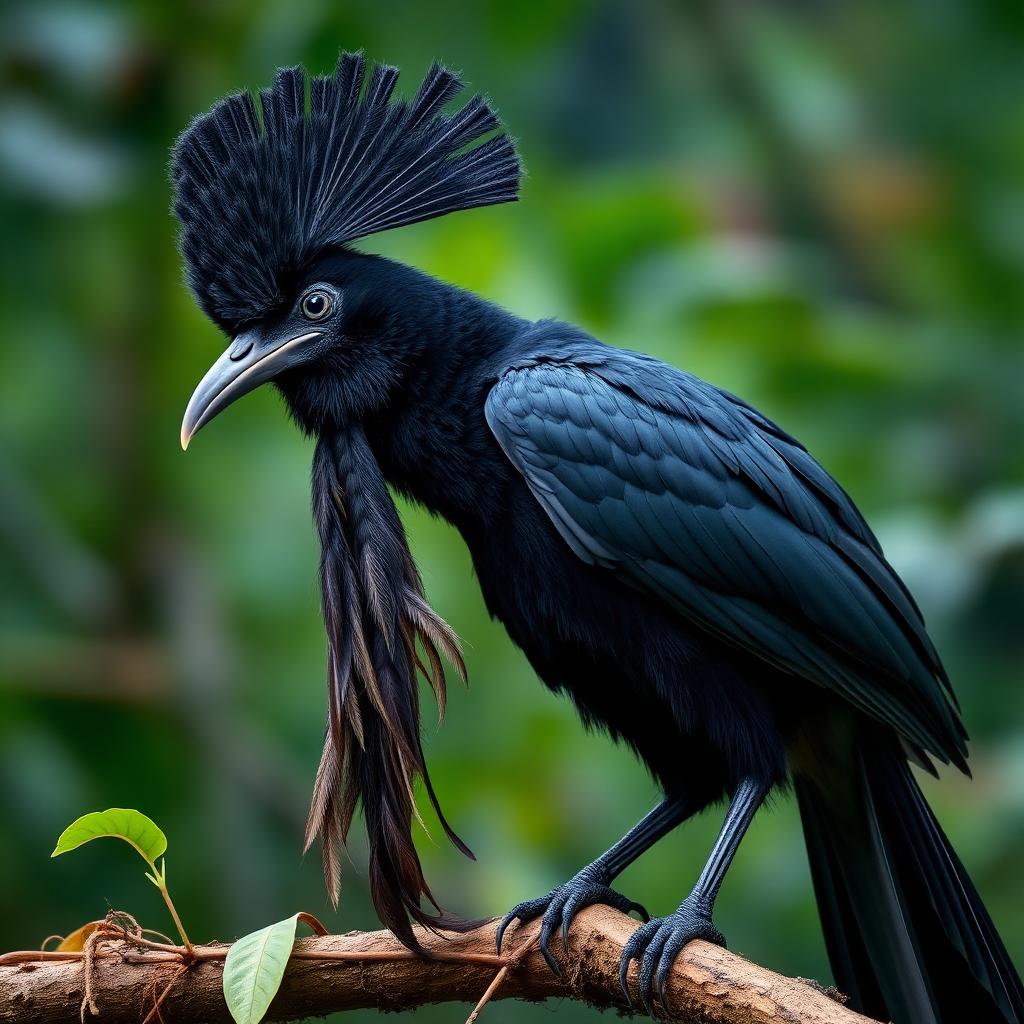
The male Long-wattled Umbrellabird looks less like a cotinga than an eccentric priest — jet black, with a pompadour crest and a feathered wattle that hangs a third of a metre from his throat.