Madagascar Pochard: The Rarest Duck’s Long Road Back
A duck found alive after years without a confirmed sighting needs more than a safe lake: it needs a wetland where its young can feed.
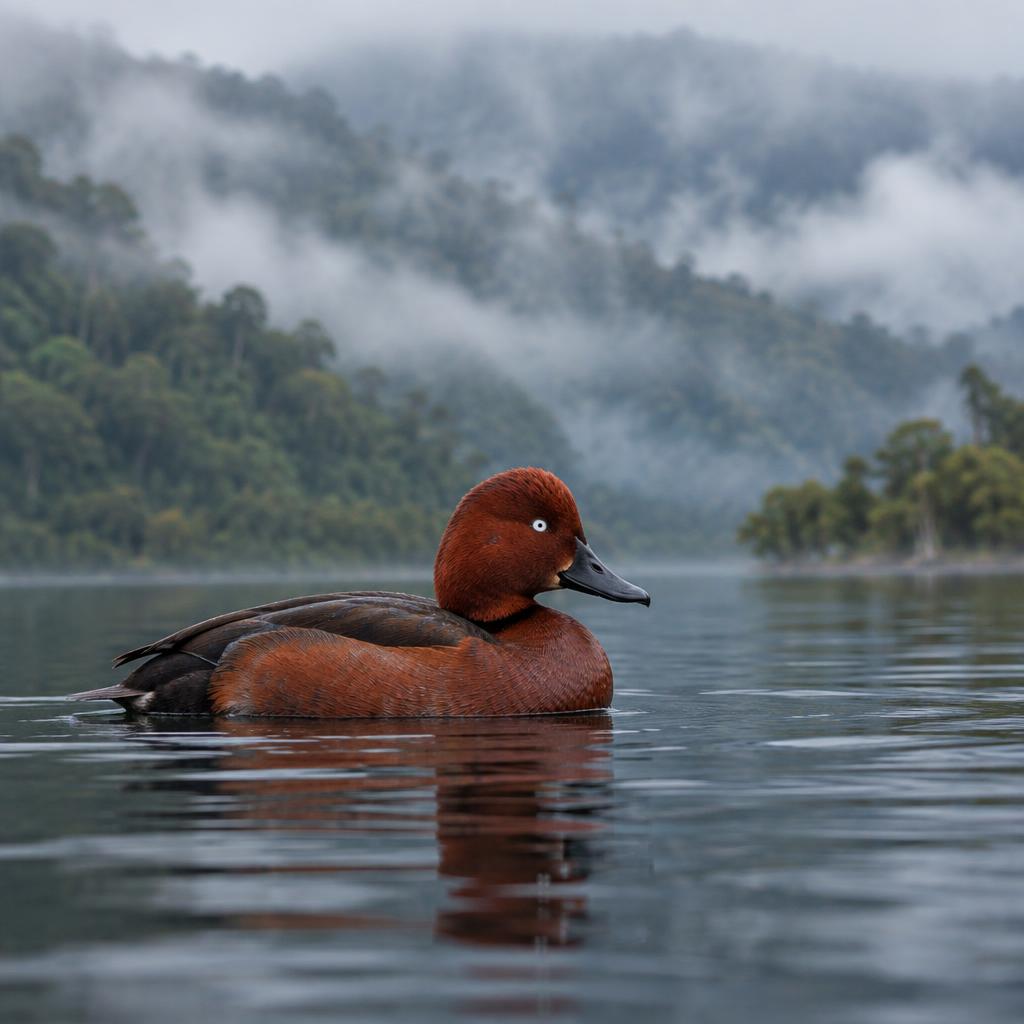
| Scientific name | Aythya innotata |
|---|---|
| Length | About 45–56 cm |
| Range | Northern Madagascar; endemic |
| Population | About 25 wild birds at rediscovery; later releases added birds |
| IUCN status | Critically Endangered |
| Habitat | Freshwater lakes and marshes |
| Diet | Aquatic invertebrates and other wetland foods |
A brown duck with an extraordinary survival story
The Madagascar pochard does not announce itself with bright feathers or a loud display. A brown diving duck on a quiet lake can be easy to miss. Yet Aythya innotata carries one of the most remarkable rescue stories in modern bird conservation. For years, people feared that this bird had vanished from the wild without a viable population left to save.
Its return to scientific attention was only the start. The birds had survived in a place where most ducklings could not grow up. Keeping adults alive would not be enough. The work that followed joined field surveys, captive breeding, wetland restoration, and patient talks with people who depend on the same water. This is a recovery effort built around a hard question: what makes a lake a home, rather than a last refuge?
How to recognise a Madagascar pochard
Adults are roughly 45–56 centimetres long, with the rounded shape and low stance of a diving duck. Males have rich chestnut tones, a darker back, and a pale eye that can stand out in good light. Females are duller brown and have dark eyes. Both can look plain from a distance, so field identification needs care rather than a quick glance at colour.
Watch how the bird uses the water. Pochards dive below the surface to search for food, then reappear and rest between feeding bouts. Aquatic invertebrates are important prey, though diet can include other wetland foods. A stretch of open water is not enough by itself. The depth, bottom conditions, and supply of prey all affect whether a bird can meet its daily needs. Those details matter even more for a small duckling with limited diving power.
From the 1991 record to Bemanevika in 2006
The species was once associated with Lake Alaotra and other highland wetlands. As marshes changed, records dwindled. Following the last widely cited confirmed record in 1991, years of searches failed to locate a surviving population. It was presumed extinct by many observers, though that is not the same as a formal declaration that every bird had died.
In 2006, a team associated with The Peregrine Fund found pochards at the remote lakes near Bemanevika in northern Madagascar. Accounts describe roughly two dozen birds, often rounded to about 25. Exact figures vary with the survey and date. What mattered was clear: living birds remained, and the whole known wild population was perilously small.
The find overturned an assumption, not the threats behind it. A few adults on secluded water could still disappear through one bad breeding period or a local disaster. The rediscovery bought time, but it did not show that the species was secure.
Why ducklings starved on a seemingly safe lake
Bemanevika looked promising in one sense: its remote crater lakes had escaped much of the damage seen elsewhere. But a lake can be relatively undisturbed and still be poor habitat for a particular bird. Steep banks and deep water left little shallow feeding space. Food that an adult could reach was not necessarily within a duckling’s range.
Research reported in 2014 found that about 96 percent of chicks died before fledging. Losses rose as chicks grew, with a peak around two to three weeks old. The evidence pointed to starvation as young birds struggled to obtain enough food. This was not simply a shortage of water or nest cover; it was a shortage of accessible prey.
Aquatic invertebrates were central to that problem. Young ducks needed feeding areas where small prey could be found without deep, costly dives. Protecting the last refuge remained essential, but protecting it alone would not rebuild the population. Conservationists needed another wetland with a better chance of supporting young.
Building a safety net through captive breeding
In 2009, partners began an emergency conservation breeding programme using eggs collected from the wild. Durrell Wildlife Conservation Trust, the Wildfowl & Wetlands Trust, The Peregrine Fund, and Malagasy authorities brought different skills to the effort. Field knowledge helped locate nests; specialist care helped turn fragile eggs into a growing population under human protection.
The earliest work was makeshift in setting but exacting in practice. Eggs were hatched in a hotel bathroom before facilities improved. Keepers had to manage warmth, clean water, food, and disease risk for birds whose husbandry needs were still being learned. Each surviving duckling mattered far beyond its own enclosure.
Captive breeding reduced the danger of losing the species through a single event at Bemanevika. It also created birds for a future release. Yet breeding success behind a fence could not substitute for wild survival. The programme needed a destination where released ducks could feed, settle, and eventually raise young without permanent dependence on people.
Lake Sofia and the first floating aviaries
After searching for a suitable site, the team chose Lake Sofia in northern Madagascar. It offered a more promising setting for release, but it was not an untouched reserve waiting for ducks. Local people used its fish, plants, and water. Improving wetland management had to work alongside those needs, not treat the community as an obstacle.
In December 2018, 21 captive-bred Madagascar pochards were released there. Before release, they spent about a week in floating aviaries. These enclosures let the birds adjust to the lake while still receiving food and shelter. When opened, they provided a familiar base from which the ducks could explore.
The birds soon dived, flew, and mixed with wild ducks, while returning to the aviaries to feed and roost. That was a useful early result, not proof of complete recovery. A successful release starts a much longer test: whether birds remain alive through changing seasons and whether their offspring can join the wild population.
Why wetland repair is still the main task
The Madagascar pochard remains Critically Endangered. Its decline reflects wider damage to freshwater habitats, including conversion to rice fields, sediment washed from cleared land, pollution, and changes linked to introduced fish. The balance of threats differs among lakes. Managers need local evidence rather than one simple explanation applied to every wetland.
For Lake Sofia, recovery means keeping feeding areas productive and protecting the vegetation and water conditions that support them. Catchment care matters too. Soil lost uphill can end up in the lake, changing the bottom and the animals that live there. A reserve boundary alone cannot stop those processes.
Population figures also need labels. A count of wild adults at Bemanevika, a captive total, and a release total describe different things. Adding old figures together can produce a false impression of progress. The strongest measures are sustained survival, successful breeding, and a growing number of wild birds able to live without routine support.
Local involvement is part of the ecological work, not a separate public relations task. People who fish, farm, and gather plants around a lake see changes that a visiting team may miss. Agreements that protect breeding cover or reduce damage to feeding areas need to be practical through the whole year. Lasting gains depend on trust, clear responsibilities, and benefits that make sense to households. Without that foundation, a release can succeed for a few weeks while the habitat continues to decline over the years that follow.
A second chance that depends on living wetlands
The Madagascar pochard story has two turning points: finding birds where extinction had been feared, and learning why that refuge could not raise enough young. Floating aviaries made the release possible, but healthy shallows and local stewardship will decide what comes next. Technology helps most when it serves the bird’s basic needs.
Follow updates from the organisations doing the work, and look for reports that distinguish releases from lasting wild recruitment. If you want to help, support wetland restoration and long-term monitoring through established conservation partners. Share the story with that distinction intact: this duck has a second chance, not a guaranteed future.
Key takeaways
- The species was rediscovered near Bemanevika in 2006 after years without confirmed records.
- Deep water limited ducklings’ access to invertebrate prey.
- Captive breeding began in 2009; 21 birds were released at Lake Sofia in 2018.
- The Madagascar pochard remains Critically Endangered and needs functioning wetlands.
Frequently asked questions
Was the Madagascar pochard extinct?
It was widely presumed extinct after the 1991 record, but a surviving population was found in 2006. It had not actually vanished.
Where was it rediscovered?
At the remote lake complex near Bemanevika in northern Madagascar.
Why did so many ducklings die?
Research found very high chick mortality consistent with starvation. Deep water limited access to the invertebrate food growing ducklings needed.
What were the floating aviaries for?
They allowed captive-bred birds to adjust to Lake Sofia before release and provided a familiar place for food and shelter afterward.
Is the species safe now?
No. It remains Critically Endangered. Releases are important, but long-term wild survival and breeding are the key tests.
References
Related reading
The Kakapo Recovery Programme: How New Zealand Saved a Flightless Parrot
The Kakapo went from a handful of survivors in the 1990s to more than 250 birds today. Here's how — and what still threatens the world's only flightless nocturnal parrot.
Black Stilt (Kakī): The World's Rarest Wading Bird
The Black Stilt has all-black plumage, long red legs, and one of the smallest wild populations of any wader on Earth.