Kittlitz's Murrelet: The Seabird That Follows Glaciers
Kittlitz's Murrelet is one of the few birds whose fate is directly tied to glaciers. As the ice retreats, so does its habitat.
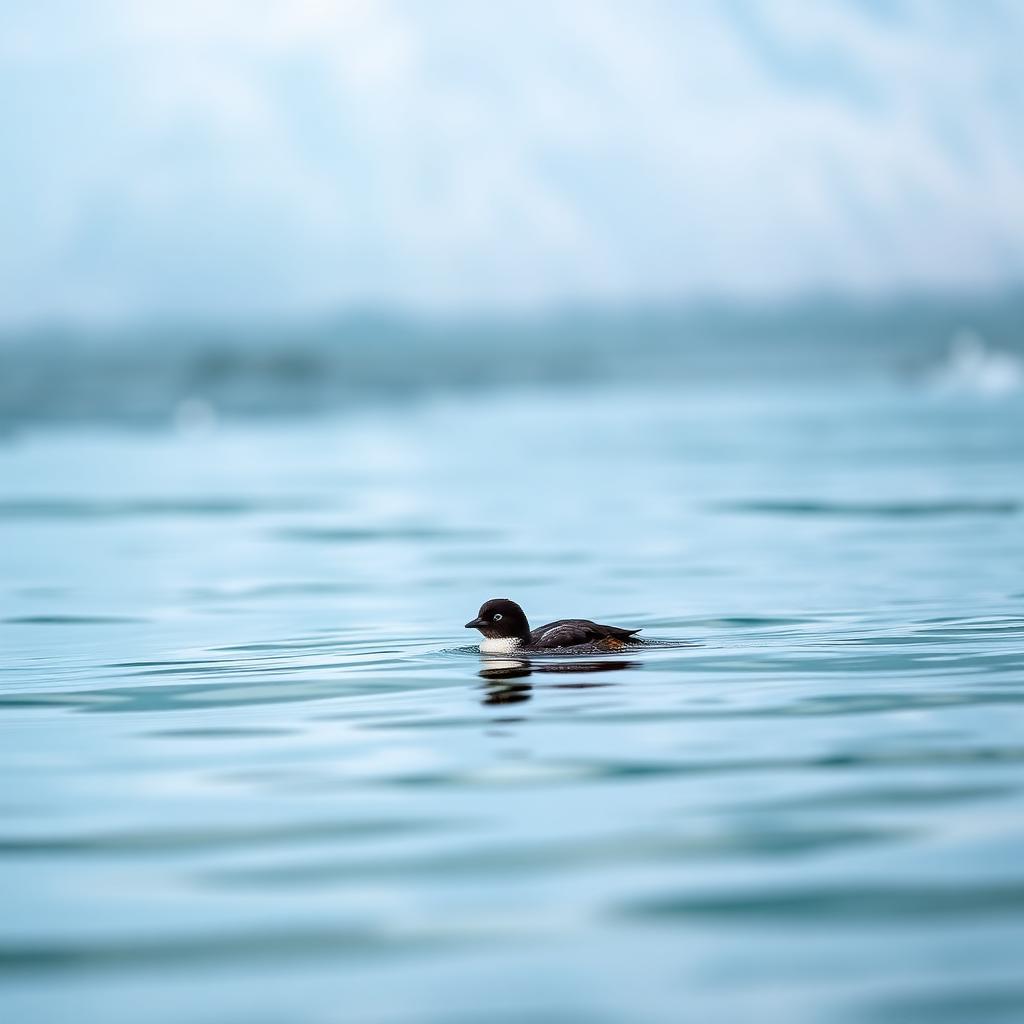
| Scientific name | Brachyramphus brevirostris |
|---|---|
| Length | ≈ 24 cm |
| Range | Coastal Alaska, Aleutians, Russian Far East |
| Diet | Small schooling fish, crustaceans |
| Population | ≈ 30,000 individuals |
| IUCN status | Near Threatened |
A small seabird with a strange nest
Kittlitz's Murrelet (Brachyramphus brevirostris) is a small, cryptic alcid — the family that includes puffins, auks and guillemots — found along the coast of Alaska, the Aleutian Islands and parts of the Russian Far East. Adults in breeding plumage look dappled brown and white, camouflaged for the alpine talus slopes where they nest.
Unlike most seabirds, it does not nest in colonies on cliffs or islands. It lays a single egg on bare rock in high, glaciated mountain terrain, often many kilometres inland.
Life in glacier-fed water
At sea, Kittlitz's Murrelet forages in cold, silty, glacier-fed inlets and fjords. Prince William Sound, Glacier Bay, Icy Bay and Kachemak Bay in Alaska are strongholds, along with parts of the Aleutian chain.
These waters are rich in juvenile fish and crustaceans because glacial meltwater fuels a specific food web. When glaciers retreat, the freshwater input, sediment load and temperature of these fjords all change.
Diet and diving
The species feeds by pursuit-diving to depths of typically 30 metres, targeting capelin, sand lance, juvenile herring and other small schooling fish, plus krill and other crustaceans.
Adults commute between distant nest sites in the mountains and feeding areas in tidewater fjords — one of the longest such commutes among seabirds relative to body size.
A steep post-1990s decline
Surveys in Prince William Sound and Glacier Bay show large declines since the early 1990s, in some areas exceeding 80% over a few decades. Similar declines have been documented in Kachemak Bay and parts of southeast Alaska.
The 1989 Exxon Valdez oil spill in Prince William Sound killed several thousand Kittlitz's Murrelets and remains one of the largest single-event losses documented for the species.
Multiple pressures at once
The strongest suspected long-term driver is climate change and glacier retreat, which alters the very fjord habitats the species depends on. On top of that: oil spills, gillnet bycatch, chronic disturbance from cruise ships in glacier bays, and shifts in forage-fish populations.
Because reproductive rates are low — one egg per year in an exposed nest — populations recover slowly from any single event.
US Fish and Wildlife assessments
The US Fish and Wildlife Service has repeatedly reviewed Kittlitz's Murrelet for Endangered Species Act listing. Recent decisions have kept it off the formal list but flagged it as a species of high conservation concern.
Practical management focuses on limiting oil-spill risk in fjords with core populations, minimising cruise-ship disturbance in glacier bays, and monitoring long-term trends.
A seabird tied to ice
Kittlitz's Murrelet is one of the clearest examples of a species whose fate is bound to a physical feature of the landscape — tidewater glaciers — that is disappearing on human timescales. Protecting it means protecting the specific fjords and mountains where its two-world life still works.
Key takeaways
- Kittlitz's Murrelet is a small Alaskan seabird tied to glacier-fed fjords.
- It nests on bare rock in high alpine terrain, not on cliffs or islands.
- Populations in key areas have declined by more than 80% since the 1990s.
- Glacier retreat, oil spills and bycatch are the dominant threats.
Frequently asked questions
Why is it named after Kittlitz?
The species honours the 19th-century German naturalist Heinrich von Kittlitz, who described several North Pacific seabirds.
How is it different from the Marbled Murrelet?
The Marbled Murrelet nests in old-growth conifer forests along the Pacific coast; Kittlitz's nests on bare alpine rock near glaciers and feeds in glacier-fed water.
How many Kittlitz's Murrelets are there?
Best current estimates place the global population at around 30,000 individuals, with a strong long-term declining trend.
Where can I see one?
Sightings are possible on wildlife cruises in Glacier Bay National Park, Kenai Fjords National Park, and parts of Prince William Sound.
Is it legally protected?
It is protected under the US Migratory Bird Treaty Act, though it has not been listed under the Endangered Species Act to date.
References
Related reading
Snowy Owl: The Arctic Nomad You Cannot Predict
The Snowy Owl is one of the few large birds most people can recognise on sight — and yet almost everything else about it, from where it will spawn to where it will winter, is genuinely hard to predict.
Northern Rockhopper Penguin: The Cliff-Climbing Seabird in Decline
The Northern Rockhopper Penguin has lost around 90% of its population in seventy years. Here is what is happening on the remote islands where it still breeds.