Hooded Grebe: Fighting Decline on Patagonia’s Lakes
On the wind-scoured plateaus of Santa Cruz, colony guardians work to keep a striking grebe from vanishing from the lakes where it breeds.
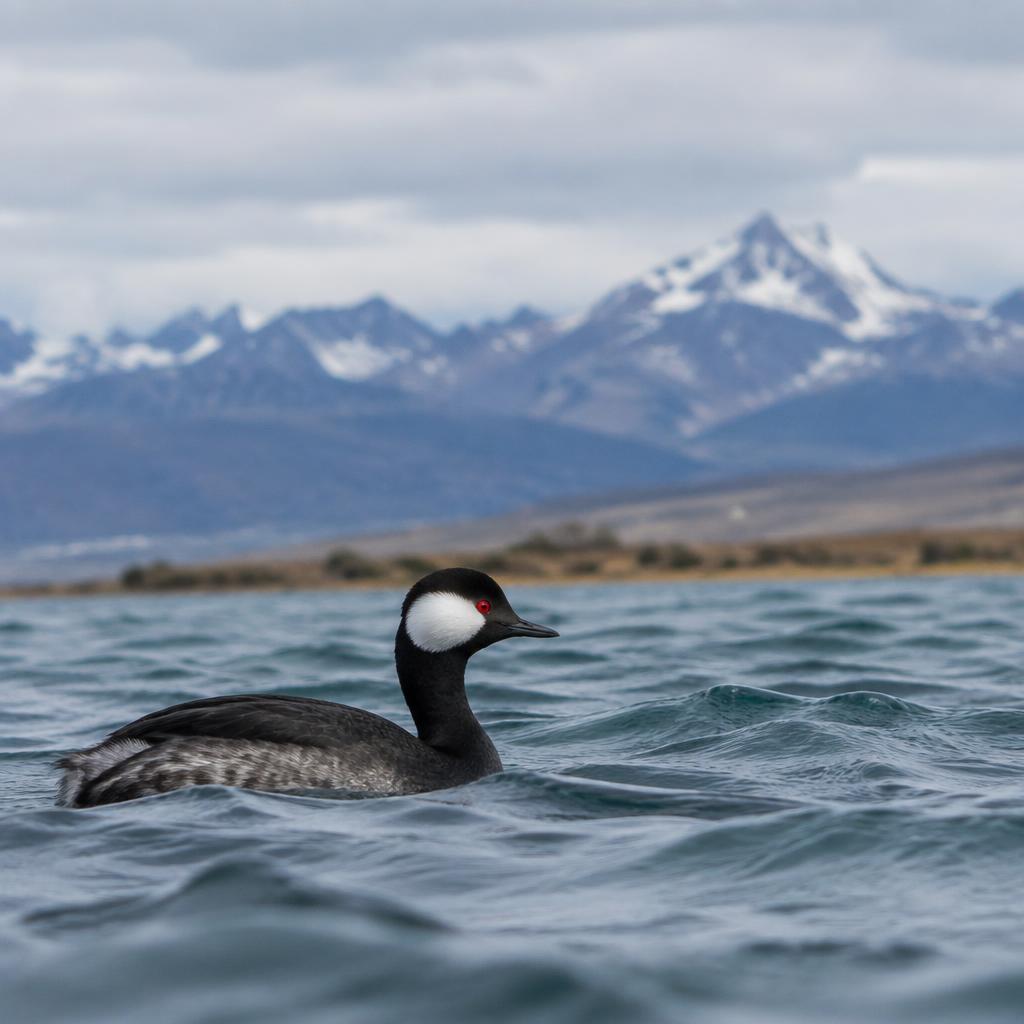
| Scientific name | Podiceps gallardoi |
|---|---|
| Length | About 32 cm |
| Range | Southern Argentina; breeds on Santa Cruz plateaus |
| Population | Roughly 800 adults; approximate, survey-dependent |
| IUCN status | Critically Endangered |
| Habitat | Plateau lakes in summer; coastal estuaries in winter |
| Scientific discovery | 1974 |
A small diver in a hard landscape
Wind runs across a high Patagonian lake, pressing ripples into sharp lines. Among the floating plants, a hooded grebe surfaces and shakes water from its head. Its white face, dark hood and warm crest stand out for a moment before it dives again. This bird is small, but the effort needed to keep its colonies alive is immense.
The hooded grebe, Podiceps gallardoi, is Critically Endangered. Its breeding world lies on the remote plateaus of Santa Cruz in southern Argentina. A steep fall in numbers has left little room for failed seasons. Here, conservation often means staying beside a lake for weeks, watching weather and predators, and acting before a single bad night wipes out a colony.
1974: a late arrival in the field guides
The species was discovered for science in 1974, with Argentine ornithologist Mauricio Rumboll central to its recognition. It had not suddenly appeared. Rather, its remote breeding sites had kept it outside formal scientific records. The plateaus are vast, the weather is harsh and many lakes are difficult to reach. A bird can live in plain sight locally yet remain unknown to the wider scientific world.
That late discovery gives its decline a sharp edge. Within a few decades of being described, the grebe had become an urgent conservation case. In Argentina it is known as the macá tobiano, a name now closely linked with Patagonia’s wildlife. Its striking courtship displays have helped draw public interest. Yet a brief film of dancing birds shows only one part of their lives, leaving out the long stretches of feeding, nest care and exposure to storms.
Why the Santa Cruz plateau lakes matter
Hooded grebes breed on lakes scattered across the high plateaus of Santa Cruz, including the Buenos Aires and Strobel plateaus. Suitable lakes offer more than open water. They need the right depth, food supply and aquatic vegetation. Watermilfoil beds provide a base for floating nests and shelter for the small animals that grebes eat. A lake that looks full from shore may still lack these essentials.
The birds are skilled divers, taking aquatic invertebrates and other small prey below the surface. Their feet sit far back on the body, a useful design for swimming but a poor one for walking on land. Breeding pairs display on the water and anchor nests among plants. Chicks depend on close parental care. A productive colony therefore needs stable conditions for much longer than the few days during which adults choose a nest site.
Lake choice can change between seasons as conditions shift. This makes surveys demanding: an empty site does not always mean the birds that used it have died. Teams must search widely enough to distinguish movement from loss. Repeated counts across the breeding range are far more useful than a single visit to a well-known colony.
An 80 percent decline, with counts to interpret
The species suffered a decline of about 80 percent over roughly a quarter century, according to widely cited conservation accounts. Around 800 adults is a useful broad figure for conveying its small population, not a precise live count. Published reports sometimes refer instead to remaining individuals or breeding pairs. Their dates and counting methods matter, so these figures should not be treated as interchangeable.
The IUCN lists the hooded grebe as Critically Endangered. That status reflects a severe risk of extinction, not proof that every colony is shrinking in every season. Intensive work has helped check losses at protected sites. A good breeding year can bring welcome gains, but it does not erase the effects of past decline. Small populations remain exposed to chance events, and several poor nesting seasons in a row can undo progress made through years of patient fieldwork.
American mink and kelp gulls: different threats
American mink were introduced to southern South America through the fur trade and spread into wild habitats. These strong swimmers can reach grebe colonies and kill adults as well as young. A single mink may kill more birds than it immediately eats. In a small colony, one intrusion can cause losses large enough to matter to the species as a whole.
Kelp gulls pose a different problem. They are native birds, but human food waste can help support larger local numbers. Gulls take eggs and chicks, adding pressure when grebes already face bad weather or poor habitat. The answer is not to label every gull an enemy. Waste management and carefully assessed, lawful action at vulnerable colonies are more useful than broad blame. Mink control likewise needs trained teams, targeted methods and monitoring to limit harm to other wildlife and detect new arrivals.
Trout, wind and drought change the lake itself
Introduced trout can alter the food webs on which nesting grebes depend. Their effects reach beyond simple competition for a meal. Changes in aquatic invertebrates and vegetation can reduce the quality of the floating plant beds used for nesting. Stocking a fishless plateau lake may create a sport fishery while removing features that made it valuable to a threatened bird.
Wind and drought add another layer of risk. Strong waves can break nests apart or wash eggs away. Lower water levels can leave plant beds unsuitable and reduce the number of lakes available for breeding. These are not separate problems with tidy boundaries: birds displaced from one dry lake may crowd into another exposed site. Protecting a network of lakes gives them more options. Keeping natural water systems intact and preventing further harmful fish introductions are therefore as important as guarding the birds themselves.
Aves Argentinas and the colony guardians
Aves Argentinas, working with partners including Ambiente Sur, has made close colony protection a core part of the response. Colony guardians spend the breeding season near remote lakes. They track nesting attempts, watch for predators and collect records that help staff decide where effort is most needed. Their work depends on field skills, supplies, clear procedures and the stamina to remain alert through long spells of rough weather.
Targeted mink control is a key part of this programme. Early detection and action around breeding sites can prevent losses that would be hard to reverse later. Teams also assess other threats and test ways to make nesting safer, including protective structures at selected sites. None of this makes the lake a controlled laboratory. Weather still changes, birds shift sites and predators can return. The value of guardians is their ability to notice those changes quickly and turn careful observation into timely, informed action.
A guardian’s notes also help explain failure. Was a nest lost during a storm, deserted after disturbance or attacked by a predator? Those causes call for different responses. Counting only the final number of chicks would hide that distinction. Good records let teams compare methods, stop work that does not help and direct scarce staff time toward the lakes where intervention has the best chance of saving birds.
A national park is a start, not an endpoint
Argentina established Patagonia National Park in 2014, strengthening protection for key habitat on the Buenos Aires Plateau. It was an important gain for the hooded grebe, but a boundary cannot keep out mink or restore rain. Nor does a breeding reserve cover the full year. In winter the birds move to Atlantic estuaries, where water quality, fishing activity and changes to river flows also deserve attention.
The strongest plan links protected lakes, predator management and safe winter waters. It also measures results: adult survival, fledged young and the return of birds in later seasons matter more than a single dramatic rescue. Long-term funding lets teams keep those records and stay in place when public interest fades. Support Aves Argentinas and its conservation partners, follow responsible local birding guidance and back protection of Patagonia’s freshwater habitats. The grebe needs more than admiration for its dance; it needs safe water through every season.
Key takeaways
- Scientifically discovered in 1974, the hooded grebe breeds on remote plateau lakes in Santa Cruz.
- A decline of about 80 percent left a population often described as roughly 800 adults.
- Mink, gull predation, introduced trout and changing lake conditions act together.
- Colony guardians and targeted mink control can protect breeding attempts, but need sustained support.
- Patagonia National Park is important, yet breeding lakes and winter estuaries both need protection.
Frequently asked questions
When was the hooded grebe discovered?
It was discovered for science in 1974 in southern Argentina. That date marks scientific recognition, not the arrival of the species in Patagonia.
Where does the hooded grebe live?
It breeds on high plateau lakes in Santa Cruz, Argentina, and moves to Atlantic coastal estuaries for winter.
How many hooded grebes remain?
Roughly 800 adults is a useful approximate headline figure. Published estimates differ in date and whether they count adults, all individuals or breeding pairs.
Why are American mink dangerous to the grebe?
These introduced predators can reach floating colonies and kill multiple birds. Even one incursion can severely damage a small colony.
What do colony guardians do?
Teams monitor breeding colonies, record threats and support authorized predator management. Their presence helps conservation staff respond quickly to changing conditions.
Did Patagonia National Park solve the problem?
No. Its creation in 2014 strengthened habitat protection, but predators, lake changes and threats at wintering sites require ongoing work beyond park boundaries.
References
Related reading
Whooping Crane: North America's Tallest Comeback
The Whooping Crane went from 21 birds to more than 800 in eighty years. Here is how — and why the species is still not out of danger.
Black Stilt (Kakī): The World's Rarest Wading Bird
The Black Stilt has all-black plumage, long red legs, and one of the smallest wild populations of any wader on Earth.