Hoatzin: The Stinkbird of the Amazon With Clawed Chicks
The Hoatzin looks like a prehistoric survivor: it eats leaves, ferments them like a cow, and its chicks are born with claws on their wings.
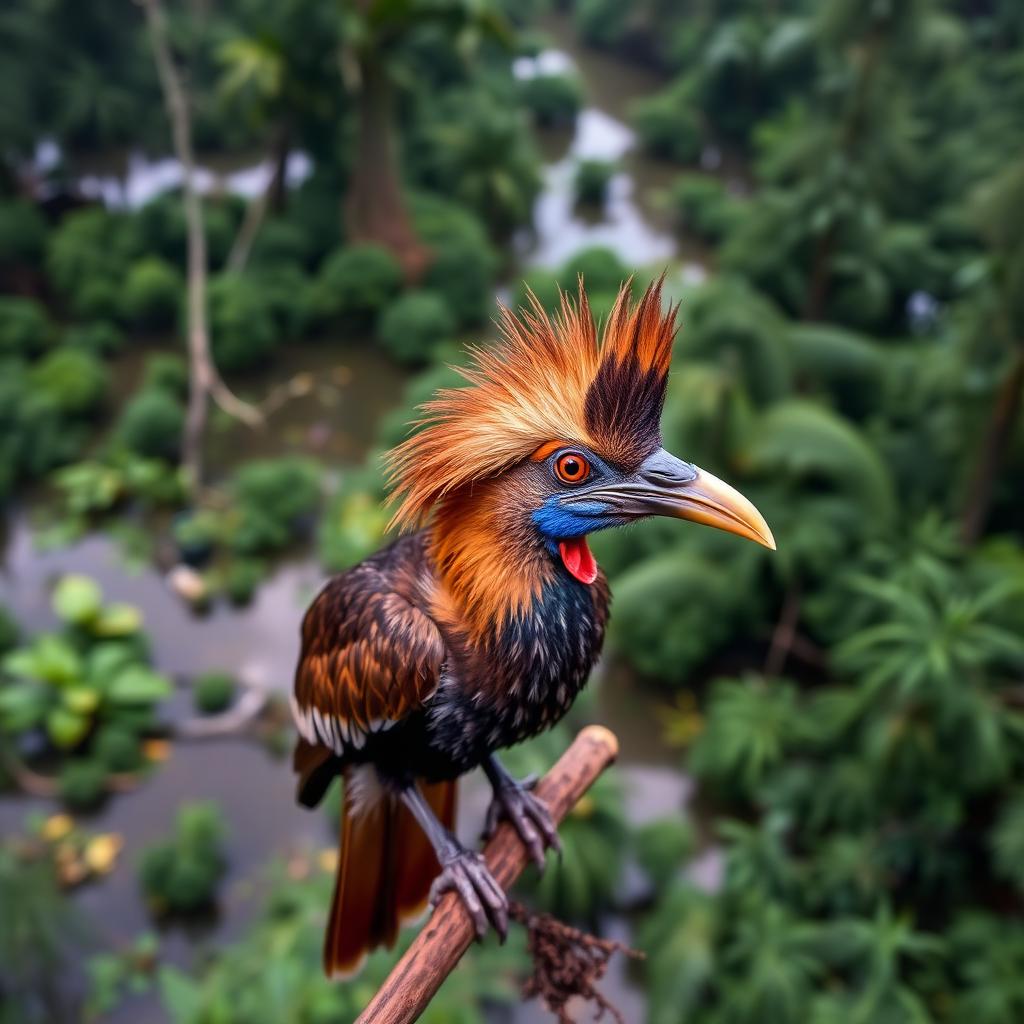
| Scientific name | Opisthocomus hoazin |
|---|---|
| Length | ≈ 65 cm |
| Range | Amazon and Orinoco basins, South America |
| Diet | Leaves, flowers and some fruit (folivorous) |
| Unique trait | Foregut fermentation; clawed nestlings |
| IUCN status | Least Concern |
The bird that looks wrong
The Hoatzin (Opisthocomus hoazin) is one of the most peculiar birds alive. Its face is bare blue skin. Its crest looks like a punk hairstyle. Its eyes are ruby red. And it eats leaves — a diet so unusual for a bird that it has evolved a digestive system unlike any other bird on Earth.
Local people along the Amazon and Orinoco call it 'stinkbird'. The name is accurate and, as it turns out, deeply informative.
Where to find one
The Hoatzin lives across the Amazon and Orinoco basins, from eastern Colombia and Venezuela south through the Guianas, Brazil, Ecuador, Peru and northern Bolivia. It stays close to slow, still water — oxbow lakes, flooded forest, mangrove edges and riverbanks lined with dense vegetation.
You are far more likely to hear one than see one first. Small groups grunt, hiss and croak from the tangle above the water, sounding more like frogs than birds.
A bird that eats leaves
Almost all Hoatzins eat is green leaves, with a smaller share of flowers and fruit. Very few birds do this. Leaves are heavy, low in energy, and full of tough plant chemistry that most vertebrates cannot break down.
The Hoatzin solves this problem the way cows do — with fermentation.
The only bird with a rumen-like gut
Instead of a normal muscular gizzard, the Hoatzin has a huge, folded, muscular crop that acts like the rumen of a cow. Bacteria and other microbes live inside and break down leaf material through fermentation.
The by-products of this fermentation give the bird its famously bad smell — described as anything from fresh manure to sour silage — and its nickname of 'stinkbird'. It also makes Hoatzins clumsy, front-heavy fliers, because so much of their body weight is packed into that oversized digestive organ.
Chicks with claws
The strangest thing about a Hoatzin is not the adult — it is the chick. Newly hatched Hoatzins have two functional claws on each wing.
If a snake, raptor or monkey approaches the nest, the chick drops straight down into the water below, swims underwater to safety, and then hauls itself back up the vegetation using those wing claws and its feet. The claws disappear as the young bird grows.
Not a link to Archaeopteryx
Because of those wing claws, popular articles often call the Hoatzin a 'living dinosaur' or 'living Archaeopteryx'. This is not accurate.
Modern genetic work shows the Hoatzin is a modern bird whose ancestors evolved wing claws independently as a nesting adaptation. It sits alone on its own branch of the bird family tree — so isolated that scientists still argue over its closest living relatives.
Family life in the flooded forest
Hoatzins live in small, cooperative groups. A breeding pair is often helped by grown offspring from previous years, who guard the nest, feed chicks and warn of predators.
Nests are simple platforms of sticks built on branches overhanging water — the exact place a chick can safely drop from when threatened.
Common, but not invincible
The Hoatzin is listed as Least Concern by the IUCN and remains locally common in many parts of its range. Its indigestible, sour meat protects it from most hunting pressure.
That does not mean it is safe forever. Large-scale deforestation, drainage of oxbow lakes, oil spills and river-course changes from dams all threaten the flooded forest habitat it needs. Localised declines have already been noted in parts of Ecuador and Peru.
The Amazon's weirdest gift
The Hoatzin is a reminder that evolution can go in genuinely strange directions. A bird that ferments leaves like a cow, smells like a farmyard and raises clawed, diving chicks — and does all of it in one of the richest ecosystems on the planet.
If you take a river trip in the Amazon or Orinoco, ask your guide about the stinkbird. It might not be the most beautiful bird you see that day, but it will almost certainly be the most extraordinary.
Key takeaways
- The Hoatzin is the only bird that digests leaves through foregut fermentation.
- Its chicks are born with claws on their wings and can swim to safety.
- Adults smell strongly of fermenting plant matter — hence the name 'stinkbird'.
- It lives across the Amazon and Orinoco basins in flooded forest habitat.
- Its closest living relatives remain a genuine mystery in bird evolution.
Frequently asked questions
Why does the Hoatzin smell bad?
Its enlarged crop ferments leaves using microbes, producing volatile compounds similar to those from cattle digestion. The odour clings to the bird's plumage.
Is the Hoatzin related to Archaeopteryx?
No. It is a modern bird. The wing claws on its chicks evolved independently as an anti-predator adaptation and are not evidence of a direct link to Archaeopteryx.
Can Hoatzin chicks really swim?
Yes. When threatened they drop from the nest into the water below, dive and swim to safety, then climb back to the nest using their wing claws.
Is the Hoatzin endangered?
The global population is currently listed as Least Concern, but local populations decline where flooded forest is drained or logged.
Where can I see a Hoatzin?
Reliable places include Ecuador's Cuyabeno Reserve, Peru's Manú and Tambopata regions, and the Orinoco Delta in Venezuela. Look along quiet, slow-moving water.
Do people hunt Hoatzins?
Very rarely. The meat is considered unpalatable, which has spared the species from the hunting pressure faced by other large Amazonian birds.
References
Related reading

The Resplendent Quetzal: Field Guide to Central America's Cloud-Forest Icon
Few birds are more mythologised than the Resplendent Quetzal. Behind the iridescence is a highly specialised cloud-forest species that depends on a single tree family to survive.
Harpy Eagle: The Apex Predator of the Neotropical Rainforest
The Harpy Eagle takes monkeys and sloths from the canopy with talons the size of a grizzly bear's. Yet across most of its range, it is now functionally rare.