Gurney’s Pitta: The Jewel of Thailand’s Rainforest Floor
Presumed extinct for decades, Gurney’s pitta stunned the birding world when it reappeared in 1986. Its lowland forest home is still vanishing — here is the full story.
| Scientific name | Hydrornis gurneyi |
|---|---|
| Length | About 18–20 cm |
| Range | Southern Thailand and southern Myanmar |
| Population | Estimated 1,500–3,000 mature individuals |
| IUCN status | Endangered |
| Habitat | Lowland semi-evergreen rainforest |
| Diet | Insects, worms and other forest-floor invertebrates |
| Rediscovered | 1986, after 34 years without a record |
The Bird That Came Back from the Dead
In 1952, ornithologists recorded a Gurney’s pitta in Thailand — and then, for 34 years, nothing. The bird was widely written off as extinct, another casualty of the rapid clearing of Southeast Asia’s lowland rainforests.
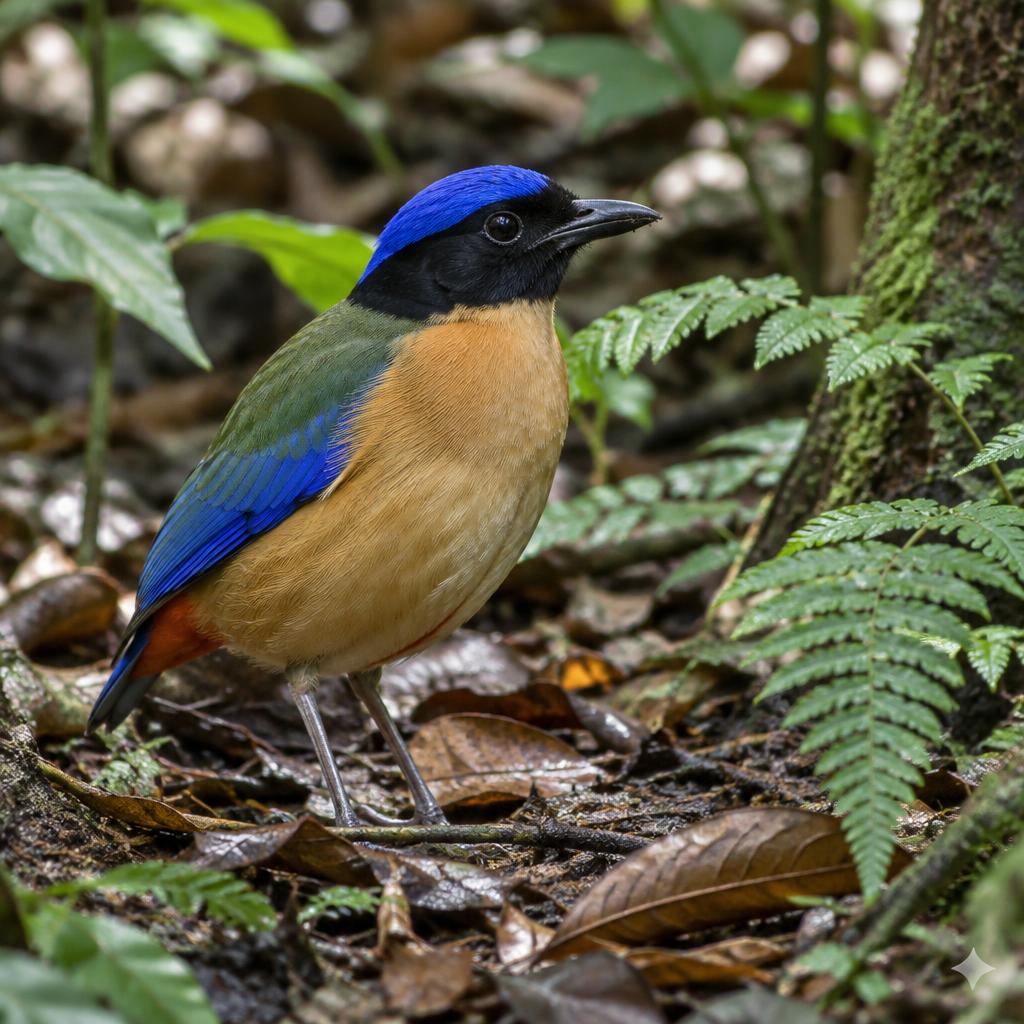
Then, in 1986, a small team searching the forests of Khao Nor Chuchi in Krabi Province heard an unfamiliar call. The bird they found was a male Gurney’s pitta, glowing blue and black and gold on the forest floor. The rediscovery made headlines around the world and turned the species into a flagship for lowland forest conservation.
Today Gurney’s pitta remains one of the most sought-after birds in Asia — and one of the most threatened. This is the story of a jewel of the rainforest floor, and of the race to keep its forest standing.
What Does Gurney’s Pitta Look Like?
Pittas are sometimes called the jewels of the forest, and Gurney’s pitta is among the most beautiful of all. The male wears a brilliant cobalt-blue crown, a velvet-black face and throat, warm buff-yellow underparts, and deep blue wings and tail set against green-tinged upperparts.
The female is more subdued but still handsome, with a buff-brown crown and plainer face pattern. Both sexes share the typical pitta shape: plump body, strong legs, short tail and an upright, almost comical stance as they hop across the leaf litter.
Useful field marks include:
• Male: blue crown, black face, buff underparts, blue wings and tail • Female: browner crown and face, similar body pattern • A clear, whistled call — often the first clue to a bird’s presence • Secretive behaviour: usually seen hopping on the shaded forest floor
Like other pittas, it feeds by flipping leaves and probing the soil for insects, worms and other invertebrates, and it nests in a domed structure of leaves and twigs on or near the ground.
A Home in the Lowland Forest
Gurney’s pitta is a bird of lowland semi-evergreen rainforest — the tall, shady forest that once clothed much of the Thai-Malay Peninsula. It needs flat or gently sloping ground below about 160 metres, with a closed canopy, moist soil and deep leaf litter.
That precise requirement is the heart of the problem. Lowland forest is exactly the habitat most easily cleared for oil palm and rubber plantations, and very little of it survives in peninsular Thailand. The species’ stronghold at Khao Nor Chuchi shrank dramatically through the 1990s and 2000s as plantations expanded around and into the forest.
In recent years, surveys have confirmed that the larger population actually lies across the border in southern Myanmar, where more lowland forest remains — though logging and agricultural expansion threaten it there too. The species’ global population is now estimated at roughly 1,500 to 3,000 mature individuals, split between the two countries.
Why Gurney’s Pitta Is Still at Risk
The overriding threat is habitat loss. Oil palm and rubber plantations have replaced most of the lowland forest within the pitta’s range, and what remains is fragmented into patches too small or too degraded to support many birds.
Other pressures compound the problem:
1. Continued clearing and logging inside and around remaining forest fragments 2. Road building that opens remote forest to settlement and hunting 3. Trapping for the cage-bird trade, which has targeted pittas in parts of Southeast Asia 4. Climate stress on already small, isolated populations
Because the pitta will not live in plantations or heavily degraded forest, every hectare of lowland rainforest lost is a permanent loss of habitat. There is no substitute landscape for this species.
Conservation: From Rediscovery to Recovery
The 1986 rediscovery triggered a remarkable conservation effort. Khao Nor Chuchi was designated a non-hunting area, and Thai conservation groups — working with international partners — launched research, patrols and community programmes to protect the remaining forest.
Key strands of the work include:
• Forest protection and anti-logging patrols around Khao Nor Chuchi • Reforestation and corridor projects to reconnect forest fragments • Community engagement, including local guiding and alternative livelihoods • Surveys in Myanmar that located the species’ main population and identified priority forests for protection
The discovery of the Myanmar population transformed the species’ outlook: it is still Endangered, but no longer clinging to a single tiny site. Conservationists now work on both sides of the border, and birdwatching tourism at Khao Nor Chuchi gives local people a direct stake in the forest’s survival.
The pitta has also become a symbol of what lowland forest protection achieves — the same forest shelters hornbills, tapirs and countless other species that share its home.
Seeing Gurney’s Pitta Responsibly
Khao Nor Chuchi remains one of the most reliable places in the world to see Gurney’s pitta, particularly in the breeding season when males call at dawn. Local guides know the territories and greatly improve your chances while ensuring the birds are not disturbed.
If you plan a visit, a few principles protect both bird and forest:
• Hire a licensed local guide and follow their instructions • Never use excessive call playback, which stresses territorial birds • Stay on trails and keep noise to a minimum • Support community-based tourism that funds forest protection
Seeing a male Gurney’s pitta hop into a shaft of forest light is an experience birdwatchers remember for life — and your visit can help ensure the species survives.
A Second Chance Worth Taking
Gurney’s pitta was given a second chance in 1986. Four decades on, that chance is still alive — but only just. The species’ future depends on a simple equation: keep the lowland forest standing, and the pitta survives; lose it, and no amount of effort elsewhere will bring the bird back.
If this story has captured your imagination, explore our guides to other forest jewels such as the Sri Lanka frogmouth and the Araripe manakin, and consider supporting the organisations protecting Thailand and Myanmar’s last lowland rainforests. The jewel of the forest floor is still shining — let’s keep it that way.
Key takeaways
- Gurney’s pitta is a brilliantly coloured ground-dwelling bird of the Thai-Malay Peninsula.
- It was unrecorded for 34 years and rediscovered at Khao Nor Chuchi in 1986.
- It depends on lowland semi-evergreen rainforest, most of which has been cleared.
- The largest surviving population is in southern Myanmar; the species is Endangered.
- Forest protection, corridors and community tourism are central to its survival.
Frequently asked questions
Was Gurney’s pitta really thought to be extinct?
Yes. After the last confirmed record in 1952, no Gurney’s pitta was seen for 34 years, and many assumed it had died out. Its rediscovery at Khao Nor Chuchi in 1986 was one of the most famous in modern ornithology.
Where does Gurney’s pitta live?
It lives in lowland semi-evergreen rainforest on the Thai-Malay Peninsula, in southern Thailand — chiefly around Khao Nor Chuchi in Krabi Province — and in southern Myanmar, where the larger population survives.
How many Gurney’s pittas are left?
Current estimates suggest roughly 1,500–3,000 mature individuals. The species is listed as Endangered, an improvement from its former Critically Endangered status after the Myanmar population was found.
What does Gurney’s pitta eat?
It forages on the forest floor, flipping leaves and probing the soil for insects, earthworms, snails and other small invertebrates.
Why is lowland rainforest so important for this bird?
Gurney’s pitta needs flat, shady, moist forest below about 160 metres with deep leaf litter. It cannot survive in plantations or heavily degraded forest, so every patch of lowland rainforest lost is lost habitat.
Can tourists see Gurney’s pitta?
Yes, Khao Nor Chuchi in Thailand is one of the best places, especially early in the breeding season. Going with a licensed local guide improves your chances and ensures the birds are not disturbed.
References
Related reading
Sri Lanka Frogmouth: Silent Night Bird of the Western Ghats
The Sri Lanka Frogmouth is a bark-coloured, wide-mouthed night bird so cryptic that most people walk within metres of one without noticing.
Araripe Manakin: Brazil's Rarest Songbird Explained
Discovered in 1996, the Araripe Manakin occupies barely 30 square kilometres of spring-fed forest on one Brazilian plateau. Around 800 birds remain.