Araripe Manakin: Brazil's Rarest Songbird Explained
Discovered in 1996, the Araripe Manakin occupies barely 30 square kilometres of spring-fed forest on one Brazilian plateau. Around 800 birds remain.
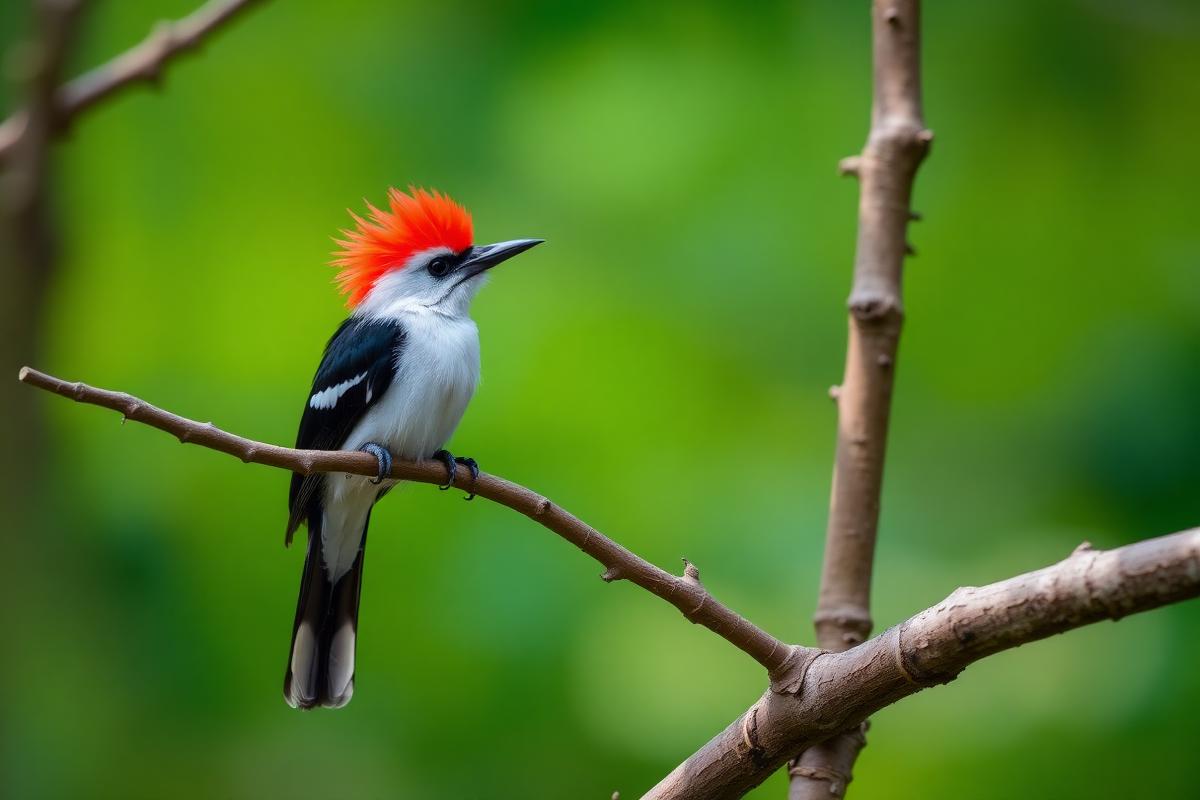
| Scientific name | Antilophia bokermanni |
|---|---|
| Length | About 14 – 15 cm |
| Discovered | 1996, described 1998 |
| Range | Chapada do Araripe, Ceará, Brazil |
| Range size | Roughly 30 – 35 km² |
| Population | Approximately 800 mature birds |
| IUCN status | Critically Endangered |
A bird science missed until 1996
Brazil is one of the best-studied bird countries in the tropics, which makes the Araripe Manakin's story unusual. It was found in 1996 by Weber Girão and Galileu Coelho on the Chapada do Araripe in Ceará, and formally described two years later.
The male is unmistakable: snow-white body, jet-black wings and tail, and a tall red crest running from the bill over the crown and down the nape.
Locally it is known as soldadinho-do-araripe — the little soldier of Araripe — and it has become the symbol of the region.
Identification and voice
Males are white, black and red, and impossible to confuse with anything else in their range.
Females are entirely different: olive-green with a paler belly and a smaller olive crest. Many visitors miss them completely.
The species is small, compact and short-tailed, typical of manakins. Birds usually perch upright at low to mid levels in shaded forest near water.
Calls are quiet and easy to overlook — thin whistles and a soft mechanical trill, delivered from cover rather than an exposed perch.
One narrow band of forest
The Araripe Manakin lives only in humid forest at the base of the Araripe plateau, where springs emerge from the rock and keep the soil wet all year.
This is a striking contrast with the surrounding landscape, which is dry caatinga scrub. The manakin cannot use that habitat; it needs shade, moisture and dense understorey.
Total suitable habitat covers roughly 30 square kilometres, and much of it lies close to the towns of Crato, Barbalha and Missão Velha.
Diet and behaviour
The diet is dominated by small fruits, taken in flight with quick sallies from a perch. Insects supplement the diet, particularly for nestlings.
Unlike many manakins, Araripe Manakins do not display in large communal leks. Pairs occupy territories, and males display in a limited area near the female.
Nesting runs mainly from November to May, matching the wetter months. Females build small cup nests over or near flowing water and raise the young alone.
Threats to survival
The pressure here is unusual: it comes mainly from water and leisure, not logging.
1. Spring capture. Water sources are diverted for agriculture and for recreational parks and swimming areas, drying the forest floor the birds need.
2. Land conversion. Banana and sugarcane plots replace understorey vegetation at forest edges.
3. Urban expansion. Housing and roads around Crato and Barbalha fragment the strip of forest into disconnected pieces.
4. Fire and drought. Prolonged droughts in the region reduce spring flow and increase fire risk.
Conservation progress
The Oásis Araripe reserve, created by Aquasis with support from international partners, protects a core section of manakin habitat and continues to expand through land purchase.
Nest monitoring has run for years, giving one of the better long-term datasets for a critically endangered Neotropical bird. Researchers have used it to show how closely breeding success tracks water availability.
Municipal environmental protection zoning now limits some development, and the bird's status as a regional emblem gives conservationists real political weight in local planning debates.
Where and how to see one
The Oásis Araripe reserve near Crato offers organised access and is by far the best place to look. Guides know the reliable territories.
Practical notes:
• Early morning gives the best activity, before heat pushes birds into deep shade.
• Stay on trails; the understorey is exactly what nesting females use.
• Visit in the wet season — roughly December to April — for peak breeding activity.
A species with nowhere else to go
The Araripe Manakin has one of the smallest ranges of any bird on earth, and it depends on something as ordinary as water flowing out of a hillside. Protect the springs and the forest around them, and the species has a genuine future.
Support Aquasis and the Oásis Araripe reserve, visit responsibly if you travel to Ceará, and share this profile to widen the audience for one of Brazil's most striking endemics.
Key takeaways
- The Araripe Manakin was only discovered in 1996 in Ceará, Brazil.
- Its entire range is roughly 30 square kilometres of spring-fed forest.
- About 800 mature birds are thought to survive.
- Water diversion for farming and recreation is the primary threat.
- The Oásis Araripe reserve protects the core breeding habitat.
Frequently asked questions
How many Araripe Manakins are left?
Recent surveys suggest around 800 mature individuals, restricted to the Chapada do Araripe in Ceará, Brazil.
Why do females look so different?
The species is strongly sexually dimorphic. Females are olive-green for camouflage while incubating, since they nest and raise chicks alone.
Where can I see an Araripe Manakin?
The Oásis Araripe reserve near Crato, Ceará, is the most accessible and reliable location, with local guides available.
What does the Araripe Manakin eat?
Mostly small fruits taken on the wing, plus insects — especially when feeding nestlings.
Why is the species so restricted?
It needs permanently humid forest fed by plateau springs. The surrounding caatinga scrub is far too dry for it.
When was it discovered?
It was found in 1996 and formally described as a new species in 1998, one of the last major Brazilian bird discoveries of the century.
References
Related reading
Long-wattled Umbrellabird: The Cloud Forest's Strangest Cotinga
The male Long-wattled Umbrellabird looks less like a cotinga than an eccentric priest — jet black, with a pompadour crest and a feathered wattle that hangs a third of a metre from his throat.
Marvelous Spatuletail: The Hummingbird With Two Racket Tails
The Marvelous Spatuletail carries two long tail rackets it whips in front of its body. It lives in one narrow valley in northern Peru.