Great Indian Bustard: The Desert Giant Losing the Sky
The Great Indian Bustard once ranged across half a continent. Today, fewer than 150 survive, and powerlines across the Thar Desert are killing them faster than they breed.
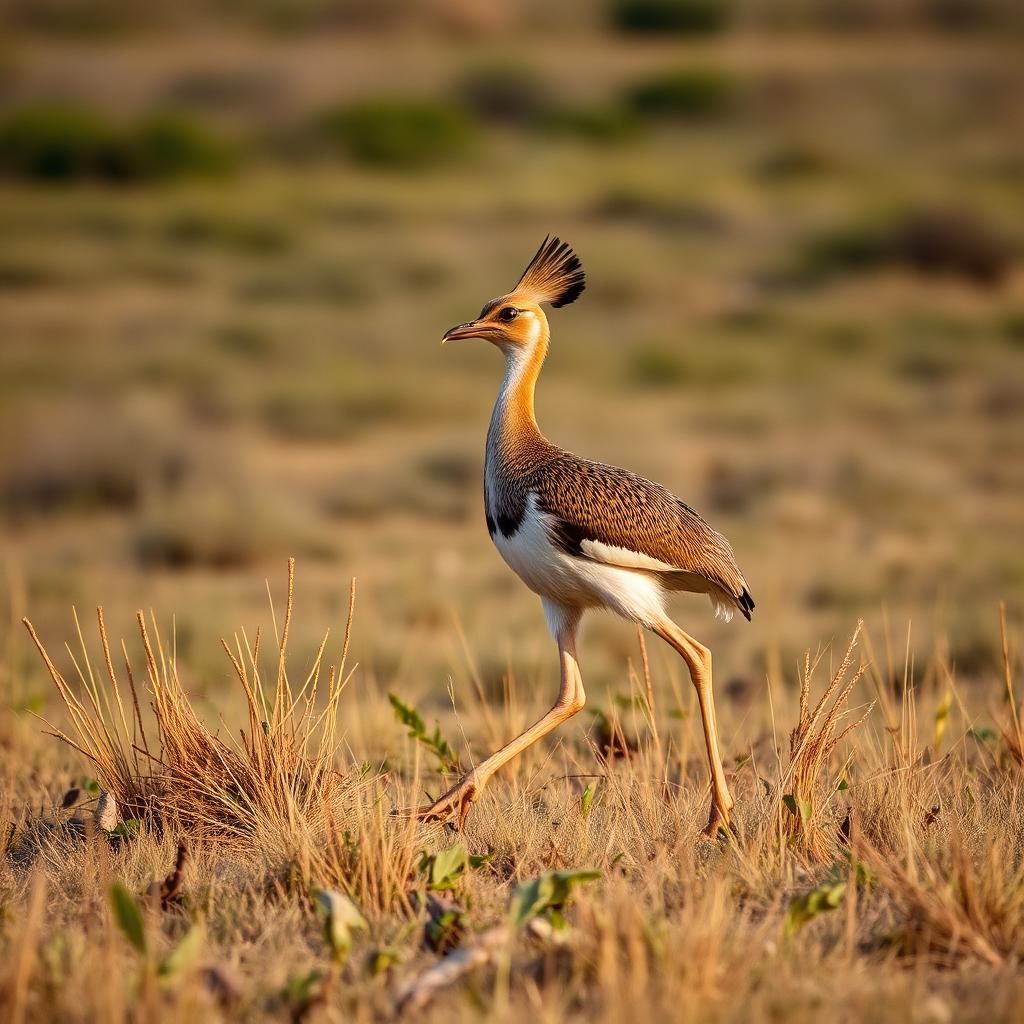
| Scientific name | Ardeotis nigriceps |
|---|---|
| Height | ≈ 1 m |
| Weight | Up to 15 kg (one of the heaviest flying birds) |
| Range | Thar Desert (Rajasthan, Gujarat); tiny populations elsewhere |
| Diet | Insects, seeds, small reptiles, crops |
| Population | ≈ 100–150 mature individuals |
| IUCN status | Critically Endangered |
One of the world's heaviest flying birds
The Great Indian Bustard (Ardeotis nigriceps) is a tall, ground-dwelling bird of open grassland and semi-desert, standing about a metre high with a broad buff body, long grey neck and black crown. Adult males can weigh 15 kg — placing it among the heaviest flying birds in the world.
It once occurred across much of India and eastern Pakistan. Today, fewer than 150 mature birds survive, almost all of them in Rajasthan's Thar Desert.
A range collapsed to a corner
The last stronghold is a landscape of grassland, fallow field and low scrub around the Desert National Park in Jaisalmer, Rajasthan. A tiny outlier population persists in Kutch, Gujarat, and single males are occasionally reported from Maharashtra and Karnataka.
Fifty years ago the species was still breeding in nine Indian states. That range has effectively collapsed to two.
Slow breeding, low tolerance
Great Indian Bustards are slow breeders even by bustard standards. Females lay a single egg on the bare ground, incubate it alone, and take at least 12 months to fledge and raise a chick. In many years, breeding success across the whole population is measured in just a handful of chicks.
This means the species cannot absorb high adult mortality. Any factor that removes even a few adults per year has an outsized effect.
Why powerlines are the emergency
The Thar Desert has become one of India's largest renewable-energy zones, with vast solar and wind farms connected by hundreds of kilometres of high-voltage overhead lines. Great Indian Bustards fly heavily, low, and with a narrow forward field of vision — a combination that makes powerlines almost invisible to them in flight.
A 2020 Wildlife Institute of India study estimated that powerlines kill up to 15% of the remaining population every year. In 2021, the Supreme Court of India ordered undergrounding of powerlines in priority bustard habitat, though implementation has been slow.
Captive breeding in Desert National Park
The Wildlife Institute of India and Rajasthan Forest Department run a captive-breeding facility in the Desert National Park, taking wild eggs, hatching them under controlled conditions and hand-rearing the chicks. The first captive-bred birds hatched in 2019 and the programme has since produced several successful cohorts.
This buys time. But without powerline mitigation, releasing captive-bred birds into the same landscape will simply feed the same mortality sink.
A last-decade species
The Great Indian Bustard is one of the clearest examples in the world of a species that can still be saved this decade but almost certainly not the next, if renewable-energy infrastructure and bustard habitat are not reconciled. It is a hard, specific engineering problem — and time is short.
Key takeaways
- Fewer than 150 Great Indian Bustards remain, mostly in Rajasthan.
- It is one of the heaviest flying birds in the world.
- Powerlines in the Thar Desert kill an estimated 15% of the population per year.
- A captive-breeding programme in Desert National Park is producing chicks since 2019.
Frequently asked questions
How many Great Indian Bustards are left?
The most recent estimates suggest between 100 and 150 mature individuals, the great majority in Rajasthan.
Why are powerlines such a problem?
The species is heavy, flies low, and has poor forward vision, so it does not detect thin overhead wires until it is too late. Collisions are the leading cause of adult mortality.
Where can I see a Great Indian Bustard?
The most reliable option is Desert National Park near Jaisalmer, Rajasthan, ideally with a licensed forest-department guide during the cooler months.
Is captive breeding working?
Chicks have been successfully hatched and reared since 2019. It is an important insurance measure but cannot replace fixing the powerline mortality problem in the wild.
Is it the same as the MacQueen's Bustard?
No. The Great Indian Bustard is much heavier and darker, and is a resident of Indian grasslands, while MacQueen's Bustard is a Central Asian migrant that reaches western India in winter.
References
Related reading
The Grey Crowned Crane: Africa's Golden-Crowned Wetland Icon
With its glowing straw-coloured crown and pale blue eyes, the Grey Crowned Crane is one of Africa's most recognisable birds — and one of its most rapidly declining wetland species.
Bengal Florican: The Grassland Bustard on the Brink
Fewer than 1,000 Bengal Floricans remain across two continents. Here is what makes this small bustard extraordinary, and why its grasslands must be saved.