Bengal Florican: The Grassland Bustard on the Brink
Fewer than 1,000 Bengal Floricans remain across two continents. Here is what makes this small bustard extraordinary, and why its grasslands must be saved.
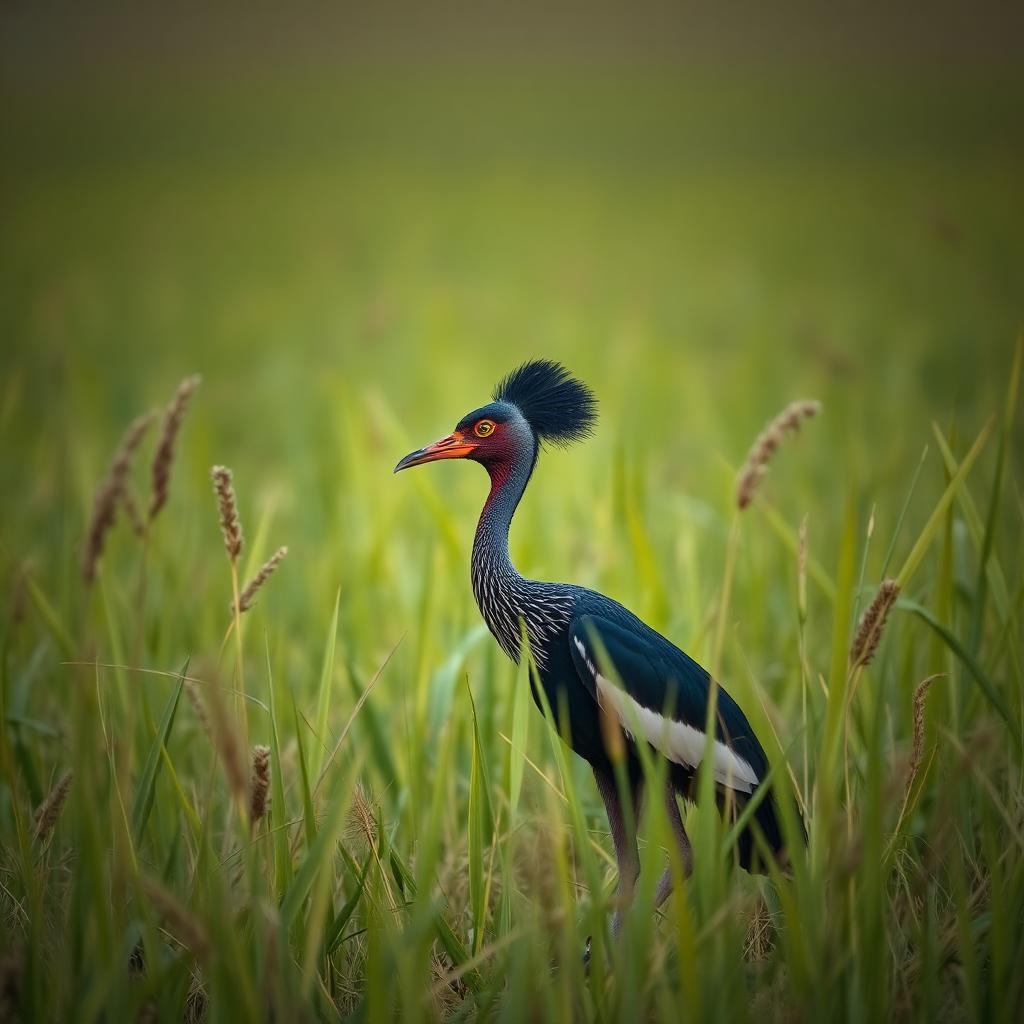
| Scientific name | Houbaropsis bengalensis |
|---|---|
| Length | ≈ 66 cm |
| Range | Terai grasslands (India/Nepal); Tonle Sap floodplain (Cambodia) |
| Diet | Insects, seeds, small vertebrates |
| Population | ≈ 700–900 mature individuals |
| IUCN status | Critically Endangered |
A grassland bird almost no one sees
The Bengal Florican (Houbaropsis bengalensis) is a small, secretive bustard of tall grassland. Males are jet black with contrasting white wing patches; females are cryptic, buff and streaked. Both are hard to see except in the brief display season, when males leap vertically above the grass.
With fewer than 1,000 mature birds across its entire global range, the species is one of the rarest bustards on Earth, and possibly the rarest.
Two populations, one problem
There are two disjunct populations. The northern population lives along the Terai — a belt of tall alluvial grassland at the foot of the Himalayas — from Uttar Pradesh through Nepal, Bhutan and Assam. The southern population lives on the seasonally flooded grasslands around Cambodia's Tonle Sap lake.
Both populations depend on tall (>1 m) grassland with a mosaic of shorter patches for display. Both types of grassland are among the most heavily converted habitats in Asia — to agriculture, dry-season rice, plantations, and settlements.
The extraordinary leap display
In March–May, male Bengal Floricans perform one of the most theatrical displays in the bird world. From a small patch of shorter grass, a male leaps 2–3 metres straight up, hangs for a second with wings whirring, and drops back down. He repeats this every few minutes at dawn and dusk.
The display advertises the male to females at long range across the flat grassland — a signal that only works if the grassland stays open and unfragmented.
Why the numbers keep falling
The main threat is grassland conversion. In the Terai, cattle grazing pressure and shrub encroachment have degraded the tall-grass mosaic; in Cambodia, more than 50% of Bengal Florican habitat around Tonle Sap has been converted to dry-season rice in the last two decades.
Additional threats include electrocution and collision with power lines, egg collection, and — in Cambodia — direct hunting for meat and the pet trade.
Community-managed grasslands
In Cambodia, a network of Bengal Florican Conservation Areas covering more than 300 km² was established from 2006 onwards, in partnership with local communities. Landowners are paid annual incentives to leave grassland unploughed during the breeding season.
In India, key sites include Manas National Park, Kaziranga, and Dudhwa; Nepal's Shuklaphanta and Chitwan National Parks hold the largest remaining northern population. Coordinated tall-grass burning and grazing regimes are being tested in several of these reserves.
A bustard worth stopping for
The Bengal Florican is small, secretive, and easy to overlook — which is exactly why its grassland has been treated as wasteland. Saving it means treating Asian tall grasslands as a globally important habitat in their own right, not merely land waiting to be ploughed.
Key takeaways
- Fewer than 1,000 mature Bengal Floricans remain worldwide.
- It survives in two disjunct populations: Terai grasslands and Tonle Sap floodplain.
- Males perform a spectacular vertical leap display each spring.
- Grassland conversion, powerlines and hunting are its main threats.
Frequently asked questions
How many Bengal Floricans are left?
The most recent estimates place the global population at 700 to 900 mature individuals across India, Nepal and Cambodia.
Where can I see a Bengal Florican?
Manas and Kaziranga in India, Shuklaphanta and Chitwan in Nepal, and the Bengal Florican Conservation Areas of the Tonle Sap floodplain in Cambodia.
Why does the male leap into the air?
The leap display advertises males to females across flat, tall grassland. It works only because the grassland is open enough for the flash of white wing to be seen at distance.
Is the Bengal Florican the same as the Lesser Florican?
No. Both are Indian grassland bustards, but the Bengal Florican (Houbaropsis bengalensis) is a different species from the Lesser Florican (Sypheotides indicus), which occurs mostly further west and south.
What is the biggest threat?
Conversion of tall grassland to agriculture, especially dry-season rice on the Tonle Sap floodplain in Cambodia.
References
Related reading
The Grey Crowned Crane: Africa's Golden-Crowned Wetland Icon
With its glowing straw-coloured crown and pale blue eyes, the Grey Crowned Crane is one of Africa's most recognisable birds — and one of its most rapidly declining wetland species.
Great Indian Bustard: The Desert Giant Losing the Sky
The Great Indian Bustard once ranged across half a continent. Today, fewer than 150 survive, and powerlines across the Thar Desert are killing them faster than they breed.