The Golden Pheasant: A Complete Species Profile
Vivid, secretive and easier to hear than to see, the Golden Pheasant is one of the most photographed and least understood birds native to central China.
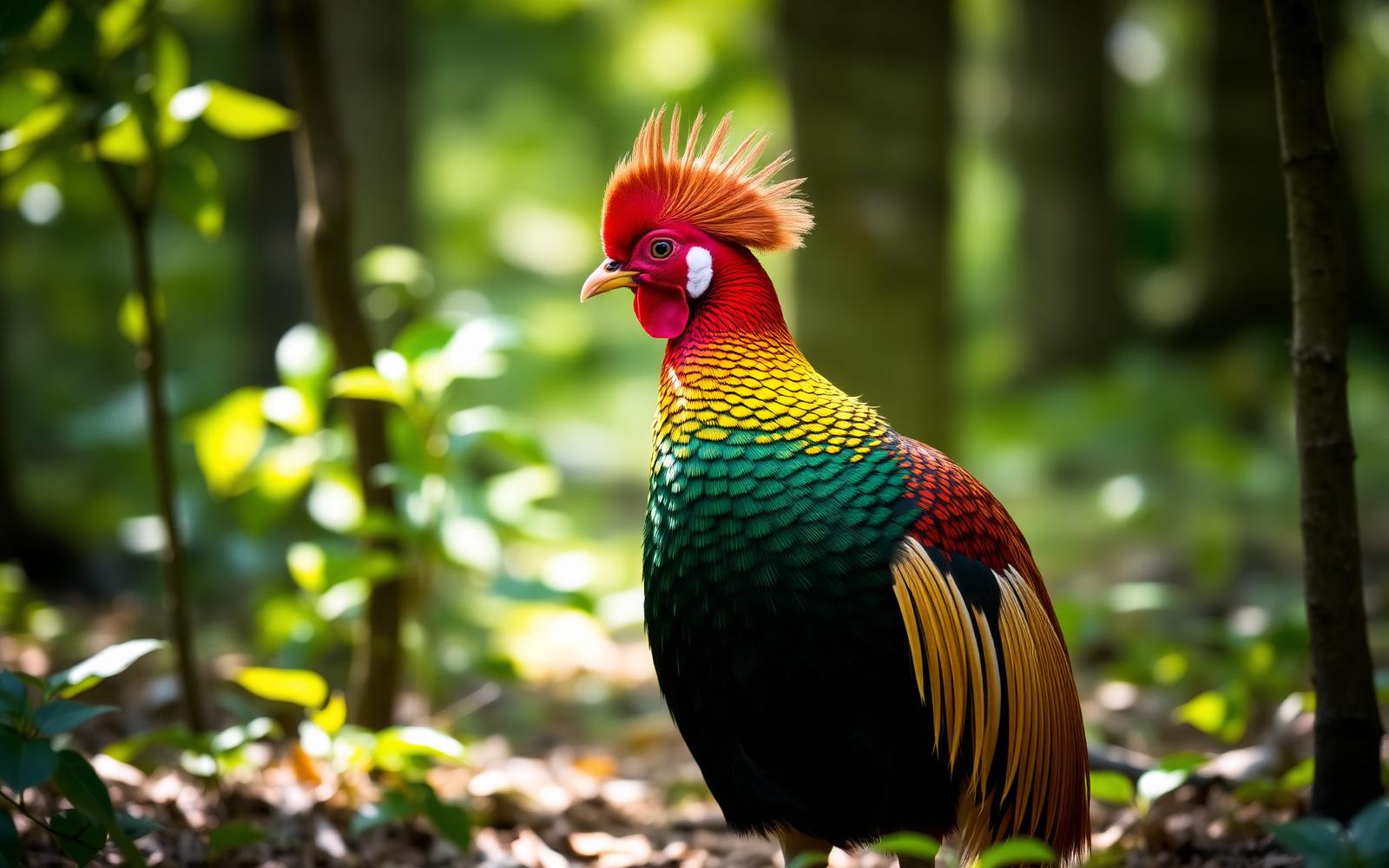
| Scientific name | Chrysolophus pictus |
|---|---|
| Length (male) | 90 – 105 cm inc. tail |
| Native range | Central China |
| Habitat | Dense mountainous forest, 600 – 2,700 m |
| Diet | Seeds, leaves, berries, insects |
| IUCN status | Least Concern (native), but hard to survey |
| Introduced range | UK, small European populations |
One of the most striking birds in Asia
The Golden Pheasant (Chrysolophus pictus) is a medium-sized gamebird native to the mountainous conifer and mixed forests of central China. The male's plumage — a fan of gold on the crown, a black-barred orange cape, a scarlet body and a long buff-and-black tail — has made it one of the most familiar 'exotic' birds in field guides worldwide.
The female is far more subtle: a mottled brown, well camouflaged among leaf litter. This dimorphism is typical of forest pheasants and reflects the reproductive division of labour — males display, females incubate.
Where the Golden Pheasant lives
In its native range, the Golden Pheasant occupies dense, steep forest between roughly 600 and 2,700 metres in elevation. Strongholds include the mountains of Gansu, Shaanxi, Sichuan and Hubei provinces. Populations are notoriously hard to survey because the birds spend most of their day on foot in thick undergrowth.
Small feral populations exist in the United Kingdom — descended from ornamental releases in the 19th and early 20th centuries — but these have declined sharply, and recent surveys suggest fewer than 100 birds remain in the UK.
Behaviour and diet
Golden Pheasants are ground foragers. Their diet is broad: seeds, young leaves of bamboo, ferns, berries, invertebrates and occasionally small vertebrates. Roosting happens high in trees, which is why the species is often heard calling at dusk but rarely seen at ground level in the middle of the day.
They are wary, fast on foot, and generally prefer to run rather than fly. In flight they are noisy and clattering, and they rarely cover long distances.
The famous courtship display
The male's courtship is one of the most photographed sequences in Chinese wildlife filmmaking. He circles the female with the golden cape spread over the eye nearest her, presenting a wall of iridescent orange and black at close range. Head cocks are sharp and quick; the bright-red iris almost seems to change size as the bird tilts.
The display is stationary — no leks, no long flights. This makes the Golden Pheasant a rare example of a strongly ornamented bird whose entire mating strategy resolves in a two-metre arena.
Status and threats
The IUCN lists the Golden Pheasant as Least Concern, but this rating reflects difficulty of surveying more than proven abundance. Native populations face habitat fragmentation from logging and infrastructure, and the species is still trapped in some areas for the caged-bird market.
Introduced UK populations are a curiosity, not a conservation success story: they have declined without new releases, and are likely to disappear this century.
Beautiful, but not invincible
The Golden Pheasant is a reminder that a species can be spectacular, widely kept in aviculture and — in its native range — genuinely difficult to see. Protecting Chinese montane forest is what keeps this species Least Concern rather than something worse.
Key takeaways
- The Golden Pheasant is native to central Chinese montane forest, not the UK.
- Males use a static close-range courtship display, not a lek.
- IUCN Least Concern status reflects survey difficulty, not proven abundance.
- Introduced UK populations are declining and near local extinction.
Frequently asked questions
Where do Golden Pheasants come from?
Golden Pheasants are native to the mountainous forests of central China. All populations elsewhere descend from captive or feral releases.
Are Golden Pheasants endangered?
In their native Chinese range they are listed as Least Concern by the IUCN, though difficult to survey. Introduced UK populations are declining sharply.
Can Golden Pheasants fly?
Yes, but poorly and reluctantly. They prefer to run and typically fly only in short, clattering bursts when startled or to reach a night roost.
What do Golden Pheasants eat?
Their diet is omnivorous — seeds, leaves, bamboo shoots, berries, insects and occasionally small vertebrates foraged from the forest floor.
Are Golden Pheasants and Lady Amherst's Pheasants related?
Yes. Both belong to the genus Chrysolophus and can hybridise in captivity. Lady Amherst's Pheasant is native to south-west China and Myanmar.
References
Related reading
The Resplendent Quetzal: Field Guide to Central America's Cloud-Forest Icon
Few birds are more mythologised than the Resplendent Quetzal. Behind the iridescence is a highly specialised cloud-forest species that depends on a single tree family to survive.
Victoria Crowned Pigeon: The Regal Ground Dweller of New Guinea
The Victoria Crowned Pigeon is the largest pigeon on Earth and carries a lace-like blue crest that looks designed rather than evolved.