Giant Ibis: Cambodia's Vanishing National Bird
The Giant Ibis is the largest ibis in the world and one of Southeast Asia's most endangered birds, with a wild population estimated below 200 adults.
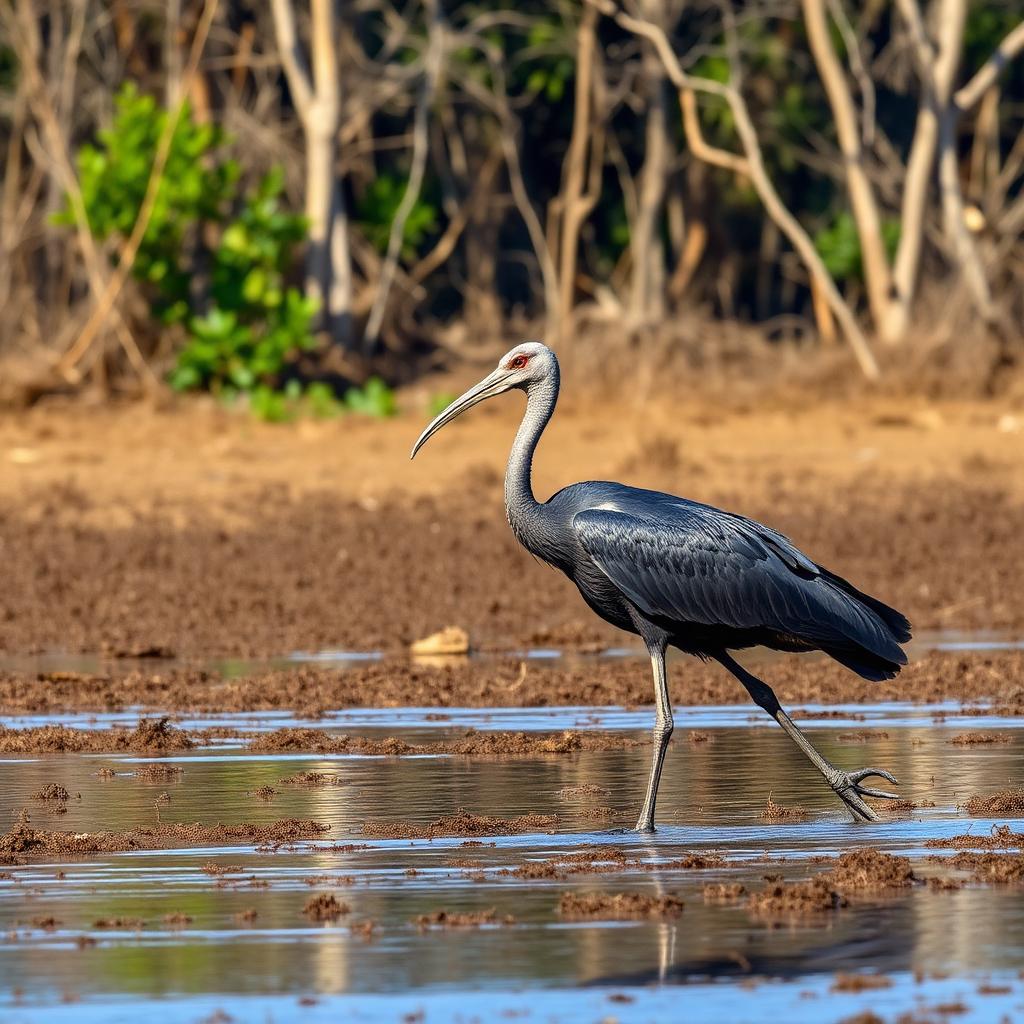
| Scientific name | Thaumatibis gigantea |
|---|---|
| Length | 102 – 106 cm |
| Range | Northern Cambodia; tiny numbers in Laos |
| Habitat | Seasonal wetlands & dry dipterocarp forest |
| Population | ~100 – 200 mature adults |
| IUCN status | Critically Endangered |
A giant on the edge
The Giant Ibis (Thaumatibis gigantea) stands more than a metre tall and is the largest ibis species on Earth. It is also one of the rarest, with likely fewer than 200 mature adults left in the wild.
Cambodia is its final stronghold. The bird's fate is now tied almost entirely to a handful of protected areas in the country's Northern Plains.
What it looks like
Adults are dark greyish-brown overall, with a bare, blackish head marked by pale bars on the nape. The bill is long, heavy and yellowish, and the legs are orange-red.
In flight the wings look surprisingly broad, and the bird's slow, deliberate wingbeats are often described as almost prehistoric.
Where it lives
The species survives mainly in northern and eastern Cambodia, with a few birds hanging on in adjacent southern Laos and possibly Vietnam. Key sites include the Northern Plains around Preah Vihear and Kulen Promtep, the Western Siem Pang area and parts of the Mondulkiri protected forest complex.
Its habitat is a mosaic of dry dipterocarp forest and seasonal wetlands known locally as 'trapeangs' — shallow pools that fill in the wet season and shrink to muddy hunting grounds in the dry season.
Diet and behaviour
Giant Ibises probe soft mud and leaf litter for frogs, crabs, molluscs, worms, insects and small reptiles. They are largely solitary or seen in pairs and small family groups.
They are shy and quickly leave disturbed sites, which makes them extremely difficult to survey in remote forest.
Voice
Adults give a distinctive loud, sad-sounding 'a-leurk a-leurk' call, especially at dawn. Local rangers use these calls as one of the most reliable ways to detect the species in dense forest.
Why the species is in trouble
The Giant Ibis has been hit by almost every threat a large forest bird can face: hunting for meat, egg collection, drainage and conversion of seasonal wetlands, and the loss of large old trees needed for nesting.
Rapid infrastructure development, illegal logging and expansion of agriculture across Cambodia's Northern Plains continue to eat into the last strongholds.
The response
The Wildlife Conservation Society, BirdLife International and Cambodian authorities run a package of measures: nest protection with local guardians, community-based ecotourism, ranger patrols and 'ibis rice' — a certified rice scheme that pays farmers a premium for practices that keep habitat intact.
These programmes have stabilised some local populations, but the total wild figure has not meaningfully increased in the last decade.
Where to see one
The most accessible viewing site is around the Tmatboey ecolodge in Preah Vihear Province, where community guides can lead visitors to known feeding areas.
Trips are best in the late dry season, when birds concentrate at the last remaining trapeangs.
A national symbol worth its weight
The Giant Ibis is Cambodia's national bird. Losing it would not just be a scientific tragedy — it would strip the country of a living symbol of its wild forests. Supporting ibis rice, community ecotourism and reputable conservation NGOs is one of the most direct ways travellers and readers anywhere in the world can help keep Thaumatibis gigantea from slipping off the map.
Key takeaways
- The Giant Ibis is the world's largest ibis species.
- Cambodia holds nearly the entire remaining wild population.
- It depends on seasonal wetlands within dry dipterocarp forest.
- It is Critically Endangered, with likely fewer than 200 adults.
- Community-based schemes like ibis rice are central to its survival.
Frequently asked questions
How many Giant Ibis are left?
Best current estimates place the wild population at around 100 to 200 mature adults, almost all in Cambodia.
Why is it Cambodia's national bird?
It was declared Cambodia's national bird in 2005 to raise awareness of the country's biodiversity and the species' plight.
Where can I see one?
The Tmatboey ecolodge in Preah Vihear Province is the most reliable, well-managed site for wild Giant Ibis sightings.
What is 'ibis rice'?
Rice grown by farmers around Giant Ibis habitat under a certification scheme that requires wildlife-friendly practices; buyers pay a premium that goes to the community.
Do Giant Ibis migrate?
No, they are largely resident, moving locally between wet-season and dry-season feeding sites.
Is it hunted for food?
Historically yes, and illegal hunting still occurs. Ranger patrols and community incentives are now the main tools used to reduce it.
References
Related reading
Bengal Florican: The Grassland Bustard on the Brink
Fewer than 1,000 Bengal Floricans remain across two continents. Here is what makes this small bustard extraordinary, and why its grasslands must be saved.
Whooping Crane: North America's Tallest Comeback
The Whooping Crane went from 21 birds to more than 800 in eighty years. Here is how — and why the species is still not out of danger.