Galápagos Penguin: How a Penguin Survives at the Equator
Cold water, shaded lava cracks, and flexible breeding keep this small equatorial penguin alive in a place that often turns hostile.
| Scientific name | Spheniscus mendiculus |
|---|---|
| Length | About 49–53 cm |
| Range | Galápagos Islands, Ecuador |
| Population | Often estimated at roughly 1,200–2,000 birds; varies by year and method |
| IUCN status | Endangered |
| Core islands | Isabela and Fernandina |
| Diet | Small schooling fish |
A penguin on the warm side of the map
A small penguin stands on black lava while the equatorial sun heats the shore. It looks out of place only if we think all penguins need ice. The Galápagos penguin, Spheniscus mendiculus, needs something more precise: cool, productive water close to safe places on land. In the western Galápagos, those conditions can meet within a short swim.
This is the only penguin whose natural range extends north of the equator. Most of its world lies around Isabela and Fernandina, with smaller groups elsewhere in the archipelago. Its survival depends on events both close and distant: shade inside a rock crack, fish moving through a bay, and changes in the Pacific that can strip food from the coast. A small range makes each of those forces matter.
Recognising the Galápagos penguin
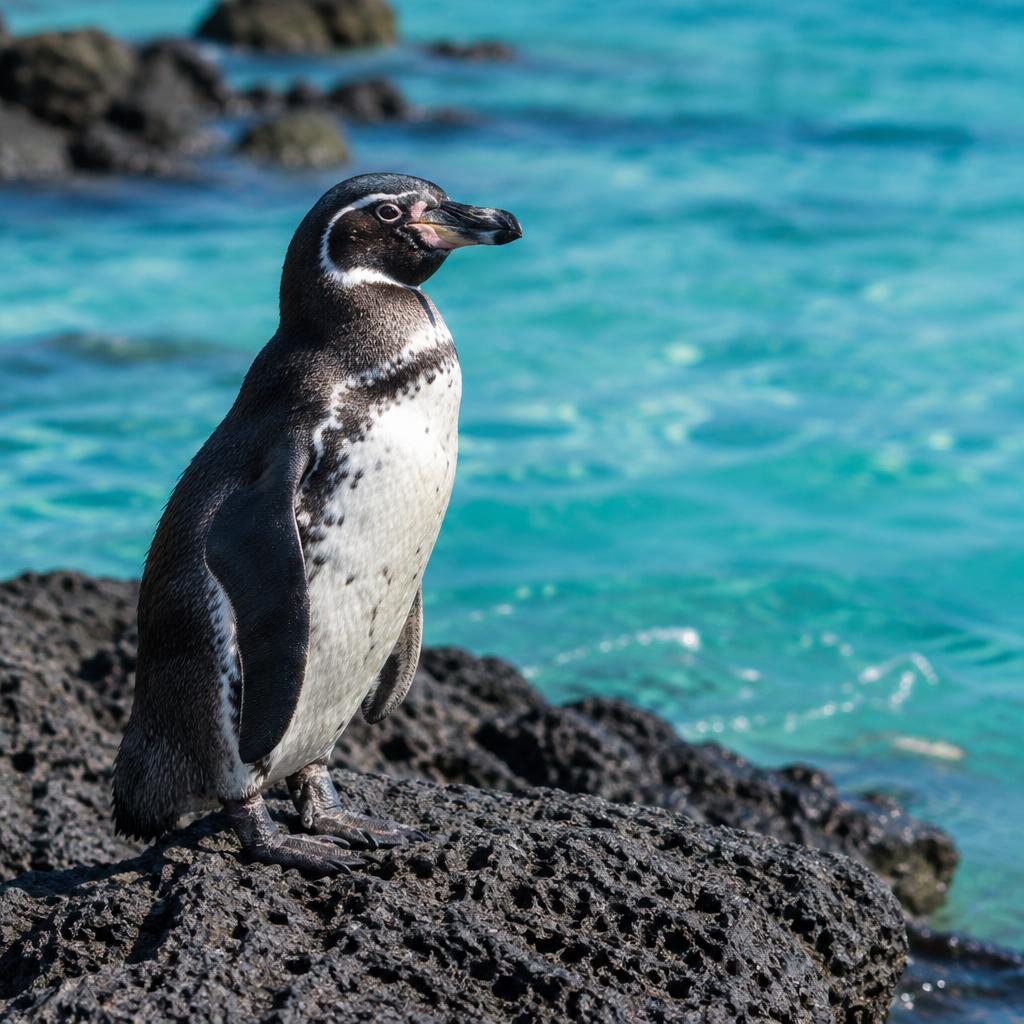
At about 49–53 centimetres long, this is a small penguin with a dark back, white underparts, and clear markings around the head and chest. Adults show a pale line that curves from the eye around the cheek and chin, along with dark chest bands. Young birds are plainer and lack the full adult pattern.
On land, watch for the stiff, upright stance and short steps over uneven rock. In water, the same bird becomes quick and sleek, driving forward with its flippers. It hunts small schooling fish near shore. A brief surface glimpse may show little more than a dark head before the next dive.
The species is endemic to the Galápagos Islands of Ecuador. A penguin seen here is not a visitor from Antarctica that took a wrong turn. It belongs to this tropical coastline, shaped by the same meeting of volcanic land and cool sea that supports so much of the islands’ wildlife.
The Cromwell Current makes the habitat possible
Latitude alone gives a poor guide to conditions in the western islands. The Cromwell Current, also called the Equatorial Undercurrent, flows east beneath the surface of the Pacific. When it meets the Galápagos platform, water rises toward the surface. That upwelling supplies cool, nutrient-rich water near Isabela and Fernandina.
Nutrients feed tiny marine producers, which support the food web that leads to fish and penguins. The birds do not need freezing seas. They need dependable prey within reach of their coastal feeding grounds. Other currents and local conditions also shape the islands, but western upwelling is central to the penguin’s stronghold.
The northern part of Isabela crosses the equator, which explains the species’ Northern Hemisphere distinction. It does not mean large colonies live far north in warm seas. The boundary is a line on a map; the birds follow useful water and shelter, not a latitude rule.
Lava crevices provide shade and nesting space
Black rock absorbs fierce heat, so nesting on an exposed surface would be risky. Galápagos penguins use shaded cavities, cracks, and lava tubes along the shore. A good nest offers cover from direct sun, room for the adults and chicks, and reasonable access to the sea. Suitable shelter can be scarce even where the coastline looks full of holes.
Adults also manage heat outside the nest. They can hold their flippers away from the body, pant, and position themselves to limit exposure. Time in the water provides relief. These behaviours help, but they do not remove the need for shade during breeding, when eggs and small chicks cannot simply leave.
Pairs commonly lay two eggs. Both parents share incubation and chick care, taking turns between land and feeding trips. Success rests on the balance between those jobs. If finding fish takes too long, an apparently well-sheltered nest can still fail because too little food reaches the young.
Breeding when the sea offers a chance
Many seabirds follow a fairly fixed annual breeding calendar. Galápagos penguins are more flexible. They can breed when cool water and plentiful food make it worthwhile, rather than waiting for one narrow season. In favourable periods, pairs may attempt more than one brood. When food is poor, breeding can pause or fail.
This opportunistic pattern fits a place where marine conditions can change sharply. Raising chicks costs energy, and adults must also survive and replace worn feathers. A good spell is a chance to produce young before the next period of scarcity arrives. Nest availability matters most when the food needed to use those nests is present.
It also makes population surveys harder to interpret. One visit may find many young birds after strong breeding, while another records few during a lean period. Counts need context: the date, area covered, survey method, and ocean conditions all influence what observers see. A single promising season is welcome, but it is not a permanent trend.
El Niño can turn a feeding ground into a famine
During strong El Niño events, the eastern tropical Pacific warms and the usual supply of cool, productive water can weaken. Fish become scarce or less accessible near the penguins’ feeding grounds. Adults struggle to maintain their own condition, and breeding may stop. Chicks cannot wait for the ocean to recover.
The 1982–83 El Niño is associated with an estimated population crash of about 77 percent. That figure describes a particular historic event, not a fixed loss expected in every El Niño. Later warm events also caused severe declines. Recovery depends on enough adults surviving and then producing young when conditions improve.
The species is often described as numbering roughly 1,200–2,000 birds, though estimates vary by year, coverage, and method. Those figures should not be treated as a precise census for every season. The IUCN lists it as Endangered. A restricted range and repeated food shocks leave little room for complacency, even when a cool year brings encouraging numbers of juveniles.
Cats and disease add pressure on land
Not every threat arrives with warm water. Introduced cats can kill penguins, and rats can threaten eggs or young. Risks vary between islands and nesting sites, so predator control needs to be targeted and checked. Losing breeding adults to a preventable land-based threat makes it harder for a small population to recover after food shortages.
Avian malaria is another concern. Researchers have detected Plasmodium parasites and evidence of exposure in Galápagos penguins. That warrants continued health work, but it does not justify claiming that a documented malaria epidemic has driven the major historic crashes. Infection, illness, and population-level mortality are different things.
Disease monitoring, mosquito surveillance, and strict biosecurity help reduce uncertainty and prevent new problems. Fishing interactions and disturbance also need attention around feeding and nesting areas. These threats can combine: a bird weakened by poor feeding has less margin for extra stress. Conservation therefore has to address both the sea where penguins feed and the shore where they rest.
Artificial nests make good years more useful
In 2010, University of Washington biologist Dee Boersma and colleagues built 120 shaded nest sites in the islands’ volcanic shoreline. Supported by Galápagos Conservancy, the programme aimed to increase the supply of safe nesting space. The shelters work with the rock, offering cool recesses rather than exposed boxes on a hot beach.
The logic is practical: when fish are plentiful, a shortage of suitable nests should not stop pairs from breeding. Researchers monitor use, breeding results, and nest condition. Artificial sites need maintenance, and not all remain usable. They are one tool alongside natural cavities, predator management, and protection of feeding habitat.
No nest can replace missing fish during a severe marine food shortage. The value of the programme lies in helping birds make the most of better periods, building resilience before the next setback. That is a measured conservation goal, not a promise that rock shelters can solve a changing ocean.
Protect the cool water and the quiet shore
The Galápagos penguin survives at the equator through a close fit between currents, prey, and shade. Its flexible breeding can turn favourable conditions into new young, while safe nest sites help those chances count. Yet warm-water crashes and introduced threats can undo progress quickly.
If you visit, keep the distance required by park rules, leave landing routes clear, and never draw birds toward you. Choose responsible operators and support established monitoring and biosecurity programmes. Help protect both halves of this penguin’s home: a productive sea and a shore where it can breed undisturbed.
Key takeaways
- The Galápagos penguin is the only penguin with a natural range north of the equator.
- Cool, nutrient-rich upwelling supports its main strongholds around Isabela and Fernandina.
- El Niño can cause severe food shortages and population declines.
- Artificial nests improve shelter but cannot replace a reliable food supply.
- The species remains Endangered; predator control and health monitoring also matter.
Frequently asked questions
Does the Galápagos penguin live north of the equator?
Yes. Its natural range includes northern Isabela, which crosses the equator. It is the only penguin with that distinction.
How does it survive tropical heat?
Cool coastal water, shaded lava cavities, and behaviours such as panting help it manage heat.
How many Galápagos penguins are left?
Often-quoted estimates are roughly 1,200–2,000 birds, but totals vary by survey year and method. Avoid treating that range as a current exact count.
Why is El Niño dangerous?
Warmer conditions can reduce the productive upwelling and accessible fish on which penguins depend, causing breeding failure and adult losses.
When did the artificial nest programme start?
Dee Boersma and colleagues began the programme in 2010, constructing 120 shaded nest sites.
Is avian malaria killing the population?
Plasmodium infection and exposure have been detected, so disease is monitored. That is not evidence that malaria caused the major historic population crashes.
References
Related reading
Blue-footed Booby: The Galápagos Seabird Whose Feet Tell the Truth
The Blue-footed Booby's feet are not just decorative. Their exact shade of blue is a live readout of the bird's diet and current health.
Northern Rockhopper Penguin: The Cliff-Climbing Seabird in Decline
The Northern Rockhopper Penguin has lost around 90% of its population in seventy years. Here is what is happening on the remote islands where it still breeds.