Blue-footed Booby: The Galápagos Seabird Whose Feet Tell the Truth
The Blue-footed Booby's feet are not just decorative. Their exact shade of blue is a live readout of the bird's diet and current health.
| Scientific name | Sula nebouxii |
|---|---|
| Length | ≈ 81 cm |
| Wingspan | ≈ 152 cm |
| Range | Eastern Pacific — Mexico to Peru, Galápagos |
| Diet | Sardines, anchovies, flying fish |
| Galápagos population | ≈ 6,400 (2012); further declines since |
| IUCN status | Least Concern (regional decline) |
The bird everyone knows by its feet
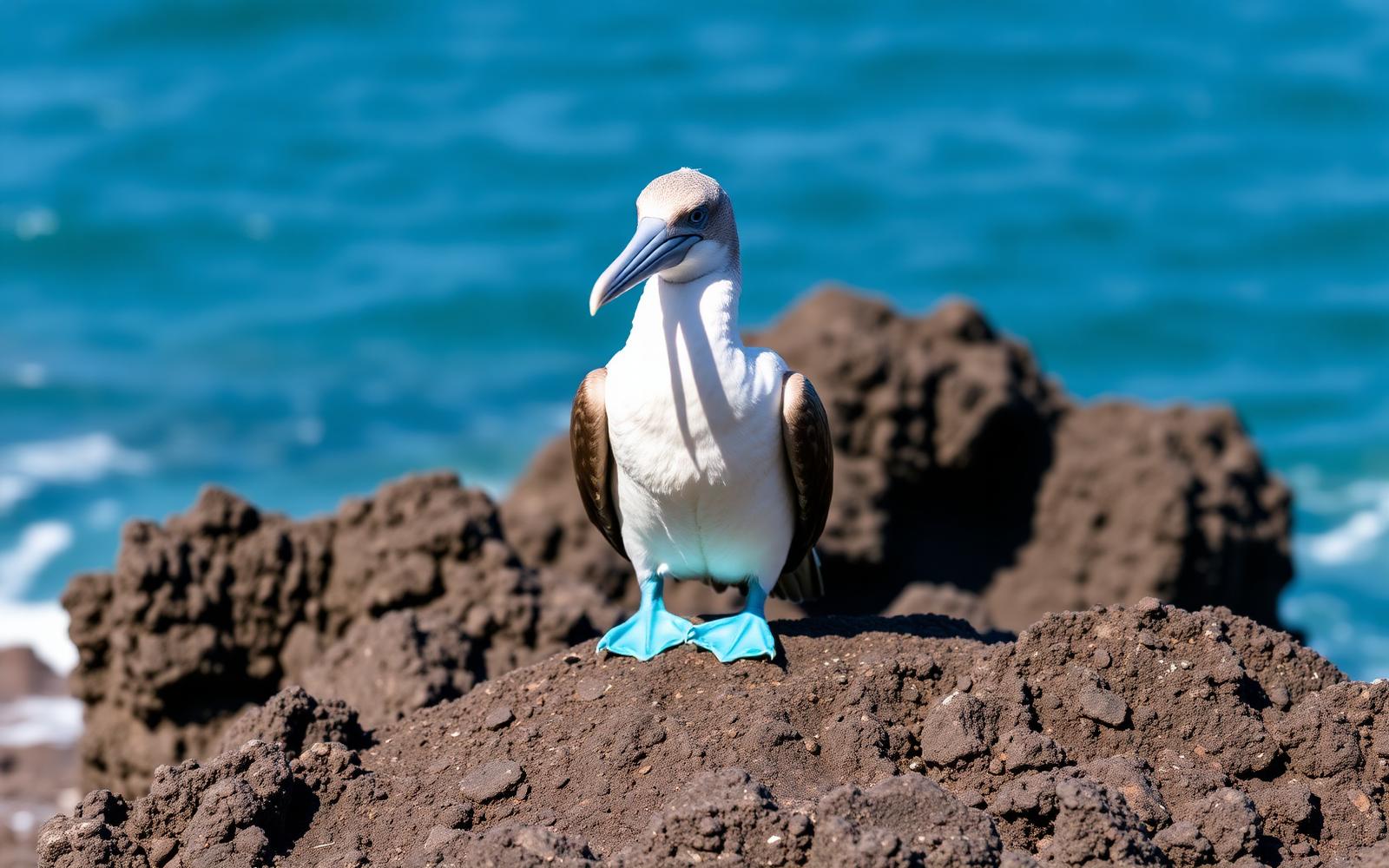
The Blue-footed Booby (Sula nebouxii) is a large pelagic seabird of the eastern Pacific, from the Gulf of California to northern Peru, with the most famous population living on the Galápagos Islands. Its bright turquoise-blue feet are the single feature everyone remembers — and they are more useful than they look.
About half the world's Blue-footed Booby population breeds on Galápagos, which is why declines there have received disproportionate global attention.
Why the feet are blue
The blue colour comes from pigments called carotenoids, which the birds obtain exclusively from a fresh diet of oily fish — sardines, anchovies and small pelagics. A well-fed, healthy booby has intensely coloured, saturated feet. A malnourished bird's feet fade within days.
Because the colour is a live readout of current fitness, female Blue-footed Boobies use it as their primary mate-quality signal. Males with duller feet are consistently less successful in courtship — an unusually direct example of an 'honest signal' in evolutionary biology.
The famous foot-lifting dance
The courtship display is a slow, choreographed sequence: the male lifts one blue foot, then the other, holding each in place long enough to be clearly seen. He then presents a small stone or twig to the female — a symbolic nest-building gesture — while sky-pointing with his bill.
The whole performance is unmistakable and often quite comic to human observers. It is also a critical filter: pairs form only when female interest matches the strength of the male's display.
Plunge diving from 25 metres
Blue-footed Boobies hunt by plunge diving from heights of up to 25 metres, folding their wings back to enter the water like a spear. Air sacs in the skull cushion the impact. Underwater they can pursue schooling fish for several metres before surfacing.
They often hunt cooperatively, with dozens of birds working the same bait ball. This makes them a reliable visual cue for pelagic sport-fishing captains looking for tuna.
The Galápagos decline
A 2012 study documented that the Galápagos Blue-footed Booby population had fallen by more than 50% since the 1990s. The most probable cause is a shift in sardine availability in the surrounding waters — Blue-footed Boobies are dietary specialists and simply do not switch to alternative prey when their preferred fish disappear.
Global IUCN status remains Least Concern because of the large mainland breeding population, but the Galápagos-specific decline is a serious regional concern and remains the subject of ongoing monitoring by the Charles Darwin Foundation.
A species tightly tied to its fish
The Blue-footed Booby is one of the clearest examples of a specialist seabird whose fate is bound up with the fish it eats. Protecting oily-fish populations across the eastern Pacific is, in practical terms, the same as protecting this bird.
Key takeaways
- The blue colour of the feet is diet-derived from carotenoids and reflects current fitness.
- Females use foot colour as an honest mate-quality signal.
- Blue-footed Boobies plunge dive from up to 25 metres.
- The Galápagos population has declined by more than 50% since the 1990s.
Frequently asked questions
Why are Blue-footed Boobies' feet blue?
Carotenoid pigments from a fresh diet of oily fish colour the feet. A well-fed bird has bright blue feet; a hungry or stressed bird's feet fade within days.
Where can I see Blue-footed Boobies?
The most famous population is on the Galápagos Islands, particularly North Seymour, Española and Isabela. They also breed along the Pacific coast from Mexico to northern Peru.
Are Blue-footed Boobies endangered?
The global IUCN status is Least Concern, but the Galápagos population has declined by more than 50% since the 1990s and remains a regional conservation concern.
What do Blue-footed Boobies eat?
Almost exclusively small schooling fish — mainly sardines, anchovies and flying fish — caught by plunge diving from heights of up to 25 metres.
Why do male Blue-footed Boobies lift their feet?
The foot-lifting display shows off the colour and condition of the feet, which females use as an honest indicator of a male's health and hunting ability.
References
Related reading
The Shoebill Stork: Africa's Prehistoric Wetland Hunter
With a bill shaped like a wooden clog and the patience of a heron, the Shoebill has become the most requested bird in African birding tourism. Here is the biology behind the icon.
The California Condor: North America's Largest Bird Fights Back
In 1987, every California Condor left on Earth was pulled into captivity. The species is back — barely — thanks to one of the most expensive recovery programmes in history.