Egyptian Vulture: The Stone-Throwing Migrant in Trouble
A yellow-faced scavenger cracks eggs with stones, crosses continents, and faces threats that no clever feeding trick can solve.
| Scientific name | Neophron percnopterus |
|---|---|
| Length | 58–70 cm |
| Range | Parts of Europe, Africa, and Asia |
| Population | Declining globally; regional trends differ |
| IUCN status | Endangered |
| Diet | Carrion, eggs, scraps, and small animals |
| Notable behaviour | Uses stones to break large eggs |
A Small Vulture with a Distinctive Face
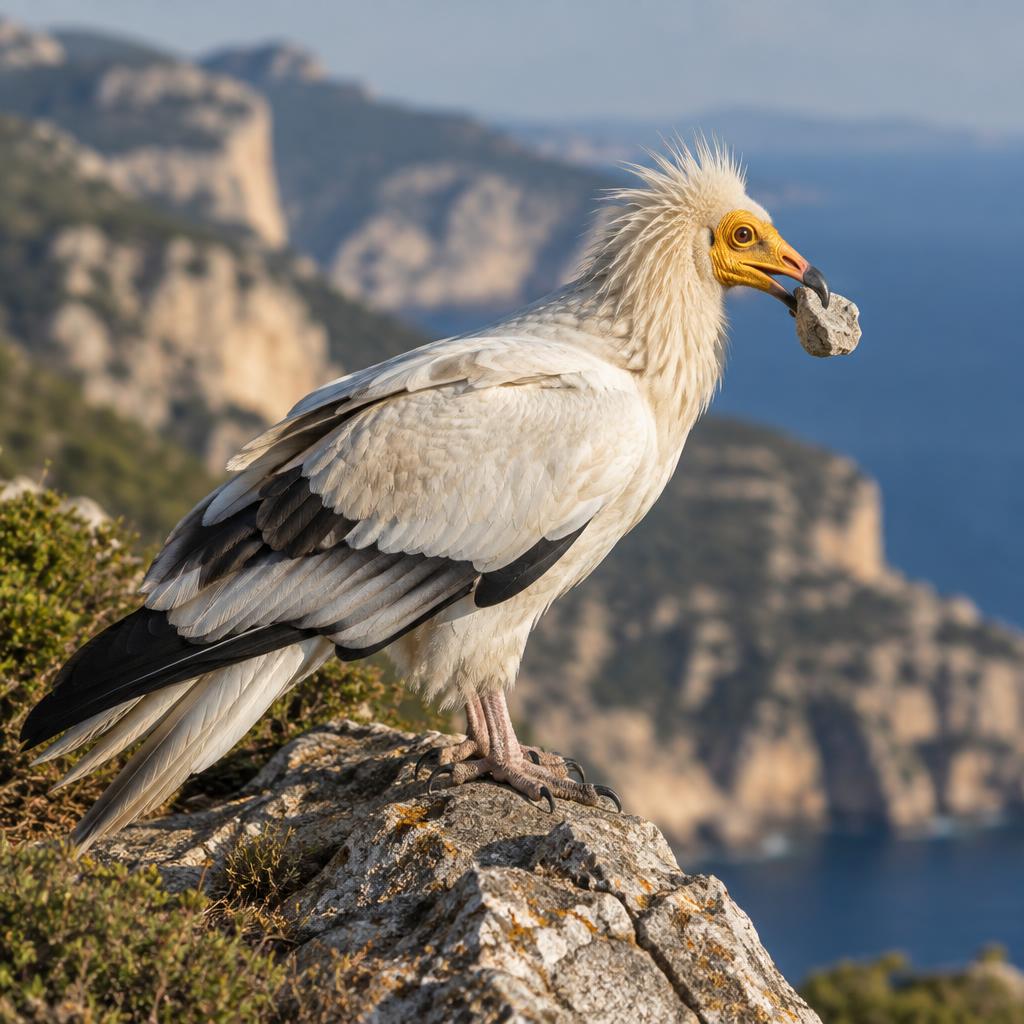
Against a pale cliff, an adult Egyptian vulture can seem almost white until it spreads its wings. Black flight feathers frame the body, and a narrow yellow face gives the bird a sharp, alert look. On the ground it walks with purpose, checking scraps that larger vultures may have left behind. This is a scavenger built for more than one kind of meal.
Neophron percnopterus is also one of the best-known bird tool users. Some individuals pick up stones and throw them at large eggs to reach the food inside. That striking skill has made the species famous, but it tells only a small part of its story. Many birds also undertake long, hazardous migrations between breeding and wintering grounds.
The Egyptian vulture is globally Endangered. Its range spans parts of Europe, Africa, and Asia, yet wide distribution has not protected it from serious decline. Following its year means moving from cliff nests to migration bottlenecks, power lines, and feeding places where a single poisoned bait can end a journey.
White Wings, Black Edges, and Yellow Skin
Adults are about 58–70 centimetres long, with long wings and a wedge-shaped tail. In flight, the contrast between white body plumage and black flight feathers is a strong clue. On a clear view, the bare yellow face and slender bill separate the bird from bulkier vultures. The loose feathers behind the head can look like a scruffy pale mane.
Young birds are mostly dark brown and do not resemble the clean white adults at first glance. Their plumage changes over several years. A dark juvenile with a wedge-shaped tail may therefore need a second look rather than a quick label based on colour alone. Light, distance, and wear can make field judgement harder.
The yellow face is bare skin, not a feather patch. Dietary carotenoid pigments contribute to its colour. Egyptian vultures consume a varied diet that can include dung as well as carrion. That breadth is worth remembering: this bird does not spend every day at a large carcass, waiting for an impressive photographic moment.
How Stones Open an Ostrich Egg
An ostrich egg is a rich meal behind a hard shell. In the classic tool-use behaviour, an Egyptian vulture takes a stone in its bill, raises its head, and throws the stone towards the egg. It may repeat the attempt many times before the shell breaks. Once there is an opening, the bill can reach the contents.
The stone is an external object used to achieve a feeding goal, which makes this genuine tool use. It is not the same as dropping prey from a height, nor does it mean that every throw is well aimed. The sequence can look awkward as well as clever. Persistence matters when a meal is protected by such a strong shell.
Not every population encounters ostrich eggs, and not every Egyptian vulture spends time using stones. The behaviour should not be treated as a daily routine across the whole range. Watch without staging a demonstration: offering eggs or placing food can alter natural behaviour and draw birds towards roads, people, or other unsafe feeding situations.
A Flexible Feeder with a Slow Life Cycle
The Egyptian vulture searches open country, grazing land, rubbish sites, and the edges of settlements. Its narrow bill can pick at small scraps and reach places less suited to a large Gyps vulture. Carrion is important, but eggs, insects, and small animals can also be taken. Food choice depends on what a landscape and season provide.
Pairs usually nest on cliffs, using ledges, caves, or sheltered recesses. They build with sticks and line the nest with softer material. A clutch commonly contains two eggs, although the number of young that fledge can be lower. Both parents help with care, and the nest may be used over successive seasons.
These birds take several years to reach breeding age. That delay makes adult survival crucial: a productive nest cannot quickly replace repeated losses among experienced breeders. Disturbance near a cliff can add pressure at the wrong time. Keep well back from occupied nesting areas, and avoid sharing precise nest locations in public posts or photo captions.
Bosphorus, Gibraltar, and the Journey South
Many European Egyptian vultures leave their breeding grounds for Africa after summer. Western birds commonly travel through the Strait of Gibraltar, while birds from the Balkans and farther east use an eastern route through Turkey and the Middle East. The Bosphorus is a major watchpoint on this wider eastern passage, not a route used by every individual.
Like other soaring migrants, they gain height on warm rising air over land. Broad stretches of sea offer fewer such lifts, so coastlines and narrow crossings shape their journeys. A map drawn as a straight line between nest and winter range misses the detours and stopovers that make migration possible. Weather can change both timing and risk.
Young birds face a steep learning challenge on their first journeys. Some remain in Africa for several years before returning north to breed. Not all populations migrate: resident birds occur in parts of the range, including island populations. Conservation must therefore protect both long flyways and places where birds spend their whole lives.
Why Balkan Vultures Have Struggled
Across the Balkans, the loss of Egyptian vultures has left empty nesting cliffs and isolated pairs. Bulgaria and Greece became central to regional rescue work because their remaining birds formed a vital part of the breeding population. Historical project figures describe particular years, so they should not be mistaken for a current census or proof that every country follows the same trend.
Poisoning is a major danger. Baits laid illegally for predators can kill scavengers that were never the intended target. Birds may also consume other contaminated food. Finding a dead vulture is only the start of an investigation: toxicology and field evidence are needed to establish the cause, rather than assuming that every death has the same explanation.
Electrocution is another serious threat. A bird landing on a poorly designed power pole can bridge live parts, or a live part and an earthed surface. Collision with wires is a separate hazard. Both require action, but insulating a dangerous pole and marking a hazardous span solve different problems and should not be confused.
LIFE Projects and the Canary Islands Guirre
In Bulgaria and Greece, the EU-funded Return of the Neophron project combined nest protection, safer food, anti-poison work, and research. The later Egyptian Vulture New LIFE project widened the focus along the migration route. Bulgarian and Greek conservation groups worked with partners farther south because saving a breeder at its nest is not enough if it dies during migration.
Satellite tracking has helped reveal routes and identify places where birds disappear. Those clues can guide field checks, power-line work, and cooperation with local communities. Tracking alone does not remove a threat, and a lost signal is not always a confirmed death. The value comes when movement data lead to action on the ground.
The Canary Islands hold a different conservation story. Their resident subspecies, Neophron percnopterus majorensis, is known as the guirre and survives chiefly on Fuerteventura and Lanzarote. Poison control, safer electrical infrastructure, and protection of breeding areas are vital there too. Island recovery can offer hope without cancelling losses elsewhere or removing the species from its global Endangered category.
Protect the Whole Journey
The Egyptian vulture brings together two forms of resourcefulness: the close work of opening a hard egg and the long search for food across continents. Neither protects it from a poisoned meal or a dangerous pole. Those are human-made hazards, and their solutions depend on people who manage land, livestock, energy networks, and protected areas.
Birdwatchers can help by choosing responsible guides, keeping a generous distance from cliffs, and reporting marked birds through the proper monitoring schemes. If you find suspected poison or a dead scavenger, do not touch the bait or carcass. Keep pets away and contact the relevant wildlife authority so trained staff can investigate safely.
The most useful conservation story is not that a clever bird will somehow cope. It is that targeted work can reduce avoidable deaths, one feeding area and one migration corridor at a time. Support trusted vulture projects in the Balkans, on the flyway, or in the Canary Islands, and help keep the next journey open.
Key takeaways
- Egyptian vultures use stones to break large eggs, a well-documented form of tool use.
- Many European birds migrate to Africa, but island and other populations can be resident.
- Poisoning and dangerous power poles threaten birds across their annual range.
- LIFE projects combine work in Balkan breeding areas with protection along the flyway.
Frequently asked questions
How does an Egyptian vulture use tools?
It picks up a stone with its bill and throws it at a large egg, repeating the action until the shell breaks.
Why is its face yellow?
Adults have bare yellow facial skin. Dietary carotenoid pigments contribute to the colour; young birds have darker faces.
Do all Egyptian vultures migrate?
No. Many European birds migrate to Africa, while some island and other populations remain resident.
Which subspecies lives in the Canary Islands?
Neophron percnopterus majorensis is the resident Canary Islands subspecies, known locally as the guirre.
Why is the Egyptian vulture Endangered?
Long-term declines reflect threats including poisoning, electrocution, persecution, and changes in food supply. Their importance varies across the range.
References
Related reading
The Secretary Bird: Africa's Long-Legged Snake Hunter
The Secretary Bird kills snakes by kicking them with the impact of a boxer's punch. It is also disappearing from parts of Africa faster than most people realise.
Bearded Vulture: The Bone-Eating Lammergeier of the High Peaks
The Bearded Vulture is the only bird on Earth that lives almost entirely on bone. Its story reaches from Himalayan cliffs to the reborn colonies of the Alps.