Bearded Vulture: The Bone-Eating Lammergeier of the High Peaks
The Bearded Vulture is the only bird on Earth that lives almost entirely on bone. Its story reaches from Himalayan cliffs to the reborn colonies of the Alps.
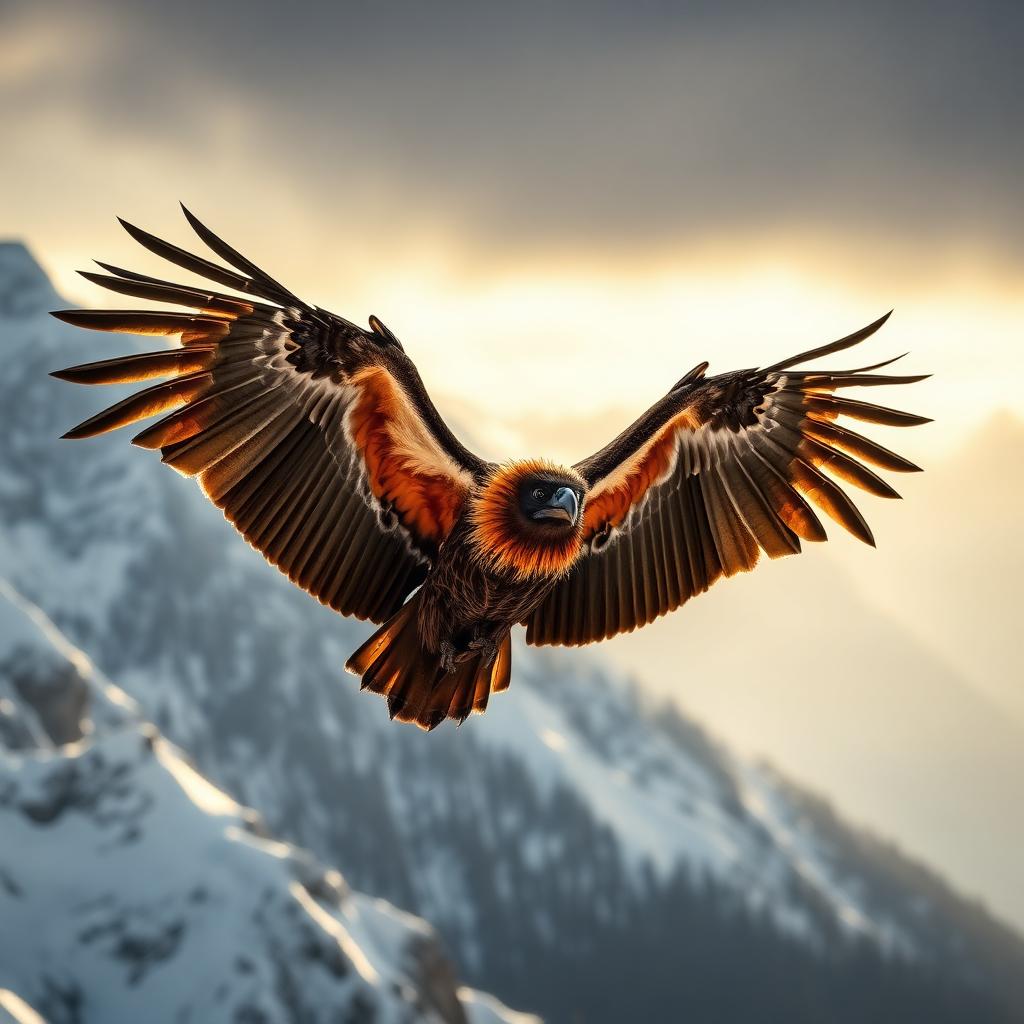
| Scientific name | Gypaetus barbatus |
|---|---|
| Wingspan | 2.3 – 2.8 m |
| Weight | 4.5 – 7.8 kg |
| Range | Alps, Pyrenees, Balkans, Caucasus, Himalayas, Ethiopian Highlands |
| Diet | Bones and bone marrow (≈ 80% of diet) |
| IUCN status | Near Threatened |
A vulture unlike any other
The Bearded Vulture (Gypaetus barbatus), also called the Lammergeier, is one of the world's most distinctive raptors. It has a wingspan close to three metres, a wedge-shaped tail, and a rust-orange chest that adult birds create themselves by bathing in iron-rich mud.
Most striking of all is its diet. Roughly 80% of what a Bearded Vulture eats is bone. That single behavioural quirk shapes almost everything about the species — where it lives, how it flies, and why it nearly vanished from Europe.
Where the Lammergeier lives
The species has a broad but fragmented range across mountainous regions of Europe, Africa and Asia. Historic strongholds include the Pyrenees, the Balkans, the Caucasus, the Ethiopian Highlands, the Zagros, the Hindu Kush, the Himalayas and the mountains of central China.
Bearded Vultures need open cliff faces for nesting and vast expanses of grazing land or high pasture below, where large mammals die and leave skeletons behind. This tie to open mountain landscapes explains their sensitivity to habitat change.
How to live on bones
Very few animals can digest bone. The Lammergeier can. Its stomach acid has been measured at roughly pH 1, strong enough to dissolve bone within a day and release the fatty marrow inside.
For pieces too large to swallow, the bird uses a trick perfected over millennia:
Ossuaries and stone anvils
A Bearded Vulture will carry a long bone high into the air and drop it onto a specific rocky slope — an ossuary — from tens of metres up. The bone shatters. The bird lands, swallows the fragments, and, if needed, repeats the drop. Individual birds return to the same ossuaries year after year.
This behaviour is so specialised that Lammergeier pairs are known to defend traditional ossuary sites just as strongly as their nest cliffs.
Slow breeders on high cliffs
Bearded Vultures pair for life and breed on sheer cliffs, usually in caves or under overhangs. They lay one or two eggs in midwinter so that chicks fledge just as spring carrion becomes available.
Reproduction is slow. Pairs raise, on average, less than one fledged chick per year, and juveniles take up to seven years to reach full adult plumage. Any loss of adults hits populations hard.
Persecuted almost to zero in Europe
For centuries the Lammergeier was misidentified as a lamb-killer — the German name Lämmergeier literally means 'lamb vulture'. Farmers, shepherds and hunters shot, trapped and poisoned it across the Alps.
By the early 20th century the species was extinct in the Alps and reduced to remnants elsewhere in Europe. It survived best in the Pyrenees, parts of the Balkans, Corsica and Crete.
The Alpine comeback
Starting in 1986, the Vulture Conservation Foundation and partners released captive-bred juveniles into the Alps at sites in Austria, France, Italy and Switzerland. It is one of the largest coordinated raptor reintroductions ever attempted.
The first Alpine chick fledged in the wild was recorded in 1997. By the 2020s, more than 300 Bearded Vultures were flying over the Alps again, with wild-born birds now raising their own young. Similar work is now underway in the Massif Central and Andalusia.
What still puts them at risk
Reintroduction has not removed the underlying threats. Illegal poisoning aimed at wolves and foxes remains the single largest killer of Bearded Vultures across their range. Collisions with power lines, lead poisoning from hunter-shot carcasses, and disturbance of nest cliffs are close behind.
In parts of Africa and Asia, populations are still declining. Ethiopia's highland population has fallen sharply in recent decades, and Central Asian populations are poorly monitored.
The clean-up crew of the mountains
Bearded Vultures are one of nature's most complete recyclers. By digesting bones that no scavenger can process, they close a nutrient loop that would otherwise stall in high, cold ecosystems. Losing them means bones piling up, disease risk rising and calcium locked out of the food web.
Their story is also a rare piece of good news in raptor conservation. Coordinated, decades-long reintroduction can work — if the killing on the ground is stopped in parallel.
A raptor worth protecting
The Lammergeier is more than a spectacular bird of prey. It is a living argument for landscape-scale conservation, cross-border cooperation and the patience needed to bring a species back over generations. If you visit the Alps, the Pyrenees or the high Himalayas, look up: the shadow you see gliding along a ridge may well be a bird that eats bones for a living.
Key takeaways
- The Bearded Vulture is the only bird whose diet is roughly 80% bone.
- It shatters bones by dropping them onto traditional stone ossuaries.
- Persecution wiped it out from the Alps by the early 20th century.
- Reintroductions since 1986 have re-established a growing Alpine population.
- Poisoning of carcasses remains the largest ongoing threat range-wide.
Frequently asked questions
Why is the Bearded Vulture also called Lammergeier?
Lämmergeier means 'lamb vulture' in German. The name comes from a false belief that the bird killed lambs; in reality it feeds almost entirely on bones from animals already dead.
How does it digest whole bones?
Its stomach acid is exceptionally strong, close to pH 1, which dissolves bone and releases the nutritious fatty marrow inside.
Why is its chest orange?
Adults deliberately bathe in iron-rich mud and springs. The rusty pigment stains the pale feathers and is thought to signal status to other Bearded Vultures.
How large is a Bearded Vulture?
Adults have wingspans of 2.3 to 2.8 metres and weigh between 4.5 and 7.8 kg, making them among the largest raptors in Europe.
Are Bearded Vultures dangerous to livestock?
No. There is no reliable evidence that Bearded Vultures kill healthy livestock. Historic accusations were based on misidentification and folklore.
Where can I realistically see one?
The best chances are in the Spanish Pyrenees, the Swiss and Austrian Alps, Ethiopia's Simien Mountains and parts of the Himalayas such as Ladakh and Nepal.
References
Related reading
Harpy Eagle: The Apex Predator of the Neotropical Rainforest
The Harpy Eagle takes monkeys and sloths from the canopy with talons the size of a grizzly bear's. Yet across most of its range, it is now functionally rare.
The Andean Condor: Master of the World's Longest Mountain Range
The Andean Condor's ten-foot wingspan is only half the story. Its slow reproduction and long life make it both a marvel of soaring flight and an early warning system for the Andes.