Crested Ibis: How a Bird Rose From Seven Individuals
In 1981 the entire wild population of the Crested Ibis was seven birds in one Chinese valley. Today there are thousands — one of conservation's great comebacks.
| Scientific name | Nipponia nippon |
|---|---|
| Length | 55 – 78 cm |
| Range | Shaanxi (China); reintroduced in Japan & Korea |
| Population (2024) | > 7,000 (wild + reintroduced) |
| Low point | 7 wild birds in 1981 |
| IUCN status | Endangered (recovering) |
A bird brought back from seven
In 1981, a Chinese survey team searching Shaanxi Province found what many ornithologists feared: seven Crested Ibises. That was, as far as anyone could confirm, the entire wild global population.
Four decades later, thanks to one of the most sustained conservation programmes ever attempted, there are more than 7,000 Crested Ibises (Nipponia nippon) alive, flying again over paddy fields in China, Japan and South Korea.
What it looks like
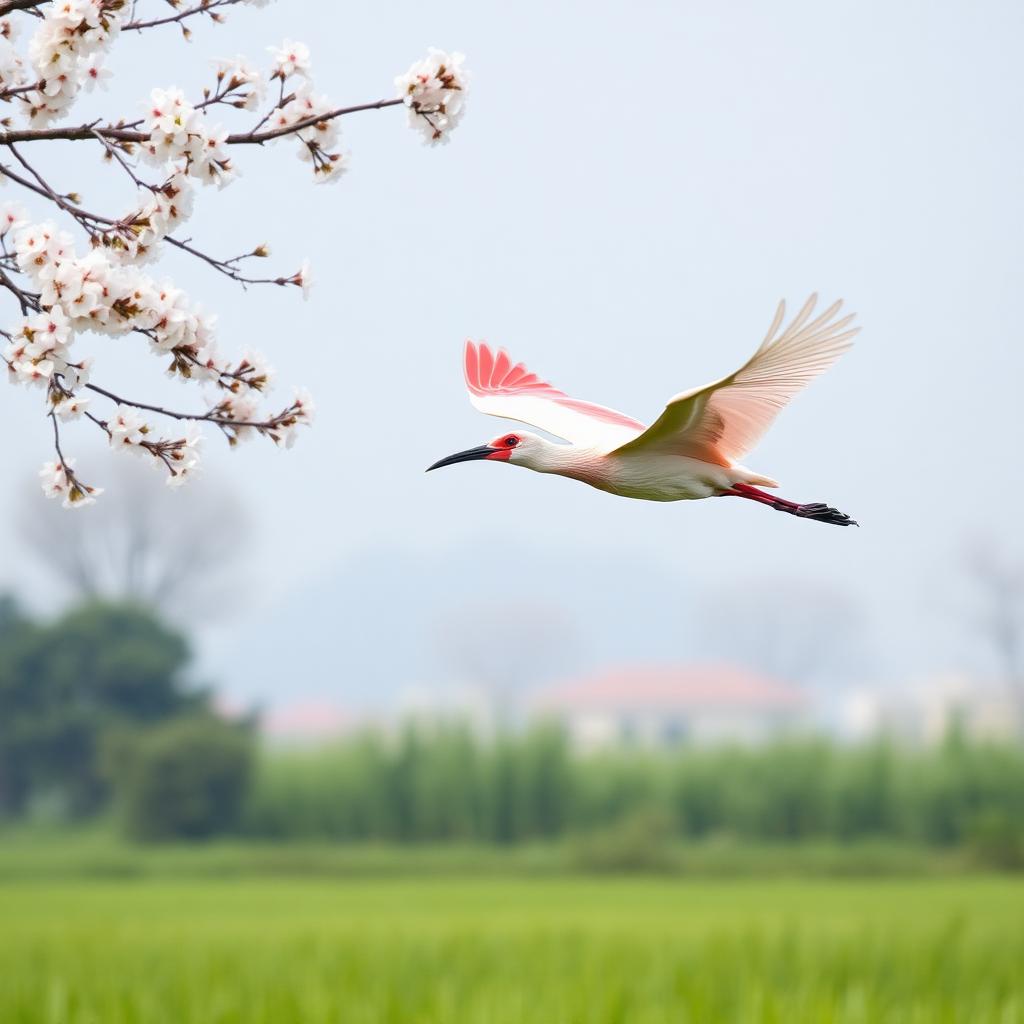
Adults are white with a soft pink wash across the wings and tail, most obvious in flight. The face is bare and bright red, and the head carries a shaggy nuchal crest that gives the species its name.
The long, decurved bill is black with a red tip. Breeding birds develop a grey wash over the head and back from a special preen-gland secretion.
Historical range
Historically, the Crested Ibis was widespread across East Asia — from north-eastern China through the Korean Peninsula, Japan and the Russian Far East. It was a familiar bird of paddy landscapes and marshes.
Twentieth-century industrialisation, hunting, pesticide use and the loss of wet rice fields drove it to near-extinction almost everywhere.
The Chinese recovery
After the 1981 rediscovery in Yang County, Shaanxi, the Chinese government protected the site, banned pesticides in nearby paddy fields and set up round-the-clock nest guarding.
A captive breeding programme at the Zhouzhi Rescue and Breeding Centre steadily built up numbers, and released birds gradually spread across the Qinling foothills. Wild breeding pairs now number in the low thousands.
Reintroduction in Japan
In Japan, the Crested Ibis — known as toki — was declared extinct in the wild in 2003 when the last native female died on Sado Island. Chinese-bred birds provided the founders for a Japanese captive population.
Since 2008, the Sado Island Toki Conservation Centre has released hundreds of birds. The species now breeds again in the wild across Sado, and a smaller population is being established on Honshu.
South Korea
South Korea launched its own reintroduction from Chinese founders at the Changnyeong Restoration Center. First releases began in 2019, and small numbers of wild-flying Crested Ibises are now recorded in the Upo Wetland region.
Why the recovery worked
Three ingredients stand out: strong government protection of a very small remaining core habitat; deep cooperation between China, Japan and South Korea on captive breeding and genetics; and long-term partnership with rice farmers, who were paid or supported to farm in ibis-friendly ways.
The Crested Ibis is now one of the clearest examples of how conservation can succeed when it is treated as decades-long policy, not a short campaign.
Ongoing risks
The species is still officially Endangered. The genetic base is narrow because all current birds descend from a very small number of founders, which raises long-term concerns about disease and inbreeding.
Continued reliance on traditional rice-paddy landscapes means agricultural change, land consolidation and heavy pesticide use remain real threats.
A quiet international success story
The Crested Ibis went from a footnote in extinction lists to a shared symbol of East Asian conservation. Its recovery shows that even a species down to a handful of birds can come back — if the science, the policy and the farming landscape line up for long enough. Follow local wetland projects, support the Sado and Changnyeong centres, and share the story when you can.
Key takeaways
- The Crested Ibis fell to just 7 wild birds in 1981.
- Today there are more than 7,000 across China, Japan and South Korea.
- Recovery required strict habitat protection and cross-border cooperation.
- It still depends on healthy traditional rice-paddy landscapes.
- Genetic bottleneck and pesticide use remain long-term concerns.
Frequently asked questions
Is the Crested Ibis still endangered?
Yes. Numbers have risen sharply, but the IUCN still lists it as Endangered due to its small genetic base and dependence on limited habitat.
Where can I see one in the wild?
The Qinling foothills of Shaanxi Province in China are the historic core range. Sado Island in Japan is the best reintroduction site.
Why do they look grey in the breeding season?
Adults smear a dark preen-gland secretion onto their feathers before nesting, temporarily turning the head and back grey.
What do they eat?
Small fish, frogs, aquatic insects, snails and crustaceans found in shallow water — especially flooded rice fields.
Are the Japanese and Chinese birds the same species?
Yes. All current Japanese toki descend from Chinese founders donated for the reintroduction programme.
What can I do to help?
Support wetland conservation NGOs in East Asia, buy rice from farms that use wildlife-friendly practices, and back the Sado and Changnyeong reintroduction programmes.
References
Related reading
The Kakapo Recovery Programme: How New Zealand Saved a Flightless Parrot
The Kakapo went from a handful of survivors in the 1990s to more than 250 birds today. Here's how — and what still threatens the world's only flightless nocturnal parrot.
Whooping Crane: North America's Tallest Comeback
The Whooping Crane went from 21 birds to more than 800 in eighty years. Here is how — and why the species is still not out of danger.