ʻAkiapōlāʻau: Hawaiʻi's Honeycreeper With a Two-Tool Bill
A short lower chisel and a long upper probe let this Hawaiian honeycreeper work wood in a way no other living bird quite matches.
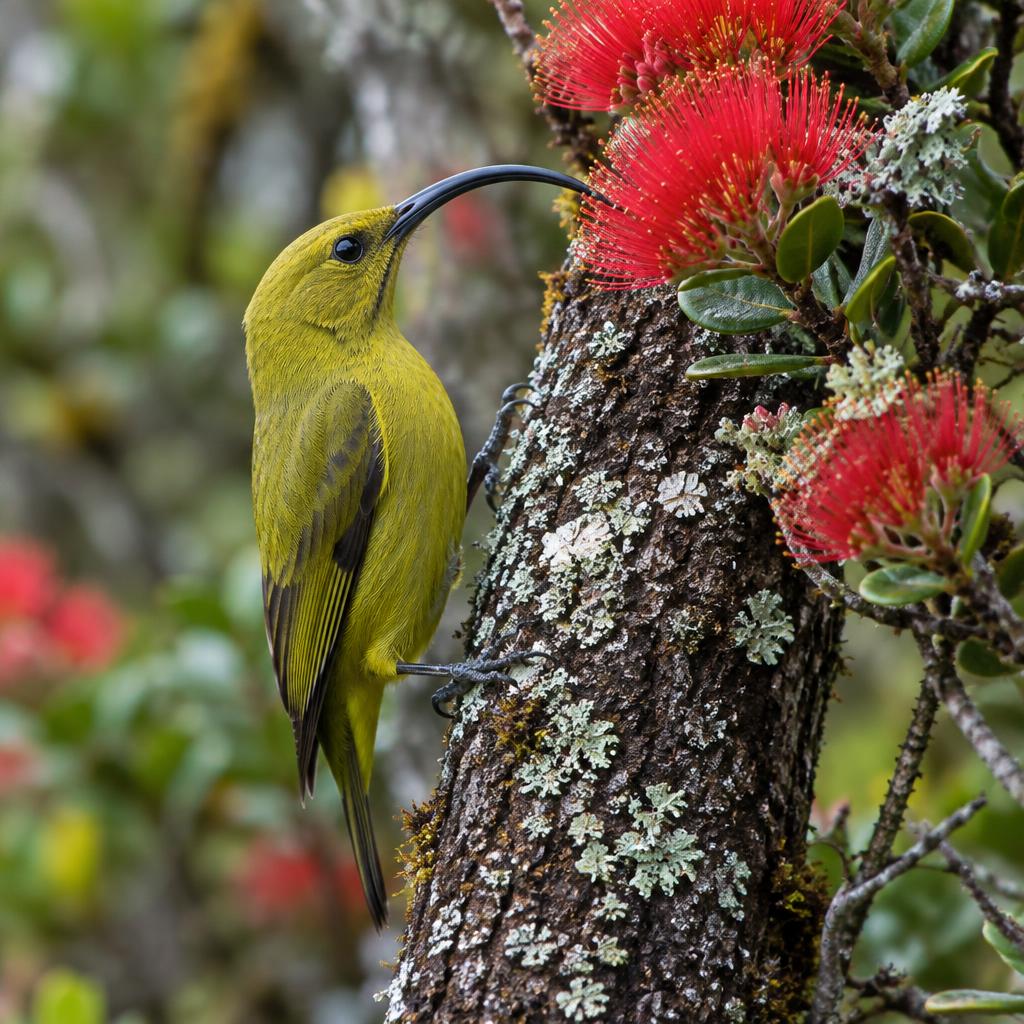
| Scientific name | Hemignathus wilsoni |
|---|---|
| Length | About 14 cm |
| Range | High-elevation native forest, Hawaiʻi Island |
| Population | Roughly 1,000–2,000; estimates vary by survey and date |
| IUCN status | Endangered |
| Family | Fringillidae (Hawaiian honeycreepers) |
| Bill | Short lower chisel; long curved upper probe |
Two tools on one small bird
Watch an ʻAkiapōlāʻau work along a branch and the odd bill begins to make sense. The short lower half strikes the wood. The long, curved upper half reaches into a crack. What looks awkward at rest becomes a precise set of tools when the bird starts to feed.
This Hawaiian honeycreeper, Hemignathus wilsoni, lives only on Hawaiʻi Island. It belongs to the finch family, not the woodpeckers, yet it fills part of the woodpecker niche in native forest. Its feeding method is one of the clearest examples of how island birds can evolve striking new ways to find food.
The species is Endangered. Estimates often cited place it at roughly 1,000–2,000 birds, though those figures come from surveys and assessments rather than a live count. Forest loss, introduced animals, and mosquito-borne disease now threaten the habitat where its unusual bill evolved. Keeping that habitat safe means addressing all three pressures together.
Recognizing the ʻAkiapōlāʻau
An ʻAkiapōlāʻau is about 14 centimeters long, with a sturdy body and a bill that seems to belong to two different birds. Adult males have bright yellow heads and underparts, greenish upperparts, and a small dark face mask. Females are generally duller, with more olive and gray tones.
The bill is the best field clue, but it is worth looking at both parts. The upper mandible curves far beyond the short, strong lower mandible. Males tend to be larger and have longer bills than females. A quick glimpse through leaves may hide that shape, so patient watching is more useful than a rushed identification.
Older sources often use the scientific name Hemignathus munroi. Current treatments commonly use Hemignathus wilsoni for the same species. Recognizing that name change helps readers connect older recovery plans with newer accounts. It does not mean there are two separate surviving species sharing this distinctive feeding system.
How the chisel-and-probe bill works
The lower mandible is short and robust. The bird uses it to tap and chisel into wood, opening access to concealed prey. The upper mandible is much longer and curves downward, allowing it to probe cracks and draw food from places the lower bill cannot reach.
This is a division of labor within one bill, not two independent beaks. The parts work in sequence as the bird searches, opens a small gap, and extracts a meal. Caterpillars, beetle larvae, adult beetles, and spiders all feature in its diet. Cornell describes the same hammer-then-extract feeding pattern in its life-history account. [1](https://www.allaboutbirds.org/guide/Akiapolaau/lifehistory)
Branches are a feeding surface in three dimensions. Birds creep along them, cling to their sides, and sometimes hang beneath them. The result can recall a woodpecker at work, but the ancestry is different. The resemblance reflects a shared task: reaching animal food hidden inside or beneath the surface of wood.
Sap wells and the woodpecker niche
The comparison with woodpeckers goes beyond insect hunting. ʻAkiapōlāʻau also make shallow holes in living ʻōhiʻa bark and feed on the sap. These sap wells recall the work of sapsuckers in North America, though the Hawaiian bird evolved its habits within a very different island community.
Sap is a supplement, not a reason to describe the species as mainly a nectar feeder. Its core feeding behavior centers on finding small animals in branches, bark, and crevices. Watching which part of the bill it uses, and on which tree, reveals more than simply noting that it is feeding.
Hawaiʻi has no native woodpeckers. The ʻAkiapōlāʻau occupies part of that vacant feeding role, but it is not a perfect substitute for every woodpecker function. Calling it a woodpecker-like honeycreeper is useful shorthand. Calling it a woodpecker is not. The distinction preserves the most interesting part of the story: a finch lineage reached a similar solution by its own route.
Native forest, koa branches, and ʻōhiʻa nests
Today the species is largely restricted to higher-elevation native forests on Hawaiʻi Island, mostly above about 1,500 meters. Important populations occur in windward forest landscapes, including Hakalau and the Kaʻū region. The range is fragmented, not a continuous band of safe woodland around the island.
Koa, Acacia koa, is a major foraging tree. Its branches provide places to search for insects and other prey. ʻŌhiʻa lehua, Metrosideros polymorpha, is also important, especially as a nesting tree and a source of sap. A forest with both trees offers more than a stand planted for a single purpose.
Nests are open cups, often placed high in ʻōhiʻa. The usual clutch is one egg, with two uncommon. Young birds can depend on their parents for months. That slow pace limits how quickly numbers can rebound after losses. Protecting adult birds and keeping breeding habitat intact therefore matters as much as counting nests in a good season.
Hakalau Forest NWR and the value of koa restoration
Hakalau Forest National Wildlife Refuge protects important habitat for native Hawaiian forest birds. On former pasture, restoration has used koa planting to help rebuild forest cover. For ʻAkiapōlāʻau, that work can provide feeding habitat where cattle once kept much of the ground open.
Koa restoration is not simply a matter of planting a row of trees. Managers must address invasive plants, browsing animals, and the slow return of a diverse native understory. Trees need time to grow branches and support the living community on which insect-eating birds depend. Continued care makes the difference between planting and genuine forest recovery.
The broader goal is to connect useful habitat and reduce the gaps between forest patches. Restored areas can extend the value of older stands, but cannot immediately replace them. Protecting mature koa and ʻōhiʻa while restoring nearby land is a stronger approach than choosing one or the other. Hakalau shows why recovery needs both patience and consistent management.
A warming climate raises the malaria threat
Avian malaria is one of the most serious threats to Hawaiian honeycreepers. Introduced mosquitoes spread the parasite between birds. Many native species are highly vulnerable, and cooler high-elevation forests have served as partial refuges because conditions there have limited mosquito activity and disease transmission.
As the climate warms, those cooler zones become less secure. Warmer conditions can allow mosquitoes and malaria transmission to reach higher into forest that once offered greater protection. Risk varies with local weather, elevation, and habitat, so there is no single line on a map that guarantees safety every year.
This is why forest restoration alone cannot solve the problem. A well-grown koa stand may provide food while still exposing birds to disease. Landscape-scale mosquito control, careful monitoring, and research on effective tools must accompany habitat work. Measures aimed at reducing mosquito reproduction are part of the wider Hawaiian forest-bird response, but their results must be assessed rather than assumed in advance.
Ungulates, rats, and a small population
Introduced ungulates, including pigs and cattle, can damage native forest in different ways. Browsing and trampling suppress regeneration, while pigs disturb soil and vegetation. Some water-filled features associated with pig activity can also provide mosquito breeding sites. Fencing and removal help native plants recover and reduce ongoing damage.
Introduced rats add another pressure. They can prey on eggs, chicks, and other forest wildlife. Control must be sustained and evaluated; a short campaign does not make an entire landscape safe. The practical goal is to reduce avoidable losses while habitat and disease measures improve the wider outlook.
Population figures deserve the same care as management claims. Roughly 1,000–2,000 birds is a useful sense of scale, not a precise current total. Survey dates, areas covered, and methods affect estimates. The important point is that the species has a small, fragmented population and a slow breeding pace, leaving little room for repeated bad years.
Keep the tools and the forest together
The ʻAkiapōlāʻau's bill tells a story of adaptation: a short chisel below, a long probe above, and a bird able to draw food from wood without being a woodpecker. Its sap wells add another layer to that story. Each behavior depends on a living native forest, not on the bill alone.
Recovery requires the same joined-up view. Koa restoration can expand feeding habitat. Protecting ʻōhiʻa supports nesting and other needs. Ungulate and rat control reduce damage and losses, while mosquito management addresses a threat that rises with a warming climate. No single measure replaces the rest.
For visitors, responsible interest means following access rules, keeping distance, and avoiding disturbance around feeding birds or nests. For supporters farther away, steady backing for native forest care and evidence-based disease control has lasting value. Support Hawaiian-led conservation and refuge partners working to keep this extraordinary honeycreeper in the forest where it belongs.
Key takeaways
- The short lower mandible chisels wood; the long upper mandible probes for prey.
- This finch-family honeycreeper fills part of Hawaiʻi's woodpecker niche.
- Koa supports foraging, while ʻōhiʻa is important for nests and sap.
- Restoration at Hakalau complements protection of mature native forest.
- Malaria, warming, ungulates, and rats require coordinated management.
Frequently asked questions
What is unusual about the akiapolaau bill?
Its short lower mandible chisels wood, while the long curved upper mandible probes and extracts hidden prey.
Is the ʻAkiapōlāʻau a woodpecker?
No. It is a Hawaiian honeycreeper in the finch family, but fills part of the woodpecker feeding niche.
Does it drink sap?
Yes. It makes shallow wells in living ʻōhiʻa bark and feeds on sap, alongside its mainly insect-based diet.
How many remain?
Frequently cited estimates are roughly 1,000–2,000 birds. This is an approximate range drawn from surveys, not a live census.
How does climate change threaten it?
Warming can allow mosquito-borne avian malaria to spread higher into forest that previously offered cooler refuge.
Why plant koa at Hakalau?
Koa restoration helps rebuild native forest and provides foraging habitat. It works best alongside mature forest protection, animal control, and disease management.
References
Related reading
Kirtland's Warbler: The Songbird That Needed Fire
Kirtland's Warbler recovered from 167 singing males to more than 2,000 pairs by rebuilding one very specific habitat: young jack-pine forest.
Palila: The Yellow Honeycreeper Tied to a Single Tree
The Palila is one of the last finch-billed Hawaiian honeycreepers. Its future is locked to a single tree species on the slopes of Mauna Kea.