Sichuan Jay: The Dark Corvid of the Tibetan Plateau
The Sichuan Jay lives quietly in the spruce and fir forests of the eastern Tibetan Plateau. It is one of the world's rarest jays.
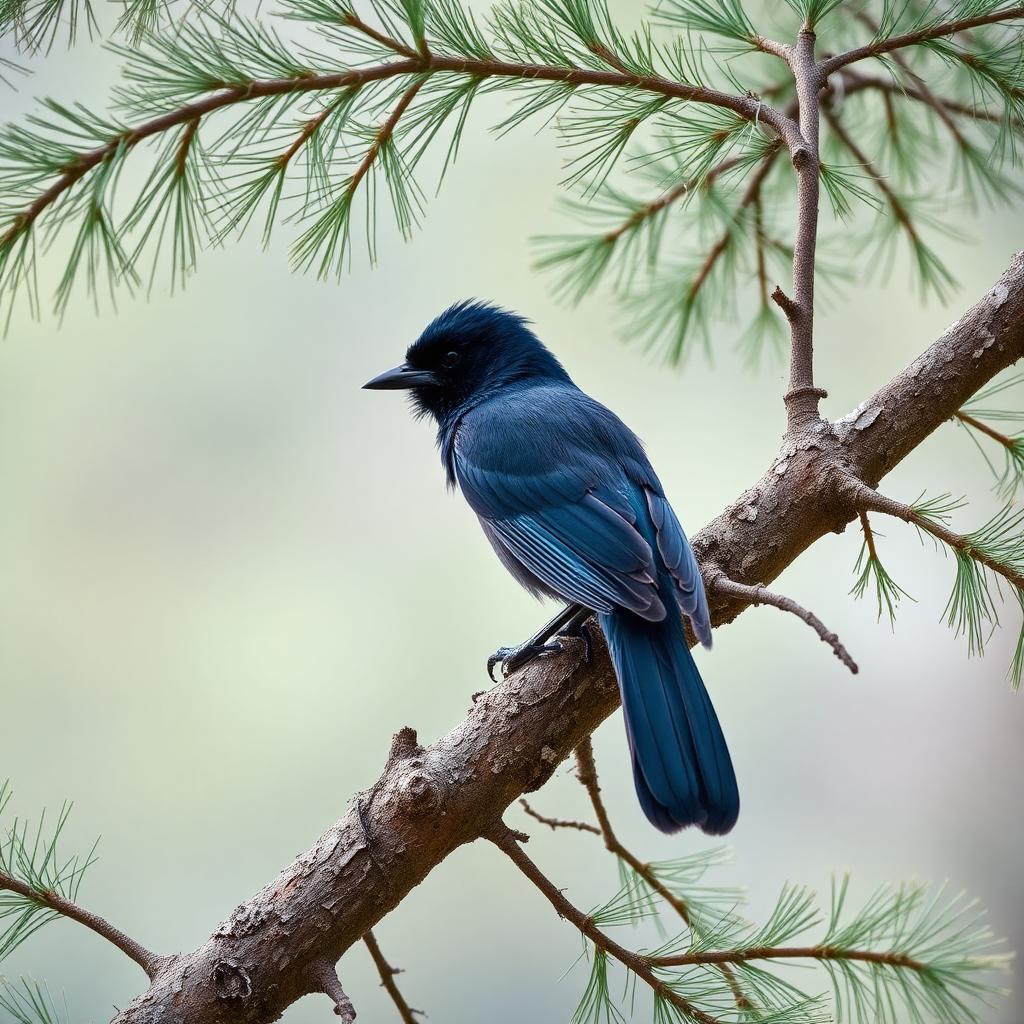
| Scientific name | Perisoreus internigrans |
|---|---|
| Length | ≈ 30 cm |
| Range | High-altitude conifer forest, eastern Tibetan Plateau |
| Diet | Insects, seeds, small vertebrates, carrion |
| Population | ≈ 3,000–15,000 mature individuals |
| IUCN status | Vulnerable |
A quiet corvid of the plateau edge
The Sichuan Jay (Perisoreus internigrans) is a slender, sooty-grey corvid of the high conifer forests along the eastern edge of the Tibetan Plateau. Adults are about 30 cm long, with dark brownish-grey plumage, a pale forehead and a relatively long tail.
It is one of only three species in the genus Perisoreus, alongside the Siberian Jay of the boreal north and the Grey Jay (Canada Jay) of North America.
Where it lives
The Sichuan Jay is confined to spruce and fir forests between roughly 3,000 and 4,300 metres elevation in western Sichuan, southern Gansu, southeastern Qinghai, and parts of eastern Tibet.
Even within that range, it is patchily distributed. It favours older-growth stands with a well-developed understorey and adjacent alpine meadow edges.
A cache-based diet
Like its northern relatives, the Sichuan Jay caches food across the landscape and relies on those hidden stores through the long winter. Diet includes insects during the summer, conifer seeds, small vertebrates, berries and carrion.
Pairs are strongly territorial. Family groups often stay together into the following breeding season, with young birds helping to defend a shared area.
A slow, quiet decline
Since the mid-20th century, large areas of high-elevation conifer forest in western Sichuan and neighbouring provinces have been cleared for timber. The remaining forest is often younger and less structurally complex than the mature stands the species prefers.
Fire suppression policies, road building and the collection of yartsa gunbu (caterpillar fungus) during the summer season all add localised pressure on breeding areas.
Climate change on the plateau
The eastern Tibetan Plateau is warming faster than the global average. Modelling suggests suitable spruce–fir habitat will shift upslope over coming decades, compressing the Sichuan Jay's already limited climate envelope.
Because it is a resident, non-migratory species tied to a narrow altitudinal band, it cannot simply relocate.
Reserves and long-term monitoring
Several Chinese national nature reserves — notably Wanglang, Jiuzhaigou and Baishuijiang — overlap Sichuan Jay habitat and provide the primary formal protection. Long-term work by Beijing Normal University, Peking University and the China Ornithological Society has begun to fill in basic ecology and population trends.
There is no captive population; conservation depends entirely on the integrity of remaining high-altitude conifer forest.
A jay worth listening for
The Sichuan Jay is easy to overlook. It is dark, quiet, and lives in cold, hard-to-access forests. But it is also one of the clearest indicators of the health of the eastern Tibetan Plateau's mature conifer forests — an ecosystem under quiet, cumulative pressure.
Key takeaways
- The Sichuan Jay is a Vulnerable corvid endemic to the eastern Tibetan Plateau.
- It occurs in spruce and fir forest between roughly 3,000 and 4,300 metres.
- It caches food and stays resident year-round in family groups.
- Timber extraction and climate-driven habitat shifts are the main threats.
Frequently asked questions
How rare is the Sichuan Jay?
Best estimates place the population at 3,000 to 15,000 mature individuals across western China, classing it as Vulnerable on the IUCN Red List.
Is it related to the Siberian Jay?
Yes. Both belong to the small genus Perisoreus, along with the Grey (Canada) Jay of North America.
Where can I see one?
The most reliable protected sites are Wanglang National Nature Reserve and parts of Jiuzhaigou in Sichuan, ideally in early morning during summer.
Does it migrate?
No. Sichuan Jays are resident year-round, caching food to survive long, harsh winters.
Why does climate change threaten it?
The species depends on a narrow altitudinal band of spruce–fir forest, which is projected to shift upslope faster than the species can adapt.
References
Related reading
Snowy Owl: The Arctic Nomad You Cannot Predict
The Snowy Owl is one of the few large birds most people can recognise on sight — and yet almost everything else about it, from where it will spawn to where it will winter, is genuinely hard to predict.
Rufous-headed Robin: China's Rediscovered Mountain Songbird
The Rufous-headed Robin nearly slipped out of the ornithological record. Its rediscovery in Sichuan opened one of Asia's most surprising songbird stories.