The Kagu: New Caledonia's Ghost of the Forest
The Kagu is a bird found nowhere else on Earth — a ghost-pale, flightless forest inhabitant that survives only on a single Pacific island.
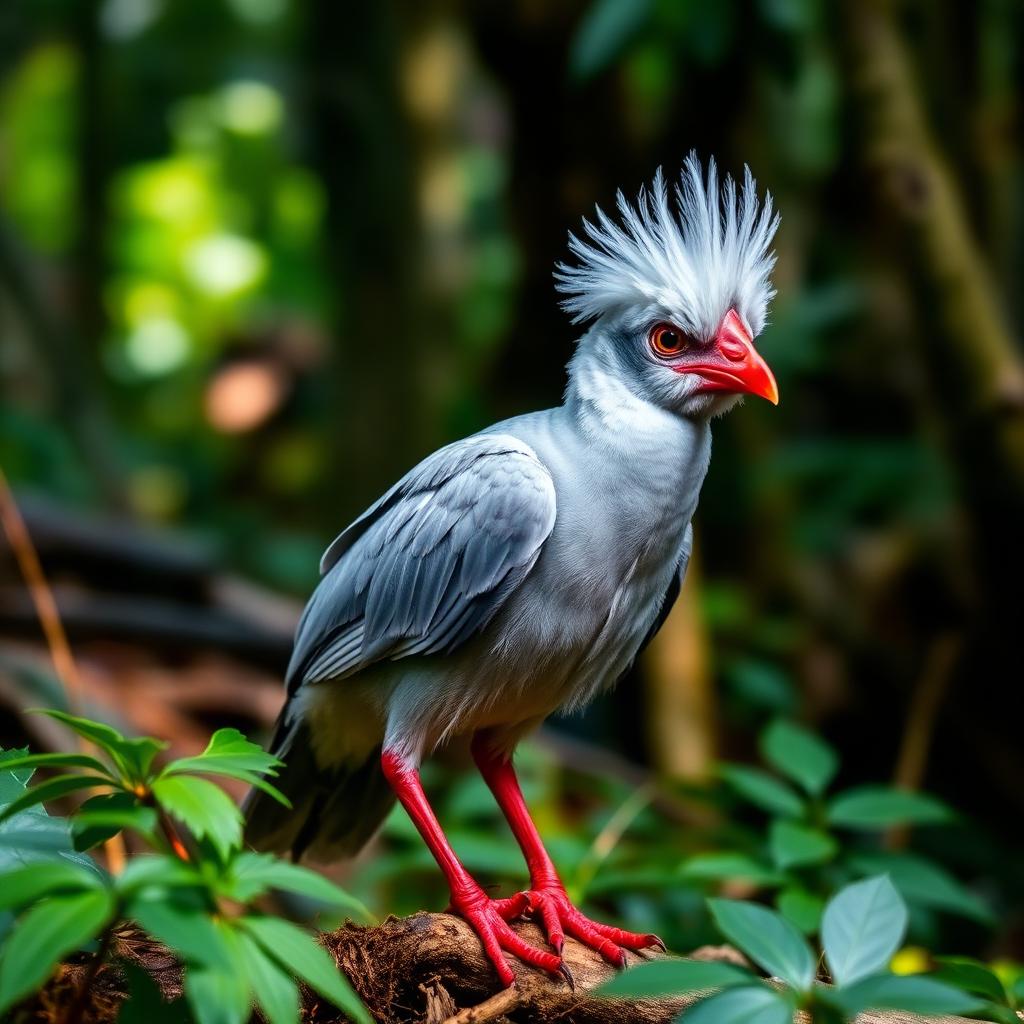
| Scientific name | Rhynochetos jubatus |
|---|---|
| Height | ≈ 55 cm |
| Weight | ≈ 900 g |
| Range | New Caledonia (Grande Terre) only |
| Diet | Snails, worms, insects, small lizards |
| Population | ≈ 1,000–2,000 (rising) |
| IUCN status | Endangered |
A bird from nowhere else
The Kagu (Rhynochetos jubatus) is the sole living member of an entire bird family — Rhynochetidae — and it lives only on Grande Terre, the main island of New Caledonia in the south-west Pacific. Ghost-pale grey with coral-red legs and bill, an expressive raised crest and a piercing bark of a call, it is unlike any bird elsewhere on Earth.
It is also flightless in practice. The wings are fully feathered and boldly marked, but the flight muscles are reduced. Kagus use their wings for balance and for a threat display, not for lift.
Where the Kagu lives
Kagus inhabit the humid montane forests and adjacent shrublands of Grande Terre, from sea level up to about 1,400 metres. They favour dense understorey with a deep leaf-litter layer, which is where their prey lives.
Pairs hold and defend territories of 10–30 hectares year-round, and family groups often include one or two grown offspring that help guard the next season's chick — an uncommon behaviour for a mainly solitary lineage.
How the Kagu hunts
Kagus forage on foot, moving slowly through the forest floor. They freeze, tilt the head, and listen — much like a thrush — before striking down into the leaf litter with a straight bill. Snails, earthworms, centipedes, spiders and small lizards form the bulk of the diet.
The bill has a peculiar adaptation: sealable flaps of skin cover the nostrils, keeping soil and litter out while the bird jabs into damp ground.
The near-loss of the species
By the 1970s, the Kagu was in serious trouble. Introduced dogs, pigs and rats killed adults and chicks, and forest was being cleared for nickel mining and agriculture. The wild population fell to just a few hundred birds concentrated in the Parc Provincial de la Rivière Bleue in the south of Grande Terre.
Dog predation, in particular, was almost catastrophic. A single feral dog with an established territory can kill dozens of Kagus in a season.
A slow, careful recovery
Sustained conservation work since the 1980s — sustained trapping of dogs and rats, protection of the Parc de la Rivière Bleue, community education, and a captive breeding programme at Parc Zoologique et Forestier in Nouméa — has stabilised and now gently increased the wild population.
In 2024, the estimate was between 1,000 and 2,000 birds, distributed across several protected forest blocks. It is still a very small population by global standards, but it is trending in the right direction — a rare and welcome pattern for a Pacific island endemic.
One island, one lineage
The Kagu is a reminder that some evolutionary lineages exist only in one place, once. Lose the forest on Grande Terre and there is no reserve elsewhere from which to restart. Protecting the Kagu is not just species conservation — it is the preservation of an entire branch of the tree of life.
Key takeaways
- The Kagu is the sole living member of the family Rhynochetidae.
- It is functionally flightless and endemic to New Caledonia's Grande Terre.
- Introduced dogs are historically the leading cause of adult mortality.
- The population has slowly recovered from a few hundred to 1,000–2,000 birds.
Frequently asked questions
Where does the Kagu live?
Only on Grande Terre, the main island of New Caledonia in the south-west Pacific. It occurs nowhere else in the world.
Can Kagus fly?
No. Their wings are fully feathered but the flight muscles are reduced. They use the wings for balance and threat displays, not for lift.
Is the Kagu endangered?
Yes. The IUCN Red List currently classes it as Endangered.
Why did the Kagu nearly go extinct?
The main historical drivers were predation by introduced dogs, cats and pigs, plus habitat loss from nickel mining and agriculture.
Where can visitors see wild Kagus?
The most reliable site is the Parc Provincial de la Rivière Bleue near Nouméa, where habituated family groups can often be seen from marked trails at dawn.
References
Related reading
The Philippine Eagle: A Complete Guide to the World's Rarest Raptor
With fewer than 400 breeding pairs remaining, the Philippine Eagle is one of the rarest raptors on Earth. Here's what field biologists have learned in three decades of recovery work.
The Kakapo Recovery Programme: How New Zealand Saved a Flightless Parrot
The Kakapo went from a handful of survivors in the 1990s to more than 250 birds today. Here's how — and what still threatens the world's only flightless nocturnal parrot.