Horned Guan: The Red-Horned Bird of Cloud Forests
A turkey-sized bird with a scarlet horn on its head, surviving in a handful of volcano-top cloud forests between Chiapas and Guatemala.
| Scientific name | Oreophasis derbianus |
|---|---|
| Length | 75 – 85 cm |
| Weight | 1.1 – 2.4 kg |
| Range | Chiapas (Mexico) and western Guatemala |
| Habitat | Cloud forest, 1,500 – 3,350 m |
| Population | Roughly 600 – 1,700 mature birds |
| IUCN status | Endangered |
A bird that looks invented
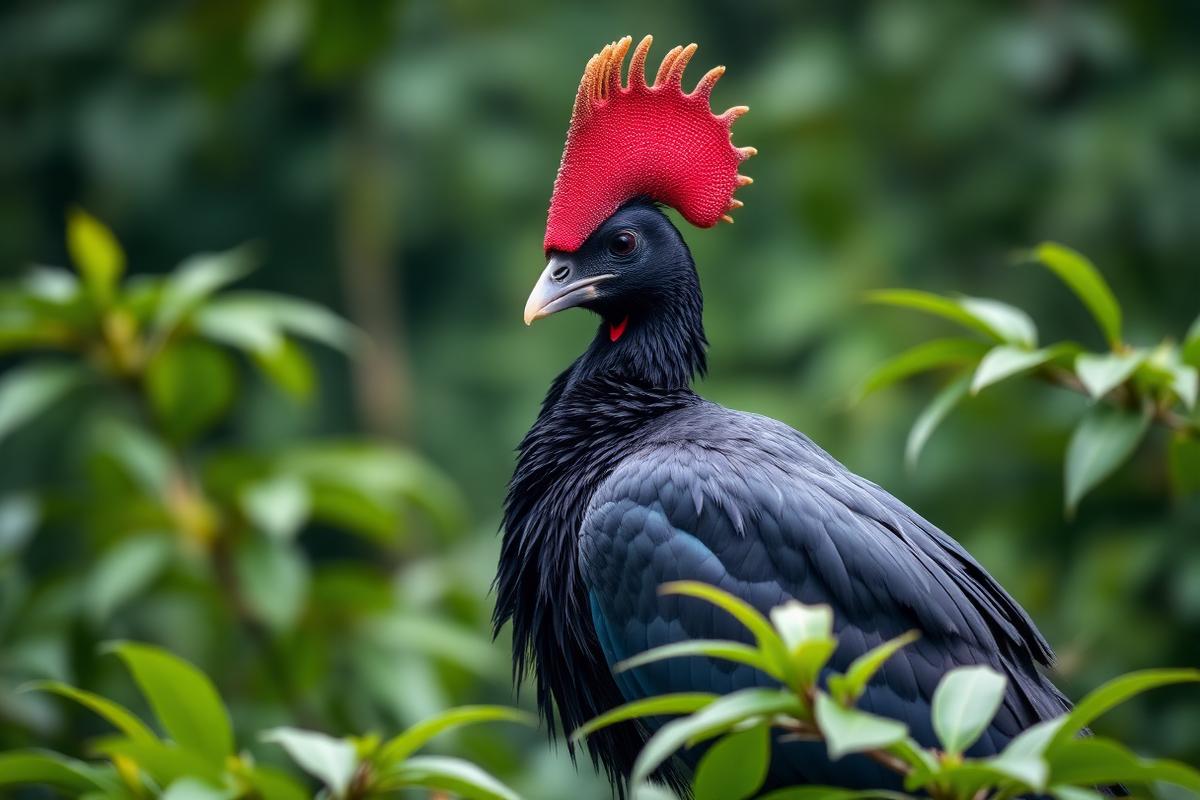
Few birds cause a longer pause on first sighting than the Horned Guan. It is heavy, glossy black above and white below, and directly on top of its head sits a smooth scarlet horn, about five centimetres tall.
The horn is not a feather crest. It is bare, brightly coloured skin over bone, and no other living bird has anything quite like it.
The Horned Guan survives in a thin ribbon of cloud forest along the volcanic highlands of southern Mexico and western Guatemala. Most birders who see one have walked uphill for hours in cold fog to do it.
How to identify a Horned Guan
Size is the first clue. This is a large, long-tailed bird roughly the bulk of a small turkey, usually seen sitting still in a mid-level branch rather than walking on the ground.
Key field marks:
• Bright red horn rising from the crown, visible even in poor light.
• Glossy blue-black upperparts with a broad white band across the tail.
• White throat and streaked white underparts.
• Red legs and a pale, thick, fruit-eating bill.
Its voice carries further than its plumage shows. Males give a low, booming series of grunts at dawn that can travel several hundred metres through dense forest.
Where it lives
The global range is small and broken into fragments. Birds occur on the Sierra Madre de Chiapas in Mexico and in the volcanic chain of western Guatemala, including sites around Volcán Tajumulco, Volcán Tacaná and Atitlán.
The species is tied to humid cloud forest between about 1,500 and 3,350 metres, where trees drip with moss and bromeliads. Below that band, forest has largely been converted to coffee and maize.
Diet and daily life
The Horned Guan is mainly a fruit eater. It swallows fruit whole from trees in the laurel and avocado families, then disperses the seeds elsewhere in the forest — a service few other large birds still provide in these mountains.
It also takes leaves, buds and flowers, especially when fruit is scarce in the dry months. Young birds eat more insects.
Birds move slowly and quietly through the canopy, often alone or in pairs. They roost high, and only rarely come down to the forest floor.
Breeding biology
Breeding runs from roughly February to June. Nests are simple platforms of sticks and moss, placed on a horizontal branch or in a tree fork several metres up.
Clutches are small — usually two eggs. Chicks are unusually well developed at hatching and can flutter to nearby branches within days, which reduces the risk from ground predators.
Because the species raises so few young each year, adult survival matters enormously. Losing a handful of breeding adults to hunting can undo a decade of local recovery.
Why the Horned Guan is endangered
Three pressures dominate:
1. Habitat loss. Cloud forest is cleared for coffee, cattle and subsistence farming, and the remaining patches are shrinking and increasingly isolated.
2. Hunting. The bird is large, tame and predictable, which makes it easy to shoot. In some communities it is still taken for meat.
3. Climate shift. Cloud forest depends on a narrow band of persistent mist. As the cloud base rises, suitable habitat is squeezed upward against mountain summits with nowhere left to go.
Volcanic activity and hurricanes add sudden, unpredictable losses to already small local populations.
Conservation work on the ground
Protected areas carry much of the load. El Triunfo Biosphere Reserve in Chiapas is the single most important stronghold, and several Guatemalan volcano reserves hold smaller populations.
Community-based projects have shifted several villages from hunting to guiding. Where a guide can earn steady income showing visiting birders a Horned Guan, the living bird becomes worth far more than a shot one.
Captive breeding at Africam Safari in Mexico and partner zoos maintains a genetic reserve and has produced birds for research, though releases remain limited.
How to see a Horned Guan responsibly
El Triunfo in Chiapas and the slopes of Volcán Atitlán and Tajumulco in Guatemala are the classic destinations. Trips usually run from March to May, when males call most.
Practical advice:
• Hire a local guide from a nearby community — it is both more effective and more useful to the birds.
• Expect steep, muddy trails and cold nights; fitness matters more than optics here.
• Watch from a distance and never play recordings repeatedly near a nesting territory.
A bird worth the climb
The Horned Guan is a reminder that some of the world's strangest birds are not in remote wilderness but in small, working landscapes where forests meet farms. Its future depends on whether cloud forest above 1,500 metres stays standing, and whether the communities around it keep gaining more from live birds than dead ones.
If you plan to travel for it, book through community guides. If you cannot travel, support cloud-forest reserves directly — and share this profile so more people learn that a bird with a red horn actually exists.
Key takeaways
- The Horned Guan is the only bird with a bare red horn on its crown.
- It survives only in cloud forests of Chiapas and western Guatemala.
- Fewer than about 2,000 mature birds remain, and the trend is downward.
- It is a key seed disperser for large-fruited cloud forest trees.
- Community guiding has become one of the strongest protections available.
Frequently asked questions
What is the horn on a Horned Guan made of?
It is a bony core covered in bare, bright red skin — not feathers. Both sexes have one, though the male's is usually larger.
How many Horned Guans are left?
Estimates range from roughly 600 to 1,700 mature individuals, split between Mexico and Guatemala.
Can Horned Guans fly?
Yes, but poorly over distance. They mostly flap heavily between branches and glide downhill rather than making long flights.
Where is the best place to see one?
El Triunfo Biosphere Reserve in Chiapas, Mexico, is the most reliable site, followed by volcano reserves in western Guatemala.
What do Horned Guans eat?
Mainly fruit swallowed whole, plus leaves, buds and flowers. Chicks take more insects early on.
Are they related to turkeys?
Not closely. They belong to the cracid family — guans, curassows and chachalacas — which is an older lineage than turkeys.
References
Related reading
The Resplendent Quetzal: Field Guide to Central America's Cloud-Forest Icon
Few birds are more mythologised than the Resplendent Quetzal. Behind the iridescence is a highly specialised cloud-forest species that depends on a single tree family to survive.
Andean Cock-of-the-Rock: Peru's Fiery Cloud-Forest Dancer
The Andean Cock-of-the-Rock is a flame-orange, disc-crested cloud-forest bird whose dawn dance-offs are one of South America's great wildlife shows.