Forest Owlet: Central India's Rediscovered Little Owl
The Forest Owlet was missing to science for 113 years. Its 1997 rediscovery in Maharashtra opened a small window that could still close.
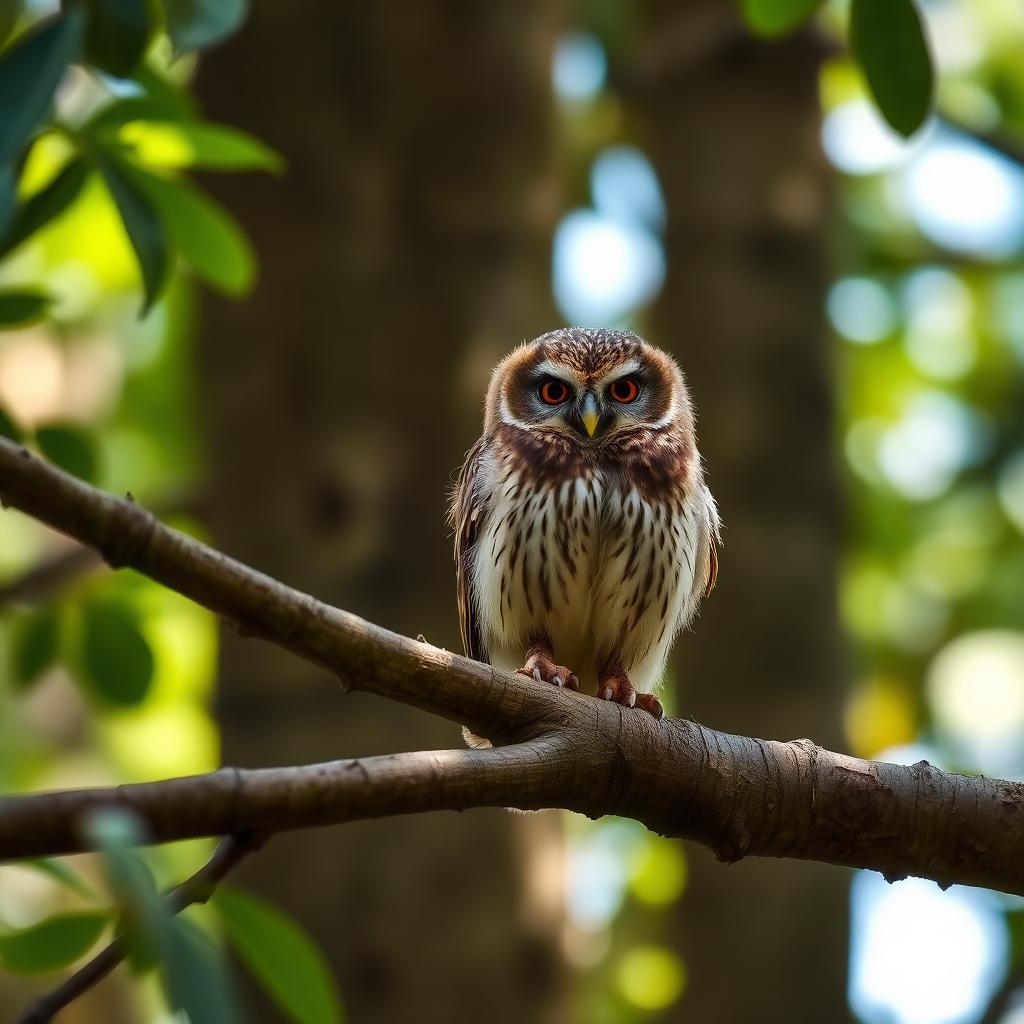
| Scientific name | Athene blewitti |
|---|---|
| Length | ≈ 23 cm |
| Range | Central India (Maharashtra, Madhya Pradesh, Gujarat) |
| Diet | Lizards, small rodents, large insects |
| Population | ≈ 250–1,000 mature individuals |
| IUCN status | Endangered |
A small owl with an outsized story
The Forest Owlet (Athene blewitti) is a small, stocky, day-active owl of central Indian dry deciduous forest. Adults are only about 23 cm long, but heavily built, with a plain crown, spotted wings and a short banded tail.
It was first described in 1873 from a single specimen collected in Odisha. Then it vanished. For 113 years, no confirmed record existed anywhere. In November 1997, ornithologists Pamela Rasmussen and Ben King rediscovered the species in the Satpura hills of northern Maharashtra.
The 1997 rediscovery
Rasmussen's team had already established, through careful re-examination of museum specimens, that a supposed Forest Owlet in London's Natural History Museum was in fact a fraudulently relabelled specimen — an infamous case involving the late nineteenth-century collector Richard Meinertzhagen.
This narrowed the search area to central India and led directly to the field survey that produced the first confirmed live sightings in more than a century, near the town of Shahada.
How the Forest Owlet lives
The species is unusually diurnal for an owl. It hunts from mid-morning through mid-afternoon, often from an exposed branch 4–8 metres above the ground, dropping onto lizards, large insects, and small rodents.
It nests in natural tree cavities, typically in mature teak or salai trees. Pairs are strongly territorial and tend to return to the same nest hollow across years.
Where the species survives today
Confirmed populations are known from several central Indian landscapes: Melghat Tiger Reserve and Toranmal in Maharashtra, parts of the Satpura Tiger Reserve in Madhya Pradesh, and the Purna Wildlife Sanctuary and adjacent forests in Gujarat.
The total population is uncertain but is estimated at between 250 and 1,000 mature individuals. The species is patchy — some seemingly identical patches of dry deciduous forest hold Forest Owlets while adjacent ones do not.
What still threatens it
The main threats are habitat loss from forest clearance, cutting of large mature trees for timber and fuelwood, and disturbance around nest sites. Because the species depends on natural cavities in mature teak and salai, selective removal of these trees is particularly damaging.
Persecution by local people, driven by folklore that associates owls with bad luck, has also been documented in some parts of the range.
Community education and protected areas
Protection of central Indian dry deciduous forest in Melghat, Satpura and Purna reserves provides the backbone of Forest Owlet conservation. Additional NGO work, particularly by Bombay Natural History Society and Nature Conservation Foundation, focuses on community education, nest-site monitoring and detailed population surveys.
As with many small, cryptic species, more field surveys will likely find new sub-populations. Each new site is a chance to secure another fraction of a species that we came very close to losing entirely.
A second chance worth using
The Forest Owlet is one of a handful of birds in the world that were classed as extinct and then were not. That second chance is not owed to us. Using it well means protecting the specific dry deciduous forests, in Melghat and beyond, where a small day-active owl still hunts lizards from a teak branch at noon.
Key takeaways
- The Forest Owlet was missing to science from 1884 to 1997.
- It is a small, day-active owl of central Indian dry deciduous forest.
- Estimates suggest between 250 and 1,000 mature individuals remain.
- Loss of mature teak and salai trees is the main threat.
Frequently asked questions
How long was the Forest Owlet lost?
There was no confirmed record of the species between 1884 and its rediscovery in 1997 — a gap of 113 years.
Where can I see a Forest Owlet?
The most accessible sites are around Melghat Tiger Reserve in Maharashtra and Toranmal, best visited with a knowledgeable local birding guide.
Is the Forest Owlet nocturnal?
No — unusually for an owl, it is largely diurnal, hunting through the middle of the day from an exposed perch.
Why was it thought extinct?
A fraudulent nineteenth-century specimen relabelling had misled researchers about the species' range, and no genuine specimen was collected for over a century.
Is it the same as the Spotted Owlet?
No. The Spotted Owlet (Athene brama) is a much more common and widespread species; the Forest Owlet is heavier, plainer-headed and much rarer.
References
Related reading

The Philippine Eagle: A Complete Guide to the World's Rarest Raptor
With fewer than 400 breeding pairs remaining, the Philippine Eagle is one of the rarest raptors on Earth. Here's what field biologists have learned in three decades of recovery work.
Snowy Owl: The Arctic Nomad You Cannot Predict
The Snowy Owl is one of the few large birds most people can recognise on sight — and yet almost everything else about it, from where it will spawn to where it will winter, is genuinely hard to predict.